NASA delays Artemis II moon mission to March after critical test raises issues


February 3, 2026
1 min reading
 Add us on GoogleAdd SciAm
NASA delays Artemis II Moon mission after critical test raises problems
NASA will review data collected during a simulated Artemis II rocket launch before revealing a new date for its next lunar mission
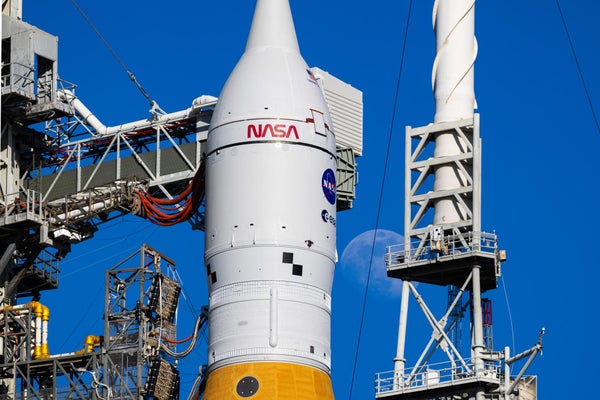
NASA has postponed its next lunar mission until at least March following a crucial test of the Artemis II rocket.
NASA said Tuesday that the mission’s wet dress rehearsal, which involved refueling the Space Launch System (SLS) rocket and then launching a countdown sequence, revealed problems with both the rocket and the Orion capsule that is supposed to house the four astronauts who will fly aboard.
Indeed, this critical test of Artemis IIThe rocket’s systems did not go smoothly: Within hours of fueling the rocket, the SLS appeared to be leaking liquid hydrogen from its core stage, which houses its main engines. This caused NASA to temporarily suspend loading the rocket’s propellant in order to resolve the problem. And later, a valve on the Orion capsule malfunctioned as engineers also attempted to troubleshoot several interruptions in ground crew audio communications channels.
On supporting science journalism
If you enjoy this article, please consider supporting our award-winning journalism by subscription. By purchasing a subscription, you are helping to ensure the future of impactful stories about the discoveries and ideas shaping our world today.
Fuel leaks have already affected the SLS. Artemis I, the previous mission of Artemis IIalso suffered from fuel leaks during its wet dress rehearsal and at other times before the mission, delaying its launch by several weeks.
Artemis II will see four astronauts complete a 10-day loop around the Moon and return to Earth, going further into space than any human has gone before.
This is a developing story and will be updated.
It’s time to defend science
If you enjoyed this article, I would like to ask for your support. Scientific American has been defending science and industry for 180 years, and we are currently experiencing perhaps the most critical moment in these two centuries of history.
I was a Scientific American subscriber since the age of 12, and it helped shape the way I see the world. SciAm always educates and delights me, and inspires a sense of respect for our vast and magnificent universe. I hope this is the case for you too.
If you subscribe to Scientific Americanyou help ensure our coverage centers on meaningful research and discoveries; that we have the resources to account for decisions that threaten laboratories across the United States; and that we support budding and working scientists at a time when the value of science itself too often goes unrecognized.
In exchange, you receive essential information, captivating podcasts, brilliant infographics, newsletters not to be missed, unmissable videos, stimulating games and the best writings and reports from the scientific world. You can even offer a subscription to someone.
There has never been a more important time for us to stand up and show why science matters. I hope you will support us in this mission.


:max_bytes(150000):strip_icc()/Health-GettyImages-1700252021-f6f07ed88b934f7288a9ebd48e39a5e0.jpg?w=390&resize=390,220&ssl=1 "10 Possible Explanations for Blood Pressure Spikes and Drops")
