What Happens to the Educators When the Schools Have Been Destroyed?


World
/
A day for Gaza
/
February 3, 2026
Hamada Abu Layla spent 22 years earning three degrees from Gaza universities. Now they’re laughing at him from a dump.
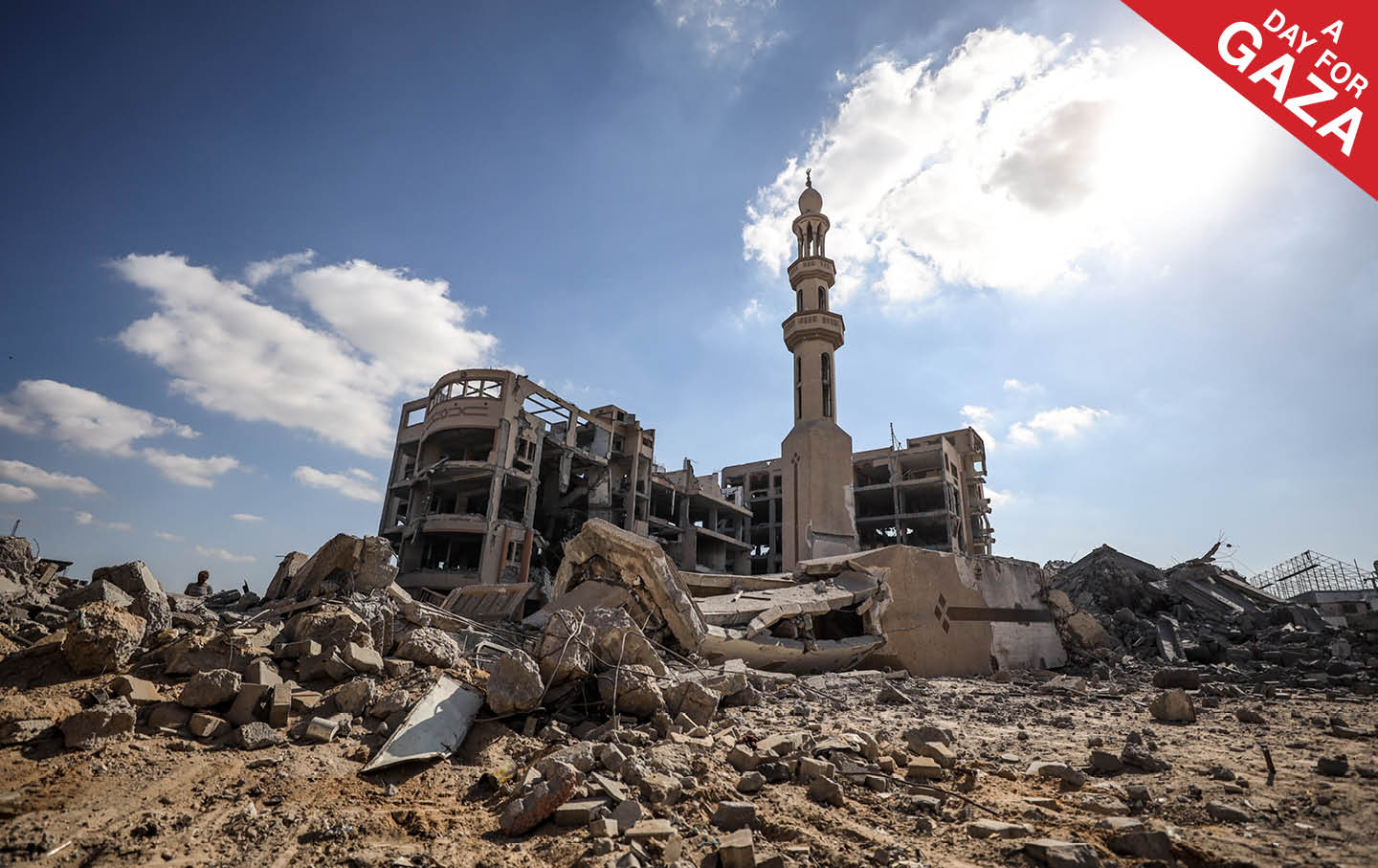
Islamic University of Gaza, October 16, 2025.
(Khames Alrefi/Anadolu via Getty Images)
This piece is part of A day for Gazaan initiative in which The Nation entrusted its website exclusively to voices from the Gaza Strip. You can find all the works in the series here
“These certificates were supposed to open doors for me, not remind me of what I lost,” explains Hamada Abu Layla, 45, who holds three university degrees.
It is January 2026, more than 90 days after the ceasefire between Israel and Hamas, and Abu Layla is standing among piles of trash bags at Al-Yarmuk, a landfill in central Gaza City; it has been his family’s home for the past few months. Unable to return to Beit Lahia, where he once lived, he spent days searching Gaza City for vacant lots on which to pitch his tent. Finding none, he finally erected it inside Al-Yarmuk.
“It’s very serious – a pure health hazard when all the waste from Gaza is dumped,” he said.
Abu Layla lives in Al-Yarmuk with his wife and five children. They share the site with rodents, insects, snakes and stray dogs who pound on the fabric walls at night, terrifying the children and preventing them from sleeping. Her children developed rashes caused by insects.
Less than two and a half years ago, Abu Layla had his own apartment – in a building where his parents and siblings also lived – and spent his days teaching at the Da’wa Islamic College in Gaza. When he was younger, he first earned his degree in Palestine in Islamic Sharia at this university, then earned degrees in information technology and mathematics.
But the war took all that away from him. The Israeli army bombed her building in Beit Lahia, killing her parents and siblings, and only Abu Layla, her immediate family and a brother survived. They fled without burying the dead, who remained under the rubble, and were unable to return. Beit Lahia, which is behind the “yellow line”, is now under Israeli military control.
Also lost in the rubble are Abu Layla’s professional dreams: the days he spent lecturing students, passing on his knowledge to subsequent generations. His diplomas, acquired over 22 years, ridicule him like a pile of garbage.
Today, instead of teaching students, Abu Layla’s job is to survive: “I stand by water pipes and in charity kitchens to eat. It’s mentally and physically exhausting, but I have to do it to keep my children alive.” This is the same routine that most Gazans are forced to follow.
“I imagine I’m living in a nightmare and I can’t wake up,” he said. “Before the war, I had a house, a family, a good social and economic situation. That’s in the past now.”
Abu Layla is one of the survivors of Gaza’s devastated intellectual class. Before the war, Gaza was known as a famously education-oriented society, with a literacy rate of nearly 97 percent and a rich intellectual tradition. Seventeen universities and colleges across the Gaza Strip, many with multiple campuses, are training the next generation of Palestinians. For these students, as well as their teachers, university was not just a step on the path to a career, but a commitment born from the deep conviction that learning is a tool for resilience – a means of preserving national identity, a fundamental investment in human development, and a promise for the future despite poverty and the blockade.
But the war destroyed much of that, silencing some of the brightest minds while overthrowing the institutions that had once nurtured them. Of the 5,102 people who worked in higher education before the war, at least 1,112 (or 22%), including 345 women, were killed, detained or injured, according to a UNESCO assessment from November 2025. Israeli bombs also destroyed 22 of Gaza’s 38 campuses, while damaging almost all remaining campuses. The attacks on these higher education institutions were so relentless – and seemed so targeted – that as early as April 2024, United Nations experts were warning that they could amount to scholasticism.
“These attacks are not isolated incidents,” more than 20 UN experts said in a statement. “They present a systematic pattern of violence aimed at dismantling the very foundations of Palestinian society. »
Today, in the slightly muted horror of the ceasefire, educators who survived the worst of the war are tasked with figuring out how to rebuild those foundations. And they have the task of doing so in a landscape where survival itself remains a struggle.
Current number

Death remains a constant threat in Gaza – death caused by Israeli bombs as well as bad weather, dangerous living conditions and an ongoing health crisis. And reconstruction remains stalled as Israel continues to control the borders entering and exiting Gaza, limiting the flow of aid and construction materials. Palestinian government statistics show that Israel has authorized only 43 percent of the 60,000 aid trucks needed to meet Gaza’s real needs. With so few resources, sustaining, let alone rebuilding, Gaza’s valuable education system is a challenge.
“Today, higher education in Gaza is fighting for survival, not for development,” says Abdel Hamid Al-Yaqoubi, head of the Palestinian Ministry of Higher Education.
Amid so much deprivation and instability, Abu Layla’s situation is far from unusual; the suffering extends to the entire academic community in Gaza.
When the war intensified, most universities put their staff on unpaid leave, meaning most received no pay. With students unable to pay their tuition, universities were unable to pay their professors and administrators. And many still can’t.
Tawfig Abu Jarad, director of public relations at Gaza University, says he knows professors who have been forced to sell vegetables to support their families. “Imagine a university professor used to standing in lecture halls in front of students, now standing behind a vegetable stand with one of his former students shopping in front of him.”
While the situation has stabilized slightly since the ceasefire, modest attempts have been made to return to face-to-face and hybrid teaching in some establishments. The Ministry of Education and Higher Education worked with international partners like UNESCO to revamp education through digital systems such as the virtual campus, and the ministry organized meetings with the presidents of universities in Gaza to support the continuity of education and overcome challenges. UNESCO has also created temporary learning spaces in Khan Younis and Deir Al Balah, where students can access digital resources (many lost their computers during the most extreme phases of the war and internet access remains patchy) as well as psychosocial support.
These are crucial efforts to bring a generation of students back to college and graduate programs. But despite this progress, the challenges remain immense. “Online education does not meet students’ aspirations, especially in engineering and medical majors that require labs and in-person instruction,” says Abu Jarad.
Moreover, even these limited efforts reach only a fraction of Gaza’s 88,000 higher education students and put only a limited number of professors back to work.
Until now, Abu Layla was not one of them.
As he stands in the Al-Yarmuk dump, looking at his certificates earned over two decades of study and effort, he feels a deep sense of loss. “I spent my money, sweat and effort to achieve a respectable position in society, not to live next to a pile of garbage,” he says.
He tries to remain hopeful, imagining a time when “the good days will return, when I will see myself in my rebuilt house and my children going to school.” But he is not naive and he knows that the time is still far away. He understands the present,
“As long as we live in tents, until we return home, while our children’s schools are destroyed, while we feel neither security nor stability, while the army occupies the areas of Gaza and the crossings remain closed,” he said, “the war is not over.”
From Minneapolis to Venezuela, from Gaza to Washington, DC, we live in a time of staggering chaos, cruelty and violence.
Unlike other publications that reproduce the opinions of authoritarians, billionaires and corporations, The Nation publishes stories that hold the powerful accountable and center communities too often denied voice in national media – stories like the one you just read.
Every day, our journalism weeds out lies and distortions, contextualizes developments that are reshaping politics around the world, and advances progressive ideas that fuel our movements and incite change in the halls of power.
This independent journalism is only possible with the support of our readers. If you would like more urgent coverage like this, please donate to The Nation Today.