As Trump reshapes foreign policy, China moves to limit risks, reap gains : NPR

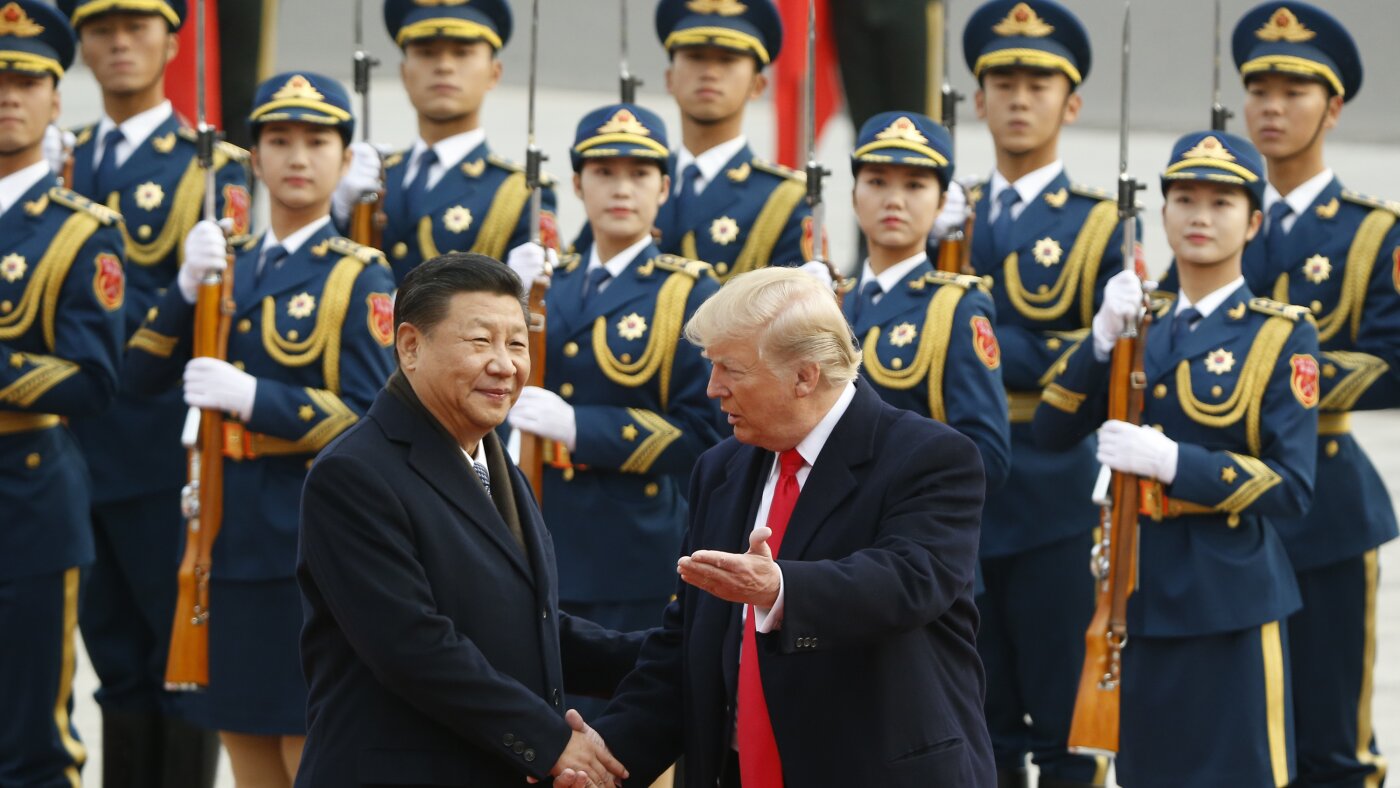

President Trump participates in a welcoming ceremony with Chinese President Xi Jinping November 9, 2017 in Beijing.
Pool/Getty Images
hide caption
toggle caption
Pool/Getty Images
Since the start of the year, the Trump administration has clearly illustrated its shift in strategic direction towards the Western Hemisphere, with the abrupt and forced departure of Venezuela’s leader and the expression of expansionist ambitions towards Greenland.
China, which the United States until recently considered a “prime threat,” may feel relieved that none of President Trump’s targets are in its neighborhood.
On the other hand, there is also concern that U.S. actions are partly aimed at countering China’s influence, according to Trump and his officials’ explanations, and that Trump’s “America First” rhetoric has not reduced its appetite for what China calls “military adventurism.”
“Given the importance China attaches to regime security, the U.S. willingness to intervene is Beijing’s greatest concern,” says Tong Zhao, an expert on strategic security issues and nuclear weapons at the Carnegie Endowment for International Peace.
China’s experience of American foreign intervention

President George W. Bush delivers a speech in an aircraft hangar at Elmendorf Air Force Base in Anchorage, Alaska, November 14, 2005, in which he accuses Democrats of playing political games over the Iraq War.
Paul J. Richards/AFP via Getty Images
hide caption
toggle caption
Paul J. Richards/AFP via Getty Images
Beijing’s concerns about U.S. foreign military intervention date back to the early days of the communist-led People’s Republic, when China deployed up to 3 million troops and support personnel to the Korean Peninsula during the 1950-53 Korean War.
In the post-Cold War era, China was alarmed by the US invasion of Iraq and the overthrow of Saddam Hussein without formal authorization from the United Nations. But Chinese experts say the Chinese military has benefited from the study of American weapons and military tactics. And for the first two decades of this century, American preoccupation with the wars in Iraq and Afghanistan absorbed American attention and resources that could otherwise have been used against China.
“I would summarize China’s position towards US military actions since World War II by considering two factors,” says Chu Shulong, an international relations expert at Tsinghua University in Beijing.
“First, is it [the U.S.] invade a foreign nation in violation of the UN charter, and second, does this have a direct effect on China’s security?
China has opposed U.S. actions in Venezuela and U.S. plans regarding Greenland, but has not responded forcefully.
China worries about its ties with the United States

A magazine advertisement featuring then-President-elect Donald Trump on the cover at a newsstand in Shanghai, December 14, 2016.
Johannes Eisele/AFP via Getty Images
hide caption
toggle caption
Johannes Eisele/AFP via Getty Images
“China’s main concern is how to maintain a working relationship with Trump to prevent him from taking further actions that harm China,” Chu said. “So even if China does not approve of US actions in other parts of the world, it does not feel [like] they have very direct relations with China. »
China gets about 4% of its crude oil from Venezuela, and because of U.S. actions, “the country’s investment environment is certainly very unfavorable for China,” says Jiang Shixue, director of the Center for Latin American Studies at Shanghai University.
But Jiang believes that China’s trade and investment in Latin America is not aimed at the United States and may actually align with Trump’s priorities.
“A prosperous and rapidly growing Latin America will reduce drug trafficking and illegal immigration,” he says. “Doesn’t this help the United States? And if the United States can develop economic and trade relations with Latin American countries, why can’t others?”
Jiang says Beijing is also happy that Trump doesn’t talk much about democracy or human rights in other countries and that the countries he intervenes in are small and weak.
“He wants to stabilize relations between the great powers and avoid a Third World War. These are reassuring messages for Beijing.”
Is a big deal looming on the horizon?
Trump’s focus on the Western Hemisphere, says the Carnegie Endowment’s Zhao, hints at the logic of a possible big deal between the United States and China, which could come during Trump’s visit to China in April.
In other words, “for China to curb its own expansion of economic and geopolitical influence in the Western Hemisphere, in exchange for the United States’ willingness to accommodate China’s core interests in the Asia-Pacific region.”
Chief among them is Taiwan, which China considers its own territory, Zhao adds. This is an optimistic scenario for China. But even if the grand deal fails, Trump’s interventionism is also a boon to China’s official narrative and criticism of U.S. foreign policy.
Beijing has long argued that the United States has a history of seizing other countries’ oil and other resources under the guise of advancing democracy and liberal values.
Chinese liberals are “truly disillusioned, because what the United States is doing now is worse than the behavior of its illiberal rivals,” Zhao says.
“Those of us who study the United States greatly admire your democracy and rule of law,” Chu says. “We view this as your most fundamental strength, something other countries should learn from and emulate. But Trump’s two terms, especially his second term, have proven that the rule of law is unreliable.”
NPR’s Jasmine Ling contributed to this report from Beijing.


