The largest life-form on land 400 million years ago was one that scientists can’t explain

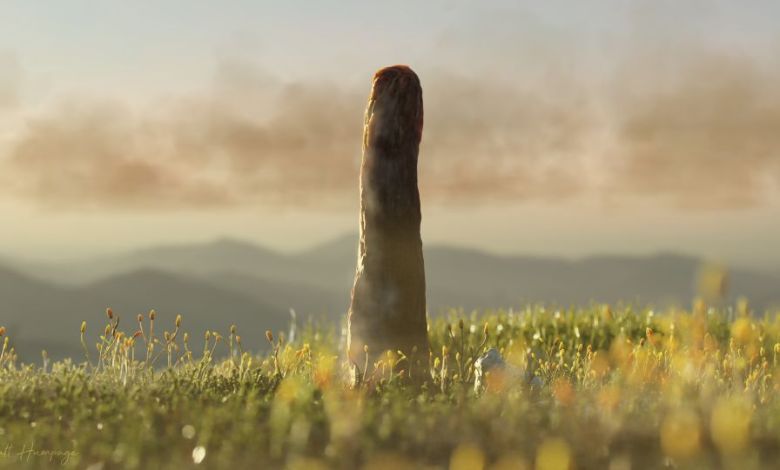
About 400 million years ago, long before dinosaurs or even trees evolved, an enigmatic organism dominated the landscape like a prehistoric monolith.
Now, new research demonstrates that the ancient life form is not a plant, animal or fungus but may instead be a completely unknown multicellular life form.
“What we can say, based on all of these new analyses, is that it is so different from any modern group that we have,” said Corentin Loron, a paleontologist at the University of Edinburgh and co-lead author of the research published in the journal Science Advances last month.
First identified 160 years ago, the fossils – known as Prototaxites – measure up to 30 feet (about 9 meters) tall and have long defied easy classification.
In the 19th century, scientists initially thought that Prototaxites was the rotted trunk of a conifer. Later studies, however, revealed that it was composed of intertwined tubes, rather than the block-shaped cells that make up plant tissue.
Other scientists have suggested that it was a lichen-like mass, a symbiotic association between a fungus and an algae. In recent years, some researchers thought the organism was more like a fungus, in part because it did not appear to produce energy through photosynthesis.
The new research focused on three Prototaxites fossils discovered in the Rhynie chert, a prehistoric terrestrial ecosystem near Aberdeen, Scotland. The Rhynie chert is home to the best preserved examples of the first plants, fungi and fauna that colonized the land 400 million years ago, during a period known as the Early Devonian. The site was once an ancient hot spring like Yellowstone.
The exceptional preservation of fossils embedded in Rhynie chert rock allows scientists, with the appropriate tools, to detect the chemical signatures of long-vanished molecules, called fossilization products.
“We can still have signatures that tell us about the original composition of these fossils, meaning that they are not overcooked, nor overly transformed by geology,” Loron explained.

A 410 million year old Protaxities fossil discovered in Rhynie, Aberdeenshire, Scotland. -Neil Hanna
Unanswered questions
The new analysis by Loron and colleagues suggests that the biomarkers in the Prototaxites fossils were chemically distinct from those in fossilized fungi found at the site and preserved under similar conditions. Mushroom fossils preserved in chert contained compounds from the breakdown of chitin and glucan, key structural molecules of fungi. Prototaxites, however, lacked these biomarkers.
“If Prototaxites were fungi, we would have expected them to follow the same trend as fungi, because they are side by side in the same burial conditions,” Loron said.
Other structural features — such as a complex branching pattern within dark spherical spots in the fossil that could have transported a gas, nutrient, water, or served some other exchange function — were distinct from all known fungi, whether living or extinct, the researchers noted in the study. Based on these results, it is too early to classify Prototaxites into a specific category, according to the team.

From right, researchers Sandy Hetherington, Corentin Loron and Laura Cooper, who led the new study, at the National Museums Collection Center at the Museum of Scotland with some Prototaxite fossils. -Neil Hanna
Different species of Prototaxites could vary in size, but the largest would have really dominated the landscape at a time when plants were less than a meter tall, said Kevin Boyce, a professor of earth and planetary sciences at Stanford University. His work on Prototaxite fossils showed that ancient organisms did not use photosynthesis to produce energy from light, like plants, but probably consumed carbon sources present in the environment, just as some living fungi live on decaying organic matter.
“People have compared it to specific fungi or algae in the past, and they did the best they could with the information they had at the time, but we now have a much better idea of the tree of life as a whole and Prototaxites is too old for those comparisons to be valid,” Boyce, who was not involved in the study, said in an email.
“You can compare it to mushrooms, but mushrooms are just not that old,” he added. “This does not mean that Prototaxites is or is not a fungus (or anything else), just that its form would have evolved independently of fungi and other complex multicellular examples among fungi that we currently have.”
Marc-André Selosse, a professor at the Paris Natural History Museum, said the authors of the new study had conducted “wonderful analyses,” but noted that the research had only looked at one of 25 known species of Prototaxites. Selosse, who was also not involved in the work, said he thought it was still possible that the organism functions in a lichen-like manner.
“The sampling does not encompass the species diversity of Prototaxites,” Selosse said. “So to me, that doesn’t constitute a finished story.”
Loron said there is still a lot that is unknown about the Prototaxites. For example, it is unclear how Prototaxites were anchored to the ground or whether the organism, thought to have grown slowly, remained upright throughout its life. His team plans follow-up studies on fossilized tubular organisms similar to prototaxites to advance the research.
“Sometimes it’s scary not knowing what something is, but it’s also scientifically exciting,” Loron said.
For more CNN news and newsletters, create an account at CNN.com


