Takeaways from Trump’s latest interview and how his bill plays in the states: From the Politics Desk


Welcome to the online version of Political officeAn evening newsletter that brings you the latest report and analysis of the NBC News Policy team from the White House, Capitol Hill and the campaign campaign.
In today’s edition, Adam Edelman looks at the Blue States seeking rapid action to adjust their budgets after the adoption of the great legislation on the national policy of President Donald Trump. In addition, Kristen Welker analyzes the main dishes to remember from her interview with Trump.
Register to receive this newsletter in your reception box every day during the week here.
– Scott Bland
The leaders of the Blue State weigh new laws to face the financial fallout from the great bill of Trump
By Adam Edelman
States legislators rush to cope with the expected financial benefits of the Great Law on the bill on President Donald Trump, with many blue states requiring special legislative sessions which, according to them, are necessary to consolidate the financing of health care and food aid programs affected by the new law.
Democratic governors in at least five states weigh on such special sessions, and democratic legislators in many others urge their governors to conceive of them to face the expected financing deficits.
In Colorado, the planning and budgeting office of the Democratic Governor Jared Polis provided that the State would receive around $ 500 million in less income each year – and could see almost the same amount in additional costs – due to the impact of the new Medicaid and food aid.
The Senator of the Democratic State Iman Jodeh said that a special session is “absolutely necessary” to cope with the new financial landscape of the State, predicting that it was “imminent” that Polis convinces one.
“We have to do so,” said Jodeh, a member of the Senate of Health and Social Services Committee. “Our budget simply cannot absorb the embankment, the deficit, the cuts.”
Polis spokesperson Shelby Wieman said by e-mail that Polis “had previously indicated that we had to design the general assembly to meet the terrible impacts of the bill-and we always examine the impacts of this new law to assess the next steps, including a potential special session.”
JODEH said that due to the Declaration of Colorado taxpayers’ rights – a 1992 measure which actually limits the quantity of the state can increase taxes – it will be extremely difficult for Democrats, despite their control by the governor and the two legislative chambers, to avoid mainly reducing and freezing social programs to solve the expected predictable problems.
“We have all incredibly frightened how we can possibly sail in this area,” she said. “What are these programs that we are going to have to freeze, finance or eliminate completely?” These will be the questions we will have to answer during the special session. ”
Learn more here →
My dishes to remember from my interview with Trump
Kristen Welker analysis
I spoke yesterday with President Donald Trump during a 20 -minute phone call, where we discussed his approach to prices, his response to devastating floods in Texas, his views of the current war between Russia and Ukraine, and more.
One of the main points to remember from our conversation is that the president reported that he was trying to pivot politics to politics now that his proposal for tax and scanning expenditure, that he nicknamed the only major bill, has become the law.
I asked Trump if he planned to take the road to talk about the measurement and he said “a little”, adding later: “But honestly, it was so well received that I don’t think I must, but a little. And certainly before the middle of the outside, we will do a lot but a little.”
This concentration of the mid-term elections next year underlines the difficult fight to come for the GOP when it tries to keep its majority close in the two rooms. Democrats must fix only three seats to return the room and four seats to take control of the Senate – a more difficult task since the general of the states organizing the Senate races next year. And the Democrats plan to campaign on taxation and the measurement of radical expenses, emphasizing the reductions of Medicaid.
But the president did not seem too concerned about the fact that his party loses seats in the congress.
“They said that in 2024 too. They said:” We are going to win seats, “said Trump about Democrats. “They did not do it. They said – we are going to do very well in the presidency, and I won the seven swing states, won the popular vote in the millions, etc. So you know, they always say that. They lost their way. They lost their heads, and they lost their way, not necessarily in this order.”
Meanwhile, the president walks a fine line with his supporters of Maga, whose republicans must present themselves en masse to maintain control of the congress next year.
These voters have more isolationist points of view of foreign policy, creating a certain tension in assistance in Ukraine. Trump made a news on this front yesterday, when he pointed out that NATO, not the United States, would cover the cost of additional weapons for Ukraine.
“We send weapons to NATO, and NATO pays for these weapons, 100%,” said Trump. “So what we do is that the weapons that come out on NATO, then NATO will give these weapons and NATO pays for these weapons.”
“We no longer pay weapons,” added the president later.
The details of this agreement with NATO are still not clear, although the president has teased a “major declaration” on Russia to come on Monday.
On Friday, NATO spokesperson responded to Trump’s comments in a statement. “The allies continue to work to ensure that Ukraine has the support they need to defend itself against the aggression of Russia.
We will deepen all this in “Meet the Press” on Sunday, where I will speak to the Kristi Noem interior security secretary, the Republican senator John Barrasso of Wyoming and the Democratic Governor Andy Beshear of Kentucky.
🗞️ The other best stories today
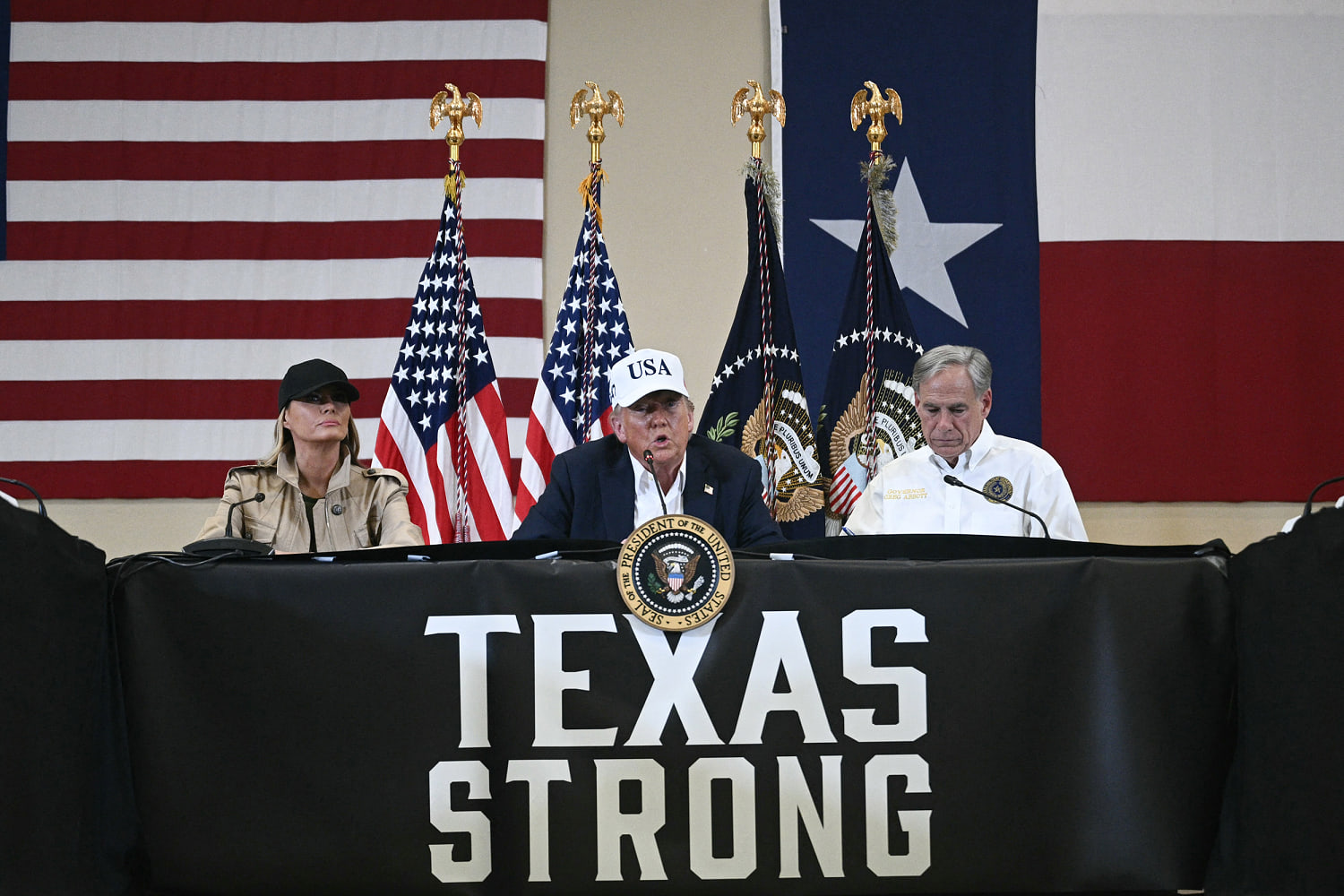
- ➡️ Trump in Texas: Donald and Melania Trump went to Texas to meet the first stakeholders and mourning families following the catastrophic floods last week who left more than 100 dead. Learn more →
- ✂️ Entranty Layoffs: American diplomats are preparing for cuts on the workforce of the State Department, the dismissal opinions which should strike the reception boxes on Friday, according to three officials of the State Department knowing the plans. Learn more →
- ⛪ Sainte rebuke: The Archdiocese of Miami condemns a controversial migrant detention center in Florida – which state officials have appointed “Alligator Alcatraz” – describing it as “inconvenience of civil servants” and “corrosive of the common good”. Learn more →
- 💰 Surprise excess: The US government posted a surplus in June, as tariff receipts gave an additional bump to a sharp increase in receipts, the Treasury department said. Learn more →
✉️ Mailbag: When do the provisions of Trump’s new law come into force?
Thank you to everyone who sent us an email! The question of this week’s reader, Cindy Scruggs, concerns the way in which the great law on Trump’s national policy will be implemented.
“Knowing that many of the cuts will be put into force after the 2026 elections, what parts of the invoice or associated fallout (if applicable) will occur before the middle?”
One of our congress experts, the main political journalist Sahil Kapur, provided an answer:
This is an important and somewhat complicated question.
The short response is that the Republicans rejected the most important cuts under Medicaid, Snap and the Act respecting affordable care until the 2026 elections.
It was a deliberate effort to manage political pain – the hard -right republicans wanted MEDICAIDE’s work requirements to take effect immediately, but the party concluded an agreement to trigger them on the last day of 2026, just a few weeks after the community.
Some GOP legislators told us that they believed (or hope) that it would insulate them during the 2026 elections.
Beyond that, many reductions in the law are progressive during the next decade. Like KFF’s health policy expert Larry Levitt told me, “there will not be a day when we wake up and there are suddenly millions of people without health insurance.”
That said, some effects will always be felt in advance. There are already reports on at least a closing Nebraska hospital, citing the “federal budget cuts planned in Medicaid”, a huge source of funding for hospitals.
Sometimes the anticipation of an unpopular law that takes effect can make the policy effective: Republicans have made sure that Democrats have paid a heavy political price in the mid-term of 2010 for the Act respecting affordable care then a little, even if it had not yet started. In 2018, vast bands of voters barely felt the advantages of the tax on tax reductions and jobs, which Trump sold as the greatest tax reduction in history, and the Democrats in the Chamber won 40 seats in the mid-term elections this year.
Finally, the impacts of Trump’s “Big Beautiful” will certainly be felt by the 2028 presidential election, and if this law takes effect, as designed, Democrats will certainly make it a problem.
It’s all of the political bureau for the moment. Today’s newsletter was compiled by Scott Bland and Dylan EBS.
If you have comments – tastes or don’t like – send us an email to politiquenewsletter@nbcuni.com
And if you’re a fan, please share with everyone and anyone. They can register here.