Enceladus Plays Bigger Role in Shaping Saturn’s Space Environment than Previously Thought


A new analysis of data from four instruments aboard NASA’s Cassini spacecraft has demonstrated the crucial role that Enceladus, Saturn’s small, icy moon, plays in circulating energy and momentum around the home planet’s space environment.
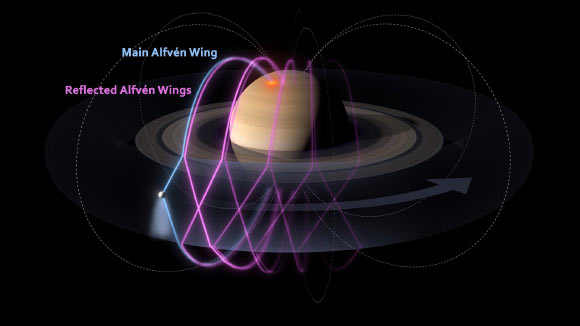
Illustration of the electrodynamic interaction between Enceladus and Saturn; Alfvén’s main wing is shown in blue and Alfvén’s wings reflected in magenta; the arrow indicates the direction of corotation of the plasma torus of Enceladus. Image credit: Fabrice Etifier, École Polytechnique.
Enceladus interacts with the gas giant’s magnetic field, generating intermittent auroras in Saturn’s upper atmosphere and electromagnetic waves that travel along invisible magnetic connections between them.
During its 13-year mission, Cassini repeatedly crossed these magnetic field lines linked to Enceladus.
“Enceladus is famous for its water geysers, but its real impact and interaction with the giant planet remains partly unknown,” said Dr. Lina Hadid, a researcher at the Plasma Physics Laboratory.
“The Cassini results transform our view of the role of the Moon in the Saturnian system.”
Dr. Hadid and his colleagues used data from four Cassini instruments to study how energy and particles move between the Moon and Saturn.
They detected wave activity characteristic of Alfvén waves (similar to the vibrations of a string), forming when Saturn’s magnetic field passes in front of Enceladus.
Due to a complex system of reflections from both Saturn’s ionosphere and the boundary of Enceladus’ torus, these waves were found not only near the Moon, but also far behind it, extending more than 504,000 km (more than 2,000 times the radius of the Moon) behind it.
This is the first time that Alfvén waves have been observed to be directly linked to charged particles associated with Enceladus.
“This is the first time such an extended electromagnetic range of Enceladus has been observed, proving that this small moon acts as a giant Alfvén wave generator on a planetary scale,” said Dr. Thomas Chust, also of the Plasma Physics Laboratory.
“This work paves the way for future studies on other systems, such as Jupiter’s icy moons or exoplanets, by showing that a small moon with an electrically conductive atmosphere can influence its host over large distances on the scale of the giant planet itself. »
“The results highlight the importance for future missions to Enceladus, such as ESA’s planned orbiter and lander in the 2040s, to carry instruments capable of studying these electromagnetic interactions in even more detail,” said Dr Hadid.
The results were published in the February 2026 issue of Journal of Geophysical Research: Space Physics.
_____
LZ Hadid and others. 2026. Evidence for an extended Alfvén wing system on Enceladus: multi-instrument observations from Cassini. Journal of Geophysical Research: Space Physics 131 (2): e2025JA034657; doi: 10.1029/2025JA034657


