Bangladesh National Party claims victory in first election since student uprising : NPR

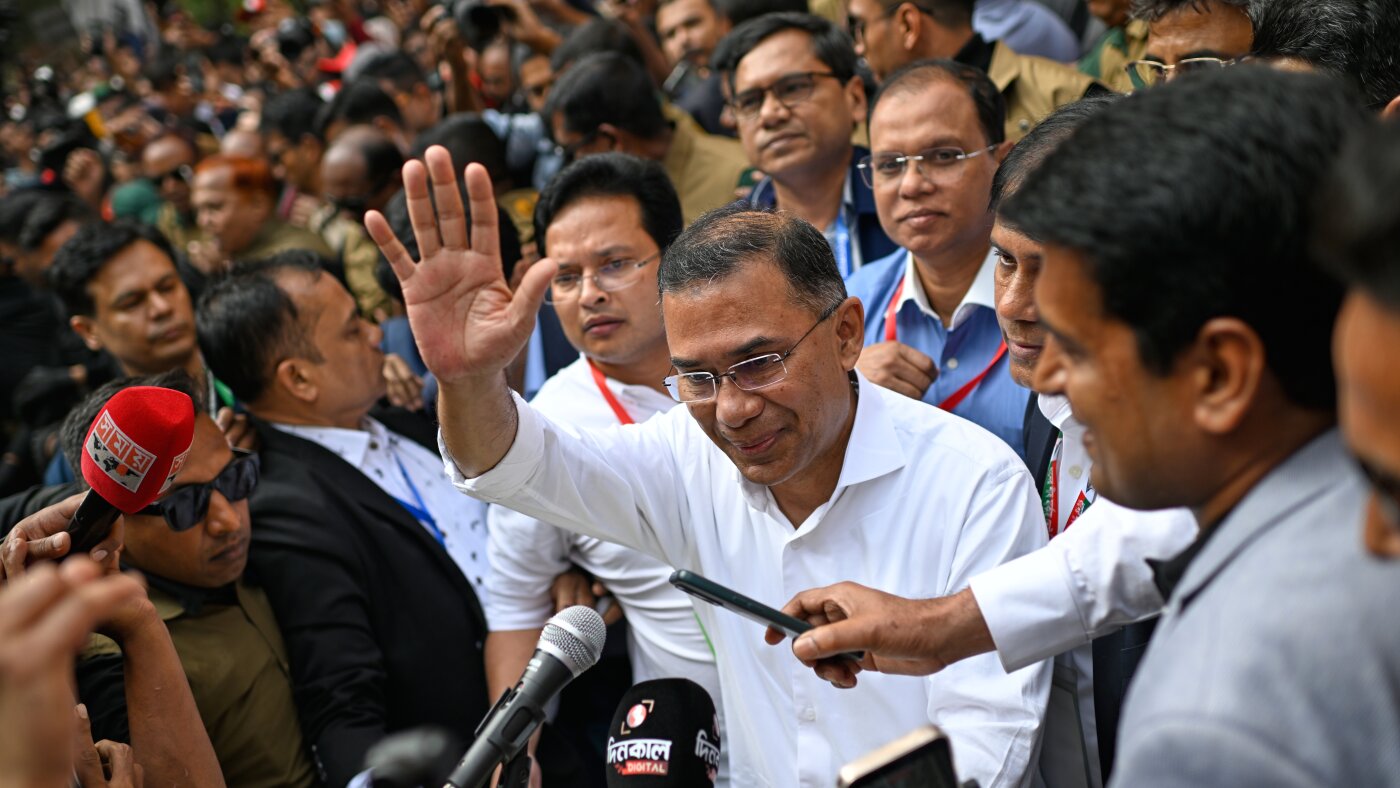

Bangladesh Nationalist Party Chairman Tarique Rahman waves as he walks out after voting in the national parliamentary elections in Dhaka, Bangladesh, Thursday, Feb. 12, 2026.
Mahmoud Hossain Opu/AP
hide caption
toggle caption
Mahmoud Hossain Opu/AP
DHAKA, Bangladesh — The Bangladesh Nationalist Party (BNP), led by Tarique Rahman, claimed victory Friday in the first elections since the previous government was toppled in a student-led revolution in 2024.
Final results have not yet been announced and the Electoral Commission is expected to do so shortly, but the BNP claims to have secured a majority.
Developments in Bangladesh are closely watched beyond its borders. It is the world’s eighth most populous country and the second largest clothing exporter after China, supplying major brands to Europe and the United States – a position the BNP will want to protect.
Rahman, 60, comes from a political dynasty. Both of his parents were central figures in the party for decades. His father, military officer and former president Ziaur Rahman, founded the BNP in 1978.
His mother, Khaleda Zia – who died in December – had led the party for more than 30 years and served as prime minister three times.
Rahman’s rise follows the uprising in July and August 2024 that left up to 1,400 people dead, according to the United Nations. The unrest ended with former Prime Minister and Awami League leader Sheikh Hasina fleeing the country.
Jon Danilowicz, an independent political analyst and retired U.S. diplomat who once served in Bangladesh, told NPR he believes the uprising could serve as a warning to Rahman.
He said: “Tarique Rahman would not be in the situation he is in if he had not been the son of Khaleda Zia and Ziaur Rahman. But it seems he understood what has changed in the country. He recognized the July revolution and the sacrifices of those on the front lines.”
Rahman faced a stiff challenge from Bangladesh’s third party, Jamaat-e-Islami, which contested the election as part of an 11-party alliance that included the National Citizens’ Party (NCP), formed by students who led the uprising.
He now faces the daunting task of guiding the South Asian country of about 180 million people through high inflation, rising unemployment and the growing impacts of climate change.

Security personnel guard near the office of the president of the Bangladesh Nationalist Party (BNP) before the announcement of the results of the national parliamentary elections in Dhaka, Bangladesh, Thursday, February 12, 2026.
Anupam Nath/AP
hide caption
toggle caption
Anupam Nath/AP
It will be a particularly difficult task for someone who has never held public office in Bangladesh and who returned to the country less than two months ago after 17 years of self-imposed exile in London.
While abroad, Rahman was convicted in Bangladesh of multiple offenses while the Awami League was in power, including corruption and money laundering – convictions he and his party rejected as politically motivated.
The decisions were reversed between 2024 and 2025 during an interim period led by Nobel laureate Muhammad Yunus, paving the way for his return.
The challenges ahead
As prime minister, his immediate challenge will be to form a government capable of confronting economic pressures, creating jobs and restoring law and order.
“Many promises have been made in terms of social protection programs and family cards, which give women with families a monthly allowance,” Danilowicz said. “But the government will face a fiscal reality. Bangladesh has one of the lowest tax rates, and there are limits to the amount of revenue it can generate.”
In terms of foreign policy, the BNP government should consolidate its relations with the United States and China. The BNP has already announced plans to deepen its ties with China, Bangladesh’s largest trading partner. Relations with neighboring India could, however, prove more complicated.
Prime Minister Narendra Modi’s government had close ties with the Awami League when it was in power and has harbored Sheikh Hasina since her flight. New Delhi has so far not responded to Bangladesh’s extradition requests after a Bangladeshi court sentenced Hasina to death in November last year for crimes against humanity linked to the uprising – a verdict she refutes.
Danilowicz said: “The people of Bangladesh have turned against India over the past 18 months. The challenge for Rahman will be how far the BNP can go towards restoring relations with India without facing a public backlash.
Rahman and his party also face a raft of reform proposals designed to prevent a return to authoritarian rule. Known as the July National Charter, the plan outlines constitutional, institutional and electoral changes.
It was signed in October last year by the leaders of the main political parties and approved by voters in a referendum held on the same day as the parliamentary elections.
Danilowicz said: “Certainly, reforms can make a difference, making it more difficult for an executive to act in a way that is not controlled by any other institution. This was a fundamental issue that needed to be addressed.”
With a reasonably strong opposition in Parliament in the form of a Jamaat-e-Islami alliance, the BNP government is likely to face greater scrutiny than its predecessor.


