The Repeating History of US Intervention in Venezuela


Our last pages
/
February 13, 2026
A return to The Nation130 years of reporting on Venezuela reveals that the more things change, the more they stay the same.
The Nation has been covering Venezuela for a long time – before Trump and Maduro, before Chavismo, before the war on drugs. Spread over three centuries, the reporting is remarkable for the coherence of its themes: struggles between autocracy and democracy, debates on foreign intervention and national self-determination, dispatches on the corrupting role of oil in the enrichment of the ruling class and the attraction of predatory foreign powers.
The NationThe first notable story was in 1895, when a conflict on Venezuela’s border with the British territory of Guyana (now Guyana) – where gold had recently been discovered – prompted President Grover Cleveland to invoke the decades-old Monroe Doctrine: European powers had no right to intervene in the Western Hemisphere. The Cleveland Declaration heralded a new era of chest-thumping in the United States, which culminated three years later with the Spanish-American War. Alarmed by the president’s rhetoric, The Nation ridiculed the idea that “we will, in the name of the Monroe Doctrine, assert such ownership of the American hemisphere as will enable us to draw all the boundaries there to our own satisfaction, in defiance of the rest of the world.”
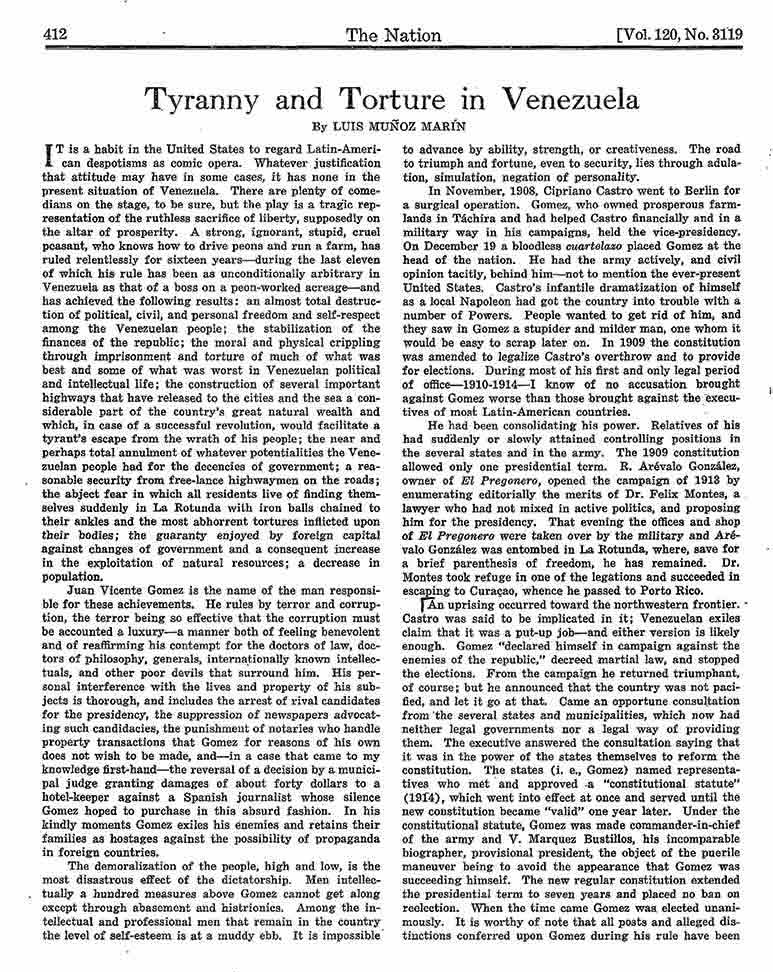
Unfortunately, that is exactly what the US government did, repeatedly interfering in Latin America to support leaders who preyed on their own people and served corporate interests. From 1908 to 1935, Venezuela was ruled by Juan Vicente Gómez, a dictator who ruled “through terror and corruption,” as the great Puerto Rican journalist and politician Luis Muñoz Marín wrote in these pages in 1925. Gómez invoked martial law, replaced the constitution, and tortured and imprisoned his critics. “The picture is sinister and grotesque,” concluded Muñoz Marín.
Venezuela had begun extracting oil in 1914. But the profits went not to the people but to foreign companies and local elites. “Gomez left nothing aside to attract foreign capital to Venezuela” The Nation» noted Mauritz A. Hallgren in 1928. American businesses returned the favor by giving their unreserved support to his regime.
In 1951, when another dictator ruled Venezuela, The Nation published “Suicide by Oil,” in which journalist Marcelle Michelin reported: “Venezuela seems extravagantly rich. But the Venezuelans for whom black gold has meant a better way of life are the happy minority in the cities and oil camps – landowners, businessmen, factory workers, government employees, corporate bureaucrats. People in the pueblos and fishing villages continue laboriously to extract from the land and water what they can to sustain themselves.” nourish.”
Again and again, reading The NationIn media coverage, we find a similar story: malicious actors, inside and outside the country, conspire to separate people from their land and resources – and, with them, the realization of their fiercely held hopes and dreams.


