Why do hammerhead sharks have hammer-shaped heads?

Curious Kids is a series aimed at children of all ages. If you have a question you’d like an expert to answer, send it to curiouskidsus@theconversation.com.
Why do hammerhead sharks have hammer-shaped heads? – Landon, 10 years old
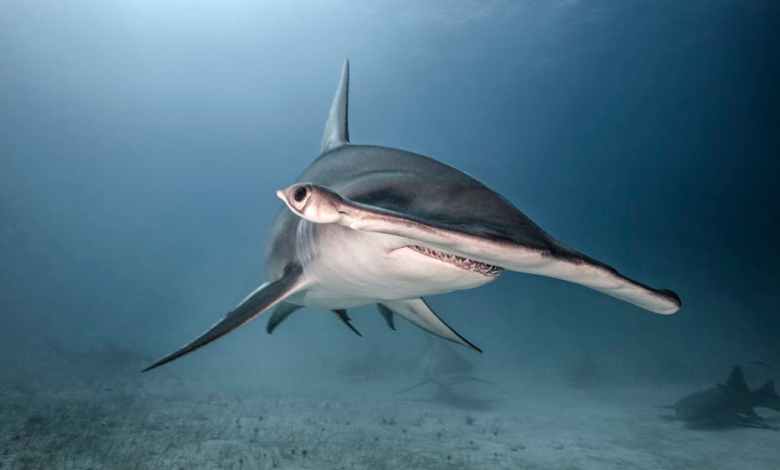
Hammerhead sharks are the strangest. It looks like someone grabbed their skull by the eye sockets and craned their heads to the side, while the rest of their body resembles that of a normal shark.
You may be wondering: what are the benefits of having a hammer head? And how did hammerhead sharks get there?
I am a scientist who has been studying sharks for almost 30 years. The answers to some of these questions even surprised me.
Advantages of the hammer
Scientists believe that hammerhead sharks have three main advantages.
The first concerns sight. If your eyes pointed in two opposite directions, for example towards your ears, this would give you a much wider field of vision. Each eye would see a different part of the world, so you would have a better idea of what’s around you. But it would be difficult to say how far apart things are.
To compensate for this trade-off, hammerhead sharks have special sensory organs, called ampullae of Lorenzini, scattered beneath their hammerheads. These porous organs can detect electricity.

The pores essentially act like a metal detector, detecting and locating prey buried under the sand on the ocean floor. Regular sharks also have these sensory organs, but hammerhead sharks have more. The farther apart these sensory organs are located on a hammerhead shark’s elongated head, the more accurate they are at locating food.
And finally, scientists believe that hammerheads help sharks make faster turns while swimming. If you’ve ever walked in gusts of wind with an umbrella or taken a plane, you know how powerful large surfaces can be in motion. If you are a hammerhead shark and your planned dinner passes quickly, you may turn around to catch it faster than other fish.
The hammerhead shark family tree
It would be great if scientists like me could examine the fossils and trace the evolution of hammerhead sharks over time. Unfortunately, hammerhead shark fossils consist almost entirely of their teeth. This is because sharks’ bodies do not have bones. Instead, they are made of cartilage, which your ears and nose are made of. Cartilage breaks down much more quickly than teeth or bones, so it is rarely fossilized. And tooth fossils tell us nothing about the evolution of hammerhead shark skulls.
Today, nine different species of hammerhead sharks swim in the oceans. They vary in size and head shape. Some have very large heads compared to their bodies. These include the winghead shark (E. blochii), the great hammerhead shark (S.mokarran), the smooth hammerhead shark (S. zygaena), the scalloped hammerhead shark (S. lewini) and the Carolina hammerhead shark (S. gilberti).

Others have smaller hammers relative to their bodies, including the hood head (S. tiburo), hollowhead shark (S. media), small-eyed hammerhead shark (S. studies) and scalloped bonnethead (S. crown).
Scientists have long assumed that early hammerhead sharks didn’t actually have hammerheads, but, over time, some gradually evolved larger hammerheads. We thought that the different hammerhead sharks living today were snapshots of different periods in the evolutionary process – with small hammerheads being the oldest species on the family tree and huge hammerheads being the most recent.
Since we don’t have fossils to examine, scientists like me have explored this idea using DNA. DNA is the genetic material found in cells that contains information about how a living thing looks and functions. It can also be used to see how living things are related.
We collected DNA from eight of the nine hammerhead shark species and used it to study the relationships between them. The results were not at all what we expected. Older species had proportionally larger hammers and younger species had smaller hammers.
Deformations as assets
When scientists think about evolution, we usually assume that living things change little by little, slowly adjusting to take better advantage of their environments. This process is called natural selection. But that’s not always how it works, as the evolution of the hammerhead shark shows.

Sometimes an animal can be born with a genetic defect that proves very useful to its survival. As long as the abnormality can survive and the animal is capable of mating, this trait can be passed on. We think that’s exactly what happened with hammerhead sharks.
The earliest diversified hammerhead shark species is the winged shark (E. blochii), which has one of the largest heads. Over time, natural selection has actually reduced the size of the hammer. It turns out that the newest species of hammerhead shark is the bonnet shark (S. tiburo), which has the smallest hammer of all.
Hello curious children! Do you have a question you would like an expert to answer? Ask an adult to send your question to CuriousKidsUS@theconversation.com. Please tell us your name, age and the city where you live.
And since curiosity has no age limit – adults, let us know what you’re wondering too. We won’t be able to answer every question, but we will do our best.
This article is republished from The Conversation, an independent, nonprofit news organization that brings you trusted facts and analysis to help you make sense of our complex world. It was written by: Gavin Naylor, University of Florida
Learn more:
Gavin Naylor works for the University of Florida. It receives funding from the National Science Foundation