The largest-ever satellite of its kind just unfurled its wings in low-Earth orbit


February 11, 2026
2 min reading
 Add us on GoogleAdd SciAm
The largest satellite of its type has just spread its wings in low Earth orbit
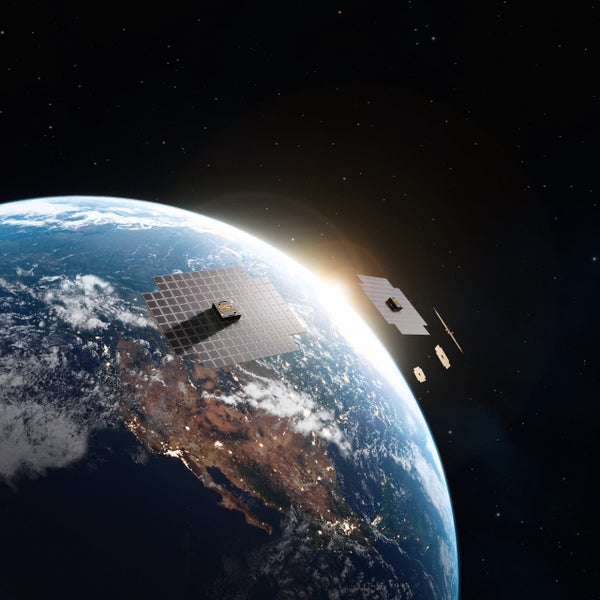
BlueBird 6 is equipped with the largest commercial communications array antenna ever deployed in orbit around Earth, spanning some 2,400 square feet
Courtesy of AST SpaceMobile
The largest communications satellite of its kind took a major step toward operation Tuesday: operator AST SpaceMobile announced that the record-breaking spacecraft, fancifully called BlueBird 6, successfully deployed its enormous antenna.
Spanning some 2,400 square feet (223 square meters), it is the largest commercial communications array antenna ever deployed in low Earth orbit. AST SpaceMobile hopes this will be the first of many: the Texas-based utility already has six small satellites operating in low Earth orbit, and plans to consider many more behemoths like BlueBird 6. Ultimately, these will form a high-speed cellular network aimed specifically at smartphones.
BlueBird 6 is huge. While Starlink satellites are about the size of a large table and have a network that spans about 100 feet, BlueBird 6’s network spans an area a little smaller than that of a doubles tennis court. It’s also very bright, says Peter Plavchan, an associate professor of physics and astronomy at George Mason University, who is not involved in the satellite company.
On supporting science journalism
If you enjoy this article, please consider supporting our award-winning journalism by subscription. By purchasing a subscription, you are helping to ensure the future of impactful stories about the discoveries and ideas shaping our world today.
“These satellites will be so bright that they will be easily visible to the naked eye,” he says, brighter than Saturn. The presence of so many such bright artificial objects in the sky means that ground-based astronomy, whether professional or amateur, will ultimately be affected, he says.
“The vision of our sky is changing,” says Plavchan. “Even in places where the sky is dark, things are going to be different.”
Samantha Lawler, associate professor of astronomy at the University of Regina, agrees, pointing out that such bright objects will confuse astronomy and much more.
“Having large numbers of these satellites in the sky will be detrimental to astronomy research, devastating to naked-eye observers, and could even cause serious problems for migratory birds and other animals that navigate the stars,” Lawler says.
It’s time to defend science
If you enjoyed this article, I would like to ask for your support. Scientific American has been defending science and industry for 180 years, and we are currently experiencing perhaps the most critical moment in these two centuries of history.
I was a Scientific American subscriber since the age of 12, and it helped shape the way I see the world. SciAm always educates and delights me, and inspires a sense of respect for our vast and magnificent universe. I hope this is the case for you too.
If you subscribe to Scientific Americanyou help ensure our coverage centers on meaningful research and discoveries; that we have the resources to account for decisions that threaten laboratories across the United States; and that we support budding and working scientists at a time when the value of science itself too often goes unrecognized.
In exchange, you receive essential information, captivating podcasts, brilliant infographics, newsletters not to be missed, unmissable videos, stimulating games and the best writings and reports from the scientific world. You can even offer a subscription to someone.
There has never been a more important time for us to stand up and show why science matters. I hope you will support us in this mission.


