To Build Bridges, We Must Block the Bombs


Policy
/
February 10, 2026
Brad Lander in The Nation: “When I am elected to Congress, I will support the Block the Bombs Act to protect more Palestinians from being killed by Israel.”
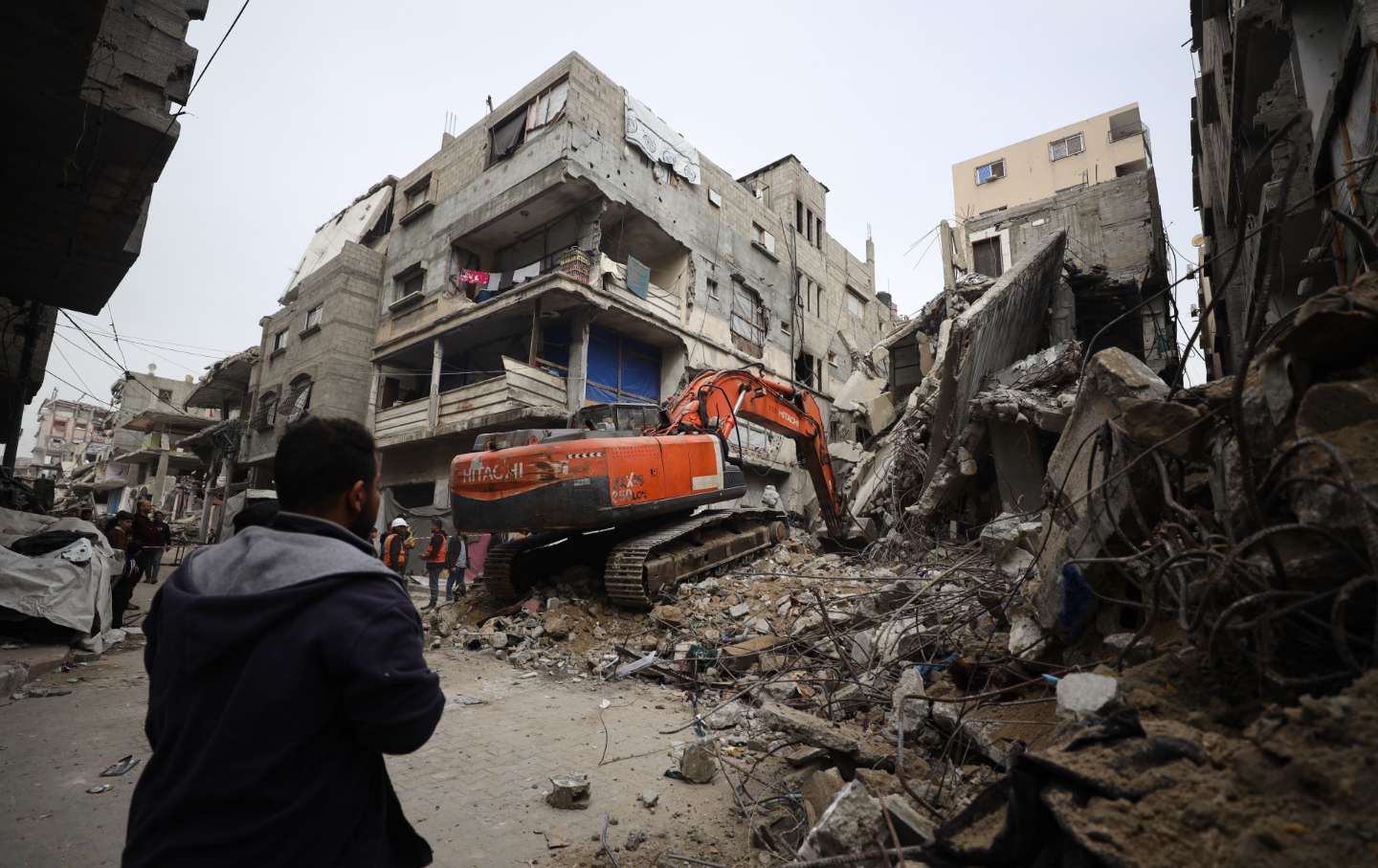
Civil protection teams carry out operations to recover the bodies of five members of the Abu Nida family trapped under the rubble of a building destroyed during Israeli attacks on the Sheikh Radwan neighborhood in the Gaza Strip on February 9, 2026.
(Khames Alrefi/Anadolu via Getty Images)
Last week, The Nation has taken the unusual step of devoting its entire homepage to covering the ongoing calamity in Gaza. While the world’s attention has shifted, Israeli bombs continue to fall, funded by American taxpayers. Hunger persists, while aid only trickles in.
Last month, Israel recovered the remains of Ran Gvili, the last hostage held by Hamas in Gaza, a move I welcomed with pain, finally providing a small measure of closure to families grieving October 7. But the remains of thousands of Palestinians still lie in the smoldering rubble of Gaza, while their grieving families face the winter in makeshift tents. Where can we find a closure or security measure, or even simply a roof, for them?
Over the past two years, I have struggled to mourn the Israelis and Palestinians killed since October 7 – to recognize their equal humanity, but also the vastly unequal scale and duration of the devastation. As part of this effort, I frequently participated in weekly vigils in Union Square with Israelis for Peace, demanding an end to the war in Gaza and the return of all hostages. We heard from Palestinians and Israelis whose lives have been torn apart. People like Maoz Inon, whose parents were murdered by Hamas on October 7, and Aziz Abu Sarah, whose brother was killed by settlers in the West Bank. “Our futures are linked” – we chant – “Israel and Palestine”.
Our future is also tied here in the United States, where Congress continues to be complicit in Israel’s destruction of Gaza, providing unconditional support for Netanyahu’s unchecked aggression. American working families struggle to understand why their tax dollars are being used to finance the 2,000 pound bombs that destroyed hospitals and schools in Gaza, when there are not enough funds for affordable health care, better schools, or affordable housing here at home.
That’s why, as a candidate for New York’s 10th Congressional District, I’m announcing my support for H.R. 3565, the Block the Bombs Act, sponsored by Rep. Delia Ramirez. This bill prohibits the Department of Defense from selling Netanyahu’s government the catastrophic weapons he used to commit genocide in Gaza (and yes, after spending a lot of time with the words of Raphael Lemkin, the Polish Jew and Holocaust survivor who developed the term, I’m sure he would consider it as such).
When I am elected to Congress, I will join 60 of my colleagues to co-sponsor this bill and fight for its passage. The Block the Bombs law will protect more Palestinians from death. I think this will push Israel to live up to the Jewish and democratic values that I hope it will uphold. This is a crucial step to begin rebuilding the conditions necessary for genuine peace and stability in the region.
Current number

It is also necessary to begin to restore a modicum of credibility in American foreign policy. As Mark Carney bluntly stated in Davos, Trump’s narcissistic takeover of Venezuela and threats against Greenland have caused a “rupture” in the supposedly liberal world order.
But Trump’s actions add up to a long-term hypocrisy in American foreign policy: We act in multilateral coalitions and respect the rules-based international order… except when we don’t. The two most prominent recent examples of us doing our own thing: the war in Iraq and unconditional support for Israel’s destruction of Gaza.
If we wish to rebuild an American foreign policy grounded in human rights, respecting sovereignty, and building multilateral coalitions to end the forever wars, it is important to start by ending American complicity in the Gaza genocide.
I believe the values I hold as a proud Jewish New Yorker, including that every human being is created b’tzelem Elohim, in the image of God – give me a special obligation in this moment to speak louder for the lives of Palestinians. As I confessed last Yom Kippur, and as I felt like I was reading The Nation coverage last week, I did not always do it at the level required by these Jewish values.
We can draw inspiration for this distressing work from the remarkable example of Maoz Inon and Aziz Abu Sarah. Despite heartbreaking losses, or perhaps because of them, they dedicated their lives to building peace together across borders and contexts in Israel and Palestine. Out of their grief, instead of despair or rage, they formed a partnership based on the recognition of intertwined destinies.
Their compelling sense of human equality does not prevent them from recognizing the totally unequal scale of suffering, nor the political structures that perpetuate it. Their courageous example reminds us that, although we are too often torn by religious or national reasons, the true dividing line lies between the peacemakers and those who perpetuate war. Between those who call for more violence and those who have the courage to reject it.
Until now, the United States has been on the wrong side of this dividing line. We must work to change this. To build a just and secure future for Israelis and Palestinians, and to move toward an American foreign policy consistent with our principles and interests, it is time to block the bombs.
More than The Nation
But Tom Homan is a liar and the work is not done. Plus, Gallup’s new polling policy (is the analytics company in Trump’s tank?), deepfake law, and more in the…
Elie Mystal
Even conservatives are fleeing the Republican Party as more and more Americans turn against Trump’s authoritarian project.
Column
/
Sacha Abramski

The administration’s crudely funded Freedom 250 project, which will oversee America’s half-century celebration, is a spectacle of right-wing extremism.
Toni Aguilar Rosenthal


