To aficionados, fungi are freaky, mystical and overlooked. They’re helping scientists learn more

ANGWIN, Calif. (AP) — Jessica Allen crunched the dead leaves among the Manzanita trees in search of something few people have spotted before: the Manzanita buttercup — a rare and little-known yellow mushroom found, until now, only along the western coasts of North America.
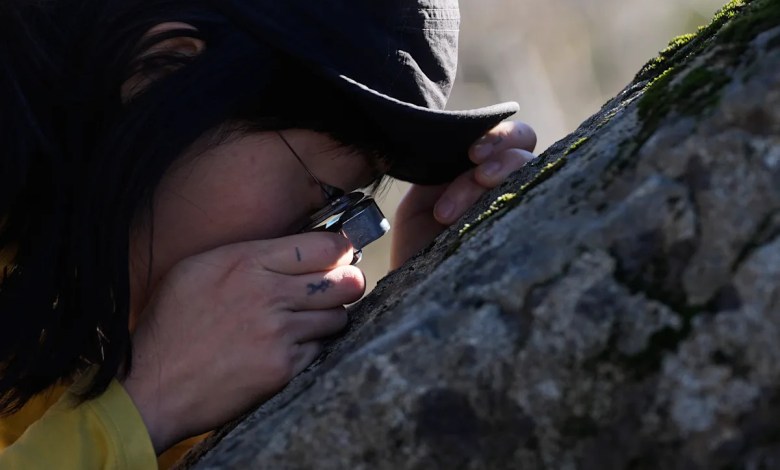
It was last seen here in Napa County, California, two years ago, and Allen, a mushroom specialist, was eager to find it. But a few minutes later, something caught his attention. She knelt down, put a lens to her eye, and peered closely at a rock: lichens—a type of fungus—brimming with shapes, textures, and dazzling colors.
“It’s so easy to get distracted, but there are so many lichens! » she said enthusiastically.
“It was a good rock,” said ecologist Jesse Miller, president of the California Lichen Society.
“Okay, let’s go get some mushrooms,” she exclaimed.
Allen and Miller are enchanted by what they describe as the wonderful and mystical world of mushrooms, and they are part of a growing community of people working to protect them. Nearly all life forms depend on the 2.5 million species of fungi on Earth, and their contribution to the global economy is estimated at $54 trillion in the form of food, medicines and more, according to a study published in Springer Nature. Despite their essential role, they have been largely neglected by conservation efforts, even as they face increasing threats from pollution, habitat loss and climate change. This has changed over the past decade thanks in part to citizen scientists and a better understanding of fungal diversity.
“It’s a very exciting time in mushroom conservation,” said Allen, a mycologist for NatureServe, a biodiversity data platform across North America. In this role, Allen helps accelerate and support mushroom conservation in the United States and Canada.
Amateur researchers play a key role in conservation
Mushrooms are neither plants nor animals. This is an enormous kingdom of life forms that includes yeasts (essential for bread, cheeses, and alcohol), molds (the fuzzy substances of forgotten fruits), lichens (a symbiosis of fungi and algae or cyanobacteria), and mushrooms (which range from edible to psychedelic to deadly). They are among the great connectors and decomposers on the planet. Forests need it and many animals depend on it for food and nesting.
People have derived medicines like penicillin from mushrooms. Some are used as building materials or can store planet-warming carbon. But scientists have documented only about 155,000 species, or 6 percent of the millions they estimate exist.
Conservation begins with knowing what species exist, where they are found, how they are faring, and what threats there are, which requires on-the-ground interventions. This allows conservationists to assess species at risk and know where to place resources.
That’s where groups like the California Lichen Society come in.
“They tend to be the ones who often make the most important discoveries, and they are the ones who will keep tabs on these rare species over time,” Allen said.
On a recent frigid day, dozens of lichenologists and lichen enthusiasts fanned out across a preserve to get up close and personal with the rocks and trees. These annual forays are part treasure hunt, part data-gathering excursion, and part nature hike, except the explorers often don’t go far.
Each powdery, leafy, branchy lichen was an invitation into a miniature world where “Wow!” », “What the hell! » and “Oh my gods!” abound. As chemist Larry Cool says, “Lichenologists make terrible hiking partners” because they keep stopping.
Cool’s interest in lichens dates back 53 years, until he learned they could be used as natural dyes. “Lichens are more than the sum of their parts and are mysteriously unpredictable,” he said. “I get a lot of pleasure from seeing the incredible variety of creation. »
Ken Kellman is also an amateur lichenologist, but you wouldn’t know it from his immense knowledge. A retired air conditioning and heating mechanic, he has been interested in it for about 10 years, learning on his own and from friends. This obsession helped scientists discover the biodiversity of his hometown of Santa Cruz, California.
“It just keeps your brain in that place where you say, ‘Wow! all the time. “It’s cool!” “And that’s my favorite place for my brain,” he said.
Mushroom conservation in the United States is ‘still far behind’ but evolving
Gregory Mueller has devoted much of his career to mushroom conservation. As co-chair of the International Union for Conservation of Nature’s Mushroom Conservation Committee, he coordinates all fungal protection activities across their global network.
According to the group’s Red List of Threatened Species, 411 of the world’s 1,300 assessed fungi are at risk of extinction. Parts of Europe and elsewhere have focused on mushroom conservation for decades, but the United States “is still far behind,” Mueller said. Only two species of fungi – both lichens – are protected under the federal Endangered Species Act, while some states like California have legal protections, while others like New Jersey have added them to their conservation plans.
This is changing slowly, in part because of the increase in community science initiatives in the United States and abroad.
“There are a lot of amateur mycologists … documenting (the fungi) with photographs, putting their images on iNaturalist and our Mushroom Observer, and we’ve been able to use that data to better document fungal diversity,” he said. We are “starting to get a sense of which species might be in trouble.”
Scientists are learning more about fungi and the threats they face
Most fungi are out of sight, spending most of their lives hidden as a vast threadlike network called mycelium and only producing mushrooms – called fruiting bodies – when conditions are ideal.
That’s one of the main reasons we know so little about them, said Nora Dunkirk, a botanist and mycologist at Portland State University’s Natural Resources Institute who works to document vulnerable species of plants and fungi to help with conservation efforts.
Among their biggest threats is climate change. Changes in precipitation patterns, higher temperatures and worsening wildfires can wipe them out or disrupt the delicate relationships between forests and good fungi. Prolonged periods of flooding can deprive them of the oxygen they need. Logging, development, invasive insects and pollution also threaten species.
Then there is overexploitation. The grapefruit-sized, long-lived quinine conk, for example, has been listed as an endangered mushroom species in Europe since the 1980s, in part because people have picked too many of them for their medicinal properties.
“This is an organism that grows on larches all over Europe, so people see it as a valuable resource and use it,” Dunkerque said. “But this species has been specifically exploited to its detriment.”
Perhaps the best-known conservation story in the United States indirectly involving fungi occurred in the 1990s. The northern spotted owl was in danger, and officials realized that to save it, they had to manage all of the old-growth forest ecosystems on which it depended, including fungi.
With the 1994 Northwest Forest Plan, the federal government established rules to protect about 400 rare and little-known species in three states.
Back in California, Allen and his mushroom-loving friends continued their quest for the elusive Manzanita butter tuft. They walked the steep slopes and descended near a stream, looking carefully at their feet.
They never found it.
But that’s how it goes when you’re looking for something as ephemeral and unpredictable as mushrooms.
“How many of my days have ended this way? So many,” Allen said. “It was still a beautiful day.”
___
The Associated Press receives support from the Walton Family Foundation for coverage of water and environmental policy. The AP is solely responsible for all content. For all of AP’s environmental coverage, visit https://apnews.com/hub/climate-and-environment.


