Here’s what to look out for around the new moon on Feb. 17

When you purchase through links on our articles, Future and its syndication partners may earn a commission.

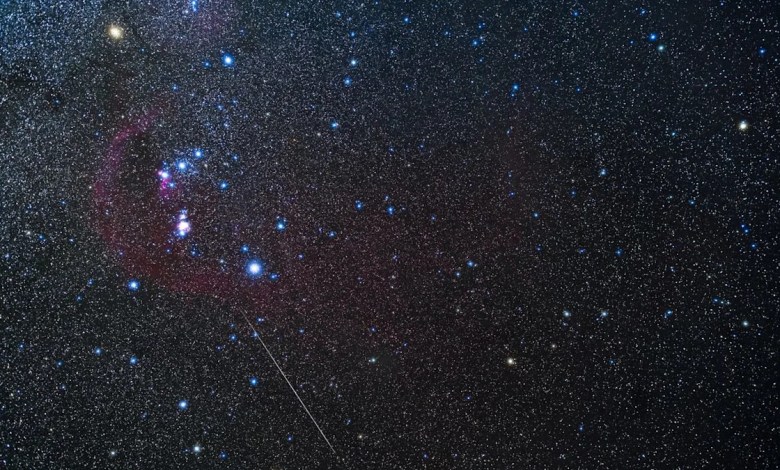
The Oriion constellation captured in a long exposure photograph from a dark sky. | Credit: Alan Dyer/VW Pics/UIG via Getty Images
The wonderfully dark nights surrounding this month’s new moon phase, February 17, provide an ideal opportunity to explore the wonders of the post-sunset realm while being free from the glare cast by our natural satellite.
A new moon This phase occurs when the moon is positioned directly between the sun And Earthmeaning the moon is not visible at night and is hidden by the sun’s glare during the day. February’s new moon phase occurred at 7:01 a.m. EST (12:01 p.m. GMT), heralding the start of a spectacular annular solar eclipse visible over part of Antarctica, as the lunar disk passed in front of the sun, leaving only the “ring of fire” on its outer edge visible.
Unfortunately, unless you’re a penguin or an Antarctic researcher, it’s unlikely you’ll be able to view the eclipse for yourself today. Still, the new moon provides several nights of perfectly dark moonless skies, so grab your telescope and join us for a sightseeing tour of the mid-February night sky.
Visible planets
Mercury will shine faintly in the west in the hour after sunset on February 17, appearing as a bright “evening star” less than 20 degrees above the horizon. If you are incredibly lucky – and have a clear view of the western horizon – you may be able to see the constant light of Venus vying for attention in the glow of the setting sun beneath Mercury on February 17, before following our parent star quickly out of sight.
Saturn will be visible within 15 degrees to the upper left of Mercury. Her iconic rings are finally starting to reveal themselves after seeming to “disappear” in November last year when they turned toward Earth, making them appear as a thin line.
Dark nights around the new moon phase are the perfect time to chase the twinkle constellations through the winter sky. Look to the left of Jupiter to find Beaver And Pollux – both stars who represent the twins in the Gemini constellation.
The bright star directly below Jupiter in the evening sky is Procyon, the brightest member of the constellation Canis Minor, the Little Dog. Siriusthe brightest star in the night sky, lies at the heart of Canis Majoris – the big dog – and shines about 20 degrees to the lower right (about the width of two stacked fists held at arm’s length), along with the Wezen and Blue stars. Adhara forming its hind leg.

Star chart for February 17. | Credit: Created by Anthony Wood in Canva.
The two star dogs hunt the night sky alongside their master, the hunter depicted in the image. constellation of Orionwhose colorful stars can be spotted to the upper right of Sirius in the hours after sunset on February 17.
Watch out for the red giant star Betelgeusewhich marks Orion’s right shoulder and the blue supergiant Rigel, which marks the left foot. Between the three familiar points of Orion’s Beltand hanging below is the milky light of Orion Nebula – a colossal stellar nursery that orbits in the Milky Way approximately 1,500 light years of the Earth.
To the right of Orion will be the red light of Aldebaran, the star that marks the eye of the great bull in the sky. Taurus constellation. Notice a hazy patch of light to the upper right of Aldebaran? This is the Pleiadesa vast star cluster full of more than a thousand blue-white stars, which makes a magnificent target whether you observe it with the naked eye, with binoculars or a telescope.

A star map from February 17 showing how to find Polaris using the Big Dipper. | Credit: Created by Anthony Wood in Canva
Next, look to the northeast to find the seven stars of the “Big Dipper” asterism standing at its end near the horizon. Locate the two highest stars – Merak and Dubhe – and draw an imaginary line from the first to the second out into space. The next bright star you find will be Polaris, the “North Star“, around which the entire sky seems to revolve.
Continue following this line and look slightly higher to find the five bright stars of Cassiopeiaarranged in a zigzag formation reminiscent of a sideways “W” or “M”, said to represent a queen who was thrown into the stars after falling foul of the Greek god Poseidon.
Want to get a closer look at the night sky? So don’t forget to check out our selection of the best binoculars and telescopes for exploring the planets and constellations, while photographers should read our selection of the best cameras and lenses for astrophotography.
Editor’s note: If you would like to share your astrophotography with Space.com readers, please send your photo(s), comments, name and location to spacephotos@space.com.