How climate change made deadly floods in Spain even worse


February 17, 2026
2 min reading
 Add us on GoogleAdd SciAm
How climate change has made Spain’s deadly floods worse
In 2024, extreme rains and flooding hit the Spanish region of Valencia, killing more than 230 people in the country. A new study shows that climate change has made the situation even worse.
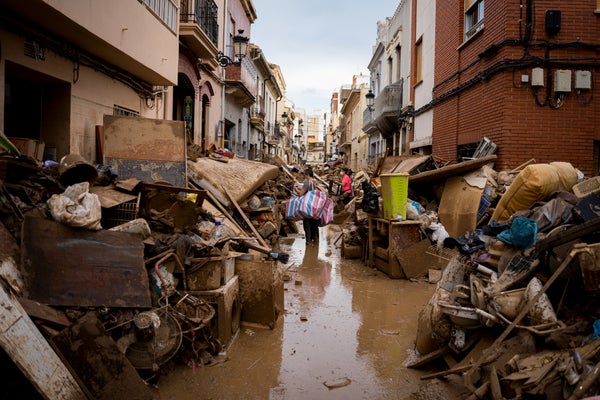
Residents and volunteers are seen manually cleaning mud-filled streets with shovels and other tools after flooding in the Valencia region of Spain in late 2024.
In October 2024, the Spanish region of Valencia was smothered by a downpour of biblical proportions. In just a few hours, more rain fell in the region than in an average year. The precipitation triggered a series of flash floods that washed away bridges and rail cars and even derailed a train. In Spain, more than 230 people were killed in the flood. At the time, scientists believed that climate change had fueled this event. Now a new study reveals just how much of this has been the case.
The study shows that due to climate change, the rate of intense precipitation was around 21 percent higher over a six-hour period in Valencia than it would have been without the influence of climate change.
The research is what’s called a climate attribution study: The science clearly shows that a changing climate will make extreme weather and disasters like floods and wildfires worse and more frequent. But it can be difficult to say exactly how much global warming influenced a specific event.
On supporting science journalism
If you enjoy this article, please consider supporting our award-winning journalism by subscription. By purchasing a subscription, you are helping to ensure the future of impactful stories about the discoveries and ideas shaping our world today.
In the new study, researchers used real data to simulate different flood scenarios and compared them to measurements of what the climate looked like before the widespread use of fossil fuels in the new study. In doing so, the researchers were able to determine not only that rainfall in Valencia was more intense due to climate change, but also that the deluge was more widespread due to global warming.
The area that received about seven inches or more of rain in 24 hours during the disaster was about 55 percent larger than the region that would have received that amount under pre-industrial conditions, the researchers found. Notably, 2024 was the hottest year on record.
The study was published Tuesday in the journal Natural communication.
The results show that the types of storms that researchers once predicted due to climate change are “already becoming evident,” the authors write. Ultimately, they highlight the “immediate need” to ensure cities are prepared for a possible onslaught of extreme weather resulting from climate change.
It’s time to defend science
If you enjoyed this article, I would like to ask for your support. Scientific American has been defending science and industry for 180 years, and we are currently experiencing perhaps the most critical moment in these two centuries of history.
I was a Scientific American subscriber since the age of 12, and it helped shape the way I see the world. SciAm always educates and delights me, and inspires a sense of respect for our vast and beautiful universe. I hope this is the case for you too.
If you subscribe to Scientific Americanyou help ensure our coverage centers on meaningful research and discoveries; that we have the resources to account for decisions that threaten laboratories across the United States; and that we support budding and working scientists at a time when the value of science itself too often goes unrecognized.
In exchange, you receive essential information, captivating podcasts, brilliant infographics, newsletters not to be missed, unmissable videos, stimulating games and the best writings and reports from the scientific world. You can even offer a subscription to someone.
There has never been a more important time for us to stand up and show why science matters. I hope you will support us in this mission.


