Is This Viktor Orbán’s Last Stand?


World
/
February 17, 2026
After 16 years in power in Hungary, his Fidesz party is in double digits in the polls, behind a new opposition party.
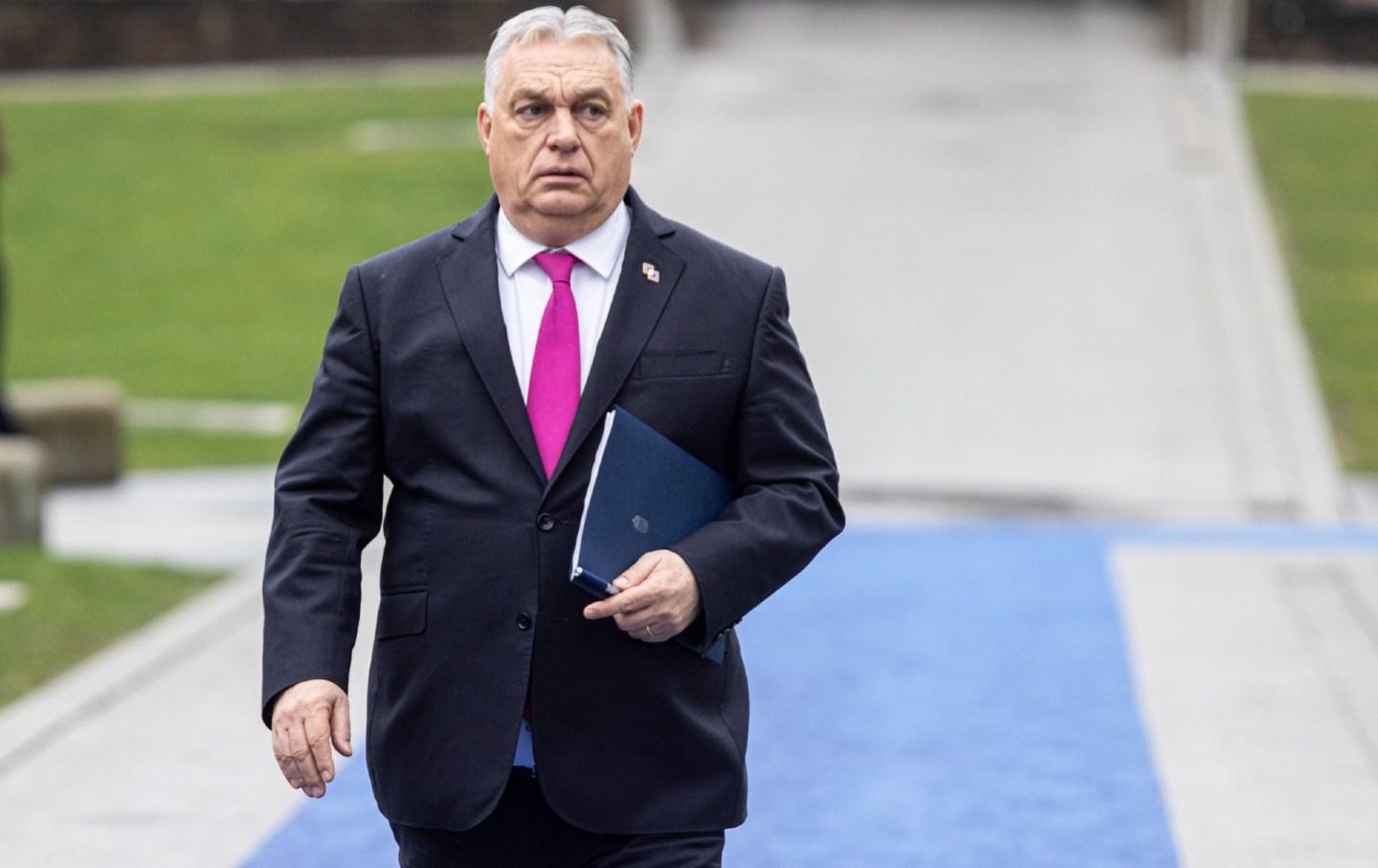
Viktor Orbán, Hungary’s autocratic prime minister, should have had no reason to worry in the run-up to the April 12 general election. In the previous four votes, he and his Fidesz party – a pioneer of the far right in Europe – triumphed handily, securing a two-thirds majority in parliament in every election since 2010. Orbán’s governments have reshaped the Hungarian state in Fidesz’s image and attempted to craft a system that would perpetuate Fidesz rule indefinitely. Moreover, the force behind Orbán and his party could hardly be more formidable: Vladimir Putin’s Russia, President Donald Trump and China too are lining up behind Orbán, their favored European leader.
And yet Fidesz is double digits behind a new opposition party, Tisza, and the buttons that Orbán has pressed so deftly for 16 years – immigration, Hungarian nativism, anti-LGBTQ, “peace” – are not triggering Hungarians as they had in the past. The Magyars seem to have had enough of the economic consequences linked to the loss of European funding, the high cost of living, omnipresent corruption and a long series of unseemly scandals. In 2024, Hungarian President Katalin Novak resigned after learning that she had pardoned the accomplice of a convicted pedophile. Last year, a pedophilia case involving videos showing children being abused in state-run juvenile facilities prompted tens of thousands of people to take to the streets.
This violent storm led observers cautiously convinced that Tisza (Respect and Freedom Party) could overthrow Orbán’s “integrated autocracy”. Two of Hungary’s most astute analysts, Andras Bozoki and Zoltan Fleck, describe Orbán’s government as a highly centralized regime, so deeply embedded in the makeup of society and so controlling of pseudo-democratic structures that it locks itself into its own electoral continuation. The Fidesz state, they argue, has the trappings of a democracy – regular polls, basic civil liberties and multiple parties – but the system is set up to produce the same result. Orbán rewrote the Constitution, packed the courts, promoted and paid his loyal allies, and redrew electoral districts to Fidesz’s advantage. Independent media have been nationalized or bought by Orbán’s supporters, while critical civil society is excluded from the public sphere.
Current number

“There is a chance that Fidesz will leave power peacefully,” said Zoltan Fleck, a lawyer at Eötvös Loránd University in Budapest and co-author of Integrated autocracy: Hungary in the European Union. “But authoritarian regimes do not usually end with elections, and Fidesz has a lot to lose in terms of money, property, and even the freedom of its main figures who have been involved for years in a criminal state.” With the country in a declared state of emergency due to the war in Ukraine, Orbán has broad powers to rule by decree, Fleck said, and has many options to change the system to Fidesz’s advantage.
“Tisza needs more than a narrow victory to dislodge Fidesz,” said Andras Biro of the Budapest-based think tank Political Capital. He explained that rural votes in Orbán’s strongholds in eastern Hungary carry more weight than urban votes and therefore the opposition needs a popular victory of at least four percentage points. According to Biro, a victory by 10 points would mean his defeat and force him to leave power. “We are not Belarus here,” he said, referring to ally Russia’s categorical refusal to accept electoral defeat.
In 2022, the European Parliament declared: “Hungary can no longer be considered a full democracy.” The bloc continues to withhold a significant share of EU funds allocated to Hungary – estimated at more than 20 billion euros – due to concerns over the rule of law, corruption, judicial independence and civil rights. Much of this sum could return to Hungary’s coffers if reforms are introduced. But Orbán hardly moves.
Undaunted, Orbán continues to put obstacles in the way of EU policy towards Ukraine, undermining Ukraine’s funding, sabotaging its EU membership and providing Putin with a foothold in EU Europe. Orbán’s long-running anti-Ukraine campaign seeks to convince voters that the neighboring country — Hungary and Ukraine share an 85-mile border — is embroiled in a war he himself provoked and poses an existential threat to Hungary’s security. “Orbán’s appeal is that of a strongman who protects Hungarians,” said Laszlo Andor, an economist and former EU minister. Andor said Orbán sees the war in Ukraine as a threat to the interests of ordinary Hungarians – a threat he keeps at bay. “Today, Ukraine is the number one topic. It has replaced migration in Fidesz propaganda.”
And then there is Orbán’s economy, which reached its peak in the mid-to-late 2010s and is largely responsible for Fidesz’s broad support. But that trend dissipated, replaced by inflation that soared to more than 17% in 2023 due to energy prices and currency depreciation. This hit average Hungarians hard. My friend Dorotteya, a private teacher, spends half of her salary feeding her family of three. Between 2019 and 2025, prices of Hungarian food products jumped by 82 percent, while cumulative inflation reached 50 percent.
Tisza is the product of Peter Magyar, a wily 44-year-old and former senior Fidesz official. Unlike previous elections, the broader opposition rallied behind him. A divided opposition never stood a chance against Fidesz, but this time, thanks to the insistence of voters, socialists, greens, liberals, conservatives, Roma activists and social democrats put aside their differences to oust Fidesz and begin dismantling its state.
As enthusiastic as the opposition is about finally uniting, Fleck notes that Magyar is a conservative with a background in Fidesz. How far and how quickly it will succeed in destroying the Fidesz state, if Tisza comes to power, remains an open question. The authoritarian ethos runs deep in Hungary, Fleck warned.
The big three
Fidesz’s poor standing in the polls is all the more extraordinary in light of its heavy-hitting global supporters. The decade-long love affair between Orbán and Putin is as much about their authoritarian affinities as it is about Hungary’s dependence on cheap Russian energy. Hungary and Slovakia are the only EU countries that have not tried to wean themselves off Russian gas. Russian robot armies, fake news, social media blitzes and other disinformation campaigns fit perfectly with Fidesz’s ideas: Europe succumbing to hordes of foreign immigrants, the corruption of Christian values by Western perversion and Ukraine as a fascist state.
Popular
“Swipe left below to see more authors”Swipe →
Trump has expressed his deep admiration for Orbán – and for the entire European far right – on several occasions, most recently in early February in a social media post that called him “a true friend, fighter and WINNER, and who has my complete and total support for his re-election as Prime Minister of Hungary.” Next week, after speaking at the Munich Security Conference, Secretary of State Marco Rubio will travel to Hungary and Slovakia.
It is perhaps thanks to Orbán’s diplomatic cunning that he has managed to align China also with Hungary’s objectives‚ so far without incurring the wrath of Washington. China is Hungary’s largest non-European trading partner, and Hungary depends on Chinese raw materials, automobile components, metal products, textiles and electronics. President Xi Jinping sings Orbán’s praises and supports Hungary in “playing a bigger role in the EU” to promote better relations between China and the European Union.
Analyst Biro said that with state support in many ways, Fidesz can outspend Tisza “more than 100 to one. The playing field is not level, not at all.”
Hungarians have clearly soured on Fidesz, but the question is to what extent. If Hungary is not Belarus, then people power can break the existing autocracy and open up space from which democratic culture can take root. But after 16 years of Fidesz rule, we have no proof that Hungary is not the Belarus of the EU.


