
Archaeologists often assume that people buried together in ancient graves were close family. But a new DNA study from a 5,500-year-old burial ground on Gotland complicates that picture.
By analyzing shared graves at the Stone Age site of Ajvide, researchers found that many individuals interred together were not immediate family at all. Instead, they were more distant relatives — cousins, great-aunts, or half-siblings — suggesting that these hunter-gatherers tracked family lineages with surprising sophistication.
The findings, published in Proceedings of the Royal Society B Biological Sciences, hint at social structures that valued extended kin networks. The four multi-person graves, situated within a larger cemetery of 85 known burials, offer rare genetic insight into northern European hunter-gatherers who persisted long after farming had spread across much of the continent.
“As it is unusual for these kinds of hunter-gatherer graves to be preserved, studies of kinship in archaeological hunter-gatherer cultures are scarce and typically limited in scale,” said population geneticist Tiina Mattila in a press release.
Read More: New Models Reveal If Neanderthals and Modern Humans Ever Met on the Iberian Peninsula During the Old Stone Age
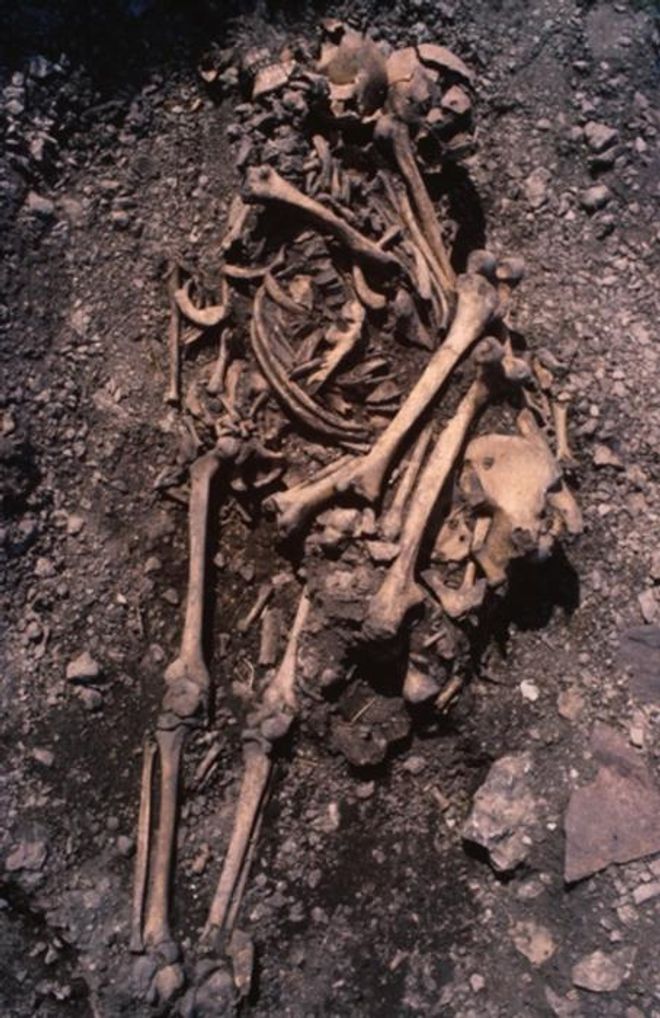
A young girl’s skeletal remains with her father’s clustered on top.
(Image Credit: Göran Burenhult/CC BY
What the Shared Graves Reveal About Stone Age Families
Ajvide’s burial ground includes at least eight graves containing two or more individuals. In the new study, researchers focused on four of them, uncovering relationships that defy long-held assumptions.
In one grave, a young woman in her early twenties lay on her back, flanked by two small children – one around four years old, the other just a year and a half. DNA showed the children were full siblings, a boy and a girl, but the woman was not their mother. Instead, she was likely their father’s sister or possible half-sister.
Another grave held a young individual alongside an adult man whose remains appeared to have been moved there from elsewhere. Genetic analysis revealed the young person was a girl and that the man was her father.
In a third grave, two children — a boy and a girl — were buried together, but they were not siblings. Their genetic similarity placed them as third-degree relatives, most likely cousins. A fourth grave contained a girl and a young woman who were also third-degree relatives, perhaps great-aunt and great-niece, or cousins.
As archaeological geneticist Helena Malmström explained, “Surprisingly enough, the analysis showed that many of those who were buried together were second- or third-degree relatives, rather than first-degree relatives – in other words, parent and child or siblings – as is often assumed. This suggests that these people had a good knowledge of their family lineages and that relationships beyond the immediate family played an important role.”
How DNA Revealed Kinship in Ancient Burials
Because children’s biological sex cannot reliably be identified from skeletons alone, researchers extracted DNA from teeth and bones to determine both sex and relatedness. Sex was identified by looking for two X chromosomes or one X and one Y chromosome.
Kinship was calculated by measuring how much DNA individuals shared. First-degree relatives share about half their DNA; second-degree relatives share a quarter; and third-degree relatives share roughly one-eighth.
Why Ajvide Matters in Scandinavian Prehistory
Ajvide is one of Scandinavia’s most important Stone Age sites, renowned for its exceptionally well-preserved graves. Around 5,500 years ago, hunter-gatherers lived along this coast, relying heavily on seal hunting and fishing. While agriculture had already spread across much of Europe, these northern communities persisted as hunter-gatherers and remained genetically distinct from nearby farming populations.
Researchers now plan to extend their interdisciplinary work to more than 70 individuals from the burial ground, aiming to reconstruct life histories, social ties, and burial practices.
Read More: Stone Age Tools Found in Central African Cave Were Remarkably Stable for 5,000 Years
Article Sources
Our writers at Discovermagazine.com use peer-reviewed studies and high-quality sources for our articles, and our editors review for scientific accuracy and editorial standards. Review the sources used below for this article:


