Federal agencies to present Washington County hazard risk assessment next month

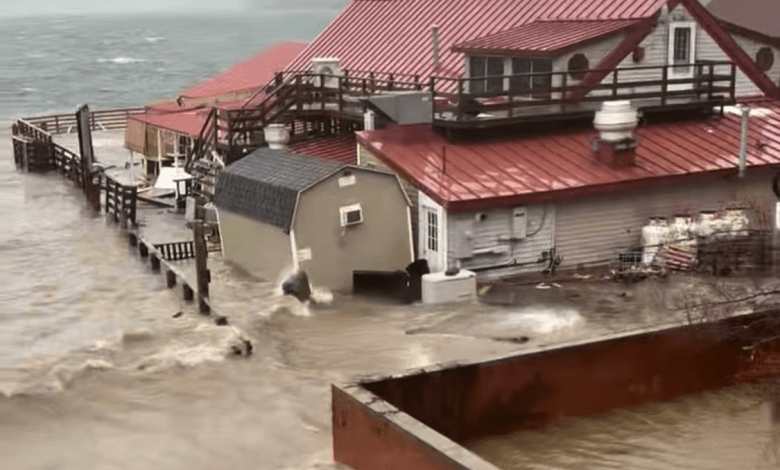
Residents are invited to a session next month where researchers plan to present an assessment of coastal and inland flood risks in Washington County and neighboring areas.
The live online event, hosted by the Sunrise County Economic Council, is scheduled for 1-3 p.m. on Friday, March 13.
The assessment, released in October 2025 by the National Centers for Coastal Ocean Science, the National Ocean Service of the National Oceanic and Atmospheric Administration, and the U.S. Department of Commerce, examined flood risks and other environmental hazards, including soil erosion and threats to wildlife, across all of Washington County and parts of Aroostook and Penobscot counties, with a particular focus on coastal communities.
Researchers looked at a wide range of hazards, including storm surge and flooding, damage from ice storms and wildfires, and resulting damage to roads and other infrastructure. They also assessed the risks that can isolate remote communities when flooding and other hazards close roads.
During the study, researchers examined national and local climate, soil and population data and held a series of in-person meetings and workshops with stakeholders over approximately a year.
One factor researchers considered when assessing risk was population density in areas vulnerable to flooding or other storm damage.
Working with local authorities, researchers identified critical infrastructure that municipalities should consider when planning for future risks, with ambulance services, county emergency management agencies, fire stations and hospitals topping the list.
Further down the list, they identified the need to protect assisted living and nursing homes, child care providers, schools, libraries and correctional facilities, grocery stores and other retail outlets at the bottom.
Researchers also identified the need to locate and protect hazardous materials sites and other sensitive locations, starting with dams and power lines, including cemeteries, recovery and treatment providers, psychiatric and psychopharmacology providers, farmers’ markets, and cultural and historical sites.
According to the report, “following destructive January 2024 storms that brought record flooding and high winds to coastal Maine, partners prioritized storm surge modeling from Category 2 hurricanes to plan for extreme conditions” in the future.
To determine the risk of stormwater flooding, researchers considered historical rainfall intensity, soil types found in coastal communities, land use relative to previously recorded risks, and the proximity of people and buildings to existing drainage networks.
Considering these factors, the report concludes that densely populated areas and wetlands are most at risk of damage from flooding and other storms, followed by pastures and agricultural lands, and then medium-to-low density land uses.
According to the report, assessment of potential ice storm damage is typically based on 30-year monthly minimum temperatures, but in this study area, temperature standards for December, January and February are always at or below freezing.
As a result, researchers were not able to model potential damage from the ice storm as clearly as they could for other hazards, although the report notes that deciduous trees would likely be most affected, as Maine has seen in past events.
Information from the National Centers for Coastal Ocean Science, or NCCOS, shows that many of the nation’s coastal communities “have limited economic resources and are disproportionately exposed to natural hazards,” with fewer resources and opportunities to prepare for dangerous events.
When these areas are identified, risk assessments like the one conducted in Maine are provided by NCCOS, NOAA and local stakeholders, according to the report.
Similar risk assessments include recent studies of flood and heat risks in Baltimore and population vulnerability and flood risks in the U.S. Virgin Islands.
According to NCCOS, risk assessments are locally tailored and intended to help public officials and others better protect people, structures and land from future hazards.
The Maine Risk Assessment is the seventh such study conducted in the region and was compiled with input from community partners including the Sunrise County Economic Council, Maine Coast Heritage Trust, University of Maine Maine Sea Grant, Greater East Grand Economic Council, NOAA Office of Coastal Management, Maine Aquaculture Innovation Center, Wells National Estuarine Research Reserve, Washington County Emergency Management Agency, Downeast Salmon Federation, Downeast Region Land Use Planning Commission and Sipayik Resilience Committee.
There is no cost to attend the March 13 event and no pre-registration is required. To join, click here. The event is live and will not be recorded.


