Scientists propose new plan to ‘catch’ comet 3I/ATLAS — but we have to act fast


The arrival of 3I/ATLAS in our solar system gave rise to multiple proposals for a rendezvous mission to study it closely. As the third interstellar object (ISO) ever detected, the wealth of information that direct studies could provide would be revolutionary in many ways. However, the mission architecture for intercepting an interstellar comet poses many significant challenges to mission designers and planners. Chief among them is the technology readiness level (TRL) of the proposed propulsion systems, ranging from conventional rockets to directed energy propulsion (DEP).
Mission proposals so far have focused on chemical rockets launched from Earth, like NASA’s. J.anal mission and the ESA Comet Interceptor, or on existing missions such as Juno probe adjusting their trajectories to meet him. In a recent article, researchers from Interstellar Studies Initiative (i4is) propose to abandon a direct transfer mission that would be launched from Earth today. Instead, they demonstrate how a mission launched in 2035 could intercept 3I/ATLAS using an indirect means. Oberth Solar Maneuver.
The main challenges of a direct rendezvous mission with 3I/ATLAS arise from the celestial mechanics of the target object, its high heliocentric velocity, and late initial detection. The first problem effectively rules out a rendezvous mission that would rely on an onboard propulsion system to match the comet’s speed, thus allowing prolonged close-up study of the body. As a result, a flyby mission is the preferred option. However, the second and third considerations rule out a direct mission because the optimal launch date had already passed before it was detected. As Hibberd summarized them for Universe Today via email:
“For the direct mission, the 3I/ATLAS object was detected too late, when it had already traveled inside the orbit of Jupiter, and with a speed greater than 60 km/s. It turns out that this was after the optimal launch date for a direct mission to intercept it. One paper revealed that there would have even been difficulty for a “Comet Interceptor” spacecraft if it had already been lurking at the Sun/Earth L2 point when 3I/ATLAS was discovered. »

Look on it
It was there that Hibberd used Optimal Interplanetary Trajectory Software (OITS), which he designed, to assess the feasibility of direct and indirect missions to intercept ISOs. This software has a proven track record in solving missions with Solar Oberths, which includes a previous i4is study for a mission (Lyra Project) which would intercept the first ISO ever detected, ‘Oumuamua. The use of gravity assists (GA) and/or Oberth maneuvers is an integral part of Project Lyra and other missions that use OITS.
The first involves a slingshot maneuver that exploits a planet’s (or moon’s) gravity to increase speed. The latter consists of a spacecraft under the gravitational influence of a massive body (the sun), waiting to reach its closest passage (perihelion), then applying thrust to reach a high heliocentric velocity. The spacecraft can thus achieve escape velocity from the solar system, or gain enough speed to encounter an ISO that has already traveled an enormous distance by that time. Hibberd said:
“For the direct mission, the 3I/ATLAS object was detected too late, when it had already traveled inside the orbit of Jupiter, and with a speed greater than 60 km/s. It turns out that this was after the optimal launch date for a direct mission to intercept it. One article revealed that there would have even been difficulties for a ‘Comet Interceptor’ spacecraft if it was already hanging around the Sun/Earth point L2 when 3I/ATLAS was discovered.”
The Solar Oberth option is designed when an interstellar object has passed through its perihelion (closest approach to the sun) and is rapidly moving away from the sun. It recognizes the fact that a spacecraft must generate enormous speed to catch such an object and exploits what is known as the “Oberth effect” in order to generate this speed. As a spacecraft approaches the sun, the sun’s gravitational pull increases its speed until perihelion is reached, then the spacecraft burns its solid propellant engines at this optimal point, to maximize the “slingshot effect” and to rapidly accelerate the probe toward the target object, in this case 3I/ATLAS.
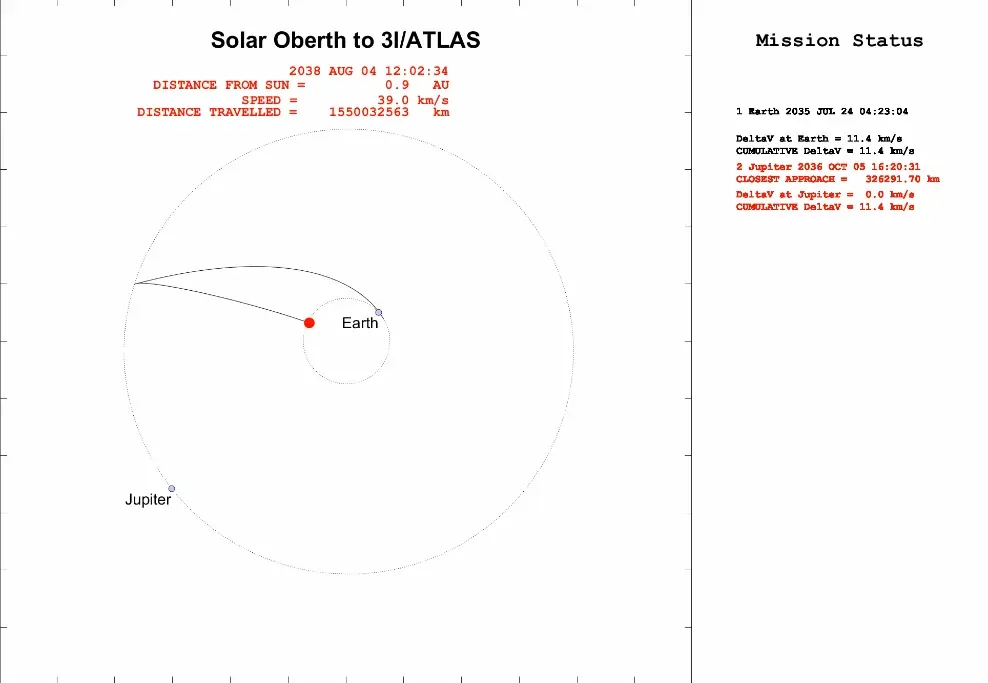
Based on their OITS simulations, the team found that an interception could be achieved via a Solar Oberth maneuver, but that launch would need to occur in 2035 to achieve optimal alignment between Earth, Jupiter, and 3I/ATLAS. The flight duration would be 50 years (although Hibberd notes that this could be reduced slightly). “2035 is optimal because the alignments of the celestial bodies involved (i.e. Earth, Jupiter, the sun and 3I/ATLAS) are most conducive to achieving 3I/ATLAS with a minimum requirement for Solar Oberth propulsion of the probe, a minimum performance requirement for the launch vehicle and a minimum flight time to the target,” he said.
Although such a mission would take a long time to intercept an ISO, the scientific results would be nothing short of revolutionary. Asteroids and comets are essentially leftover material from the formation of planetary systems. As such, studying ISOs would reveal information about other star systems without having to send missions to them, which could take centuries or more. While the DEP is being studied as a possible solution, at the Proxima Centauri Swarm (another i4is project), the TRL of this concept is probably several decades away.
Meanwhile, a spacecraft developed with current technology and relying on a Solar Oberth maneuver could achieve an ISO standard and provide detailed analysis in the same time frame. Even if we never send missions to nearby stars to observe what’s there, an ISO interceptor could tell us everything we need to know about systems other than our own.
THE original version of this article was published on The universe today.


:max_bytes(150000):strip_icc()/8560834728_2626216e21_k-9de0fa9704904904931d7424549ddb81.jpg?w=390&resize=390,220&ssl=1 "13 Facts About Armadillos")
