Rubio, Rodeo, and Tall Tales of Empire


February 24, 2026
The secretary of state angered Britain’s first black lawmaker and once again focused attention on how the United States has historically treated people of its own heritage.
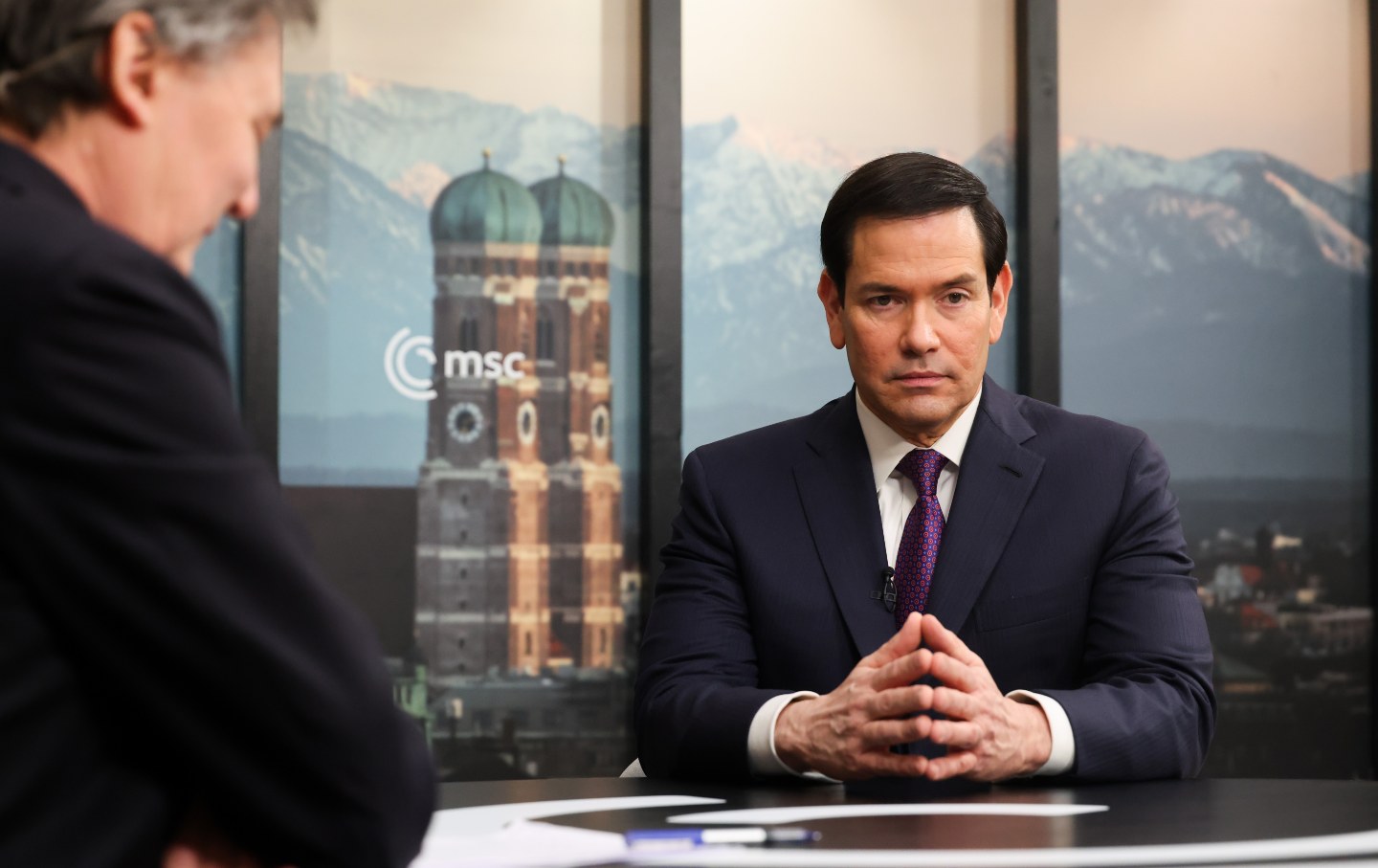
From claiming McKinley’s role to issuing a “corollary” to the Monroe Doctrine, the Trump administration has never shied away from asserting what it perceives as its place in history. Marco Rubio recently took this issue to a new level by asserting at a security conference in Munich that the United States and Europe are engaged in an existential battle against “the forces of civilizational erasure.”
Reinforcing that message last week, the State Department posted a photo of Rubio on
This drew a sharp rebuke from Britain’s first black female lawmaker. Diane Abbott, who holds the title of Mother of the House as the longest-serving female congresswoman, accused Rubio of “trying to forge a white supremacist version of human history” and said: “The language was first spoken in Africa. The language was first written in West Asia. Mathematics originated in Africa, as did the first translation. The first 2-story building was also built in Asia.”
In his Munich speech, Rubio had described colonialism as “a great civilization” that had sent “its missionaries, its pilgrims, its soldiers, its explorers flocking from its shores to cross oceans, to colonize new continents, to build vast empires stretching across the world.” To resounding applause, he told European leaders that America would always be “a child of Europe,” then illustrated his point with a curious collection of examples.
The Italians have in turn been credited for Christianity, the English for their language and their political and legal system, the Germans for agriculture and beer, the French for the exploration of the interior of North America and the Scots-Irish for Davy Crocket, Teddy Roosevelt, Neil Armstrong and Mark Twain (obviously ignoring the latter’s opposition to imperialism).
Predictably, of course, there was no place in this fairy tale for indigenous nations who had been ethnically cleansed to make way for colonization. Nor is there any mention of the 7.9 million people whose forced labor created King Cotton’s wealth and whose theoretical freedom necessitated a civil war in which approximately one million Americans died.
Current number

But what about Spain? Rubio could not credibly omit his own legacy from history, especially since NATO’s Mediterranean members are as geopolitically important as the Anglo-Saxon countries. Spain, he said with no apparent irony, was responsible for “our horses, our ranches, our rodeos – all the romanticism of the cowboy archetype that has become synonymous with the American West.” And, for good measure, he added that his own European ancestors would never have imagined that “one of their direct descendants would be back here today on this continent as the chief diplomat of this fledgling nation.”
This trite allusion to the American dream calls for an examination of real history. From the beginning, the architects of empire viewed Hispanic Americans as inferior and institutionalized their second-class status. As the United States expanded westward, it treated the lands it conquered as “incorporated territories” eligible to become “states,” but only once there were enough Anglo settlers to outnumber the native inhabitants and, in the southwest, the Mexicans from whom the lands were taken in 1848. This meant that Arizona and New Mexico were not admitted to the Union until 1912.
However, while the incorporated territories were intended to become a state once the right ethnic mix was eventually achieved, the colonies seized directly from Spain in 1898 were another matter. When the Philippines, Cuba, Guam, and Puerto Rico became U.S. possessions, there was much debate about what to do with them. Cuba gained nominal independence, but the United States retained – to this day – 45 square miles for a military base at Guantanamo. The Filipinos mounted a fierce resistance that was crushed by U.S. forces in what one senator described as “a foul stain on the flag,” but they eventually gained their independence in 1946. In the meantime, Guam and Puerto Rico were retained as U.S. possessions because of their geopolitical value in the Pacific and Caribbean respectively, leading to the need to determine what their legal status should be.
The solution of giving these outposts “unincorporated” status was proposed by Abbott Lawrence Lowell in an article in The Atlantic Monthly in February 1899. The Harvard law professor advanced the thesis that being created equal is “an entirely different matter” from their political equality. While “the Anglo-Saxon race was preparing to [political equality] by centuries of discipline under the supremacy of law,” he asserted that “the Spanish race” had not acquired “the habits of self-government.” Puerto Ricans, he continued, “must be trained for this, as our ancestors were, starting with local government with a strong judicial system, and the process will necessarily be slow.”
Puerto Rico’s unincorporated status was legally formalized in 1901 when the Supreme Court ruled that oranges imported from the island to the United States should be subject to customs duties, because “neither military occupation nor cession by treaty makes the conquered territory national territory within the meaning of the revenue laws.” In the words of Justice Edward Douglass White, Puerto Rico was “foreign to the United States in the national sense” because it was unincorporated and therefore “merely dependent upon it as a possession.”
This ruling continues to support Puerto Rico’s status. This was not changed by the granting of U.S. citizenship to Puerto Ricans in 1917, making them eligible for the draft. It was camouflaged in 1952 when, to refute accusations of colonialism at the United Nations, Congress granted the island limited autonomy. And it was exposed as a sham when Washington imposed direct rule in 2016 after a debt crisis that even a US city would have been allowed to manage independently by filing for bankruptcy protection.
Popular
“Swipe left below to see more authors”Swipe →
The hostility in some quarters towards Bad Bunny’s appearance at the Super Bowl highlighted the confusion that could only arise from the idea that a place can belong to the United States without being part of it. Attitudes have changed little since the days of Lawrence Lowell: Puerto Ricans may be fodder for war or their country’s military valor, but they are not American when they assert their cultural identity. It is not surprising that more and more people are demanding political equality through self-determination.
Rubio’s attribution of ranches and rodeos to his ancestors was antiquated and might be welcomed by some European politicians grasping at Atlanticist straws, but having someone of Hispanic descent at the center of American power doesn’t make it any less of a racist endeavor. As another Harvard professor, Samuel P. Huntington, said in 2004: “There is no American dream. There is only the American dream created by an Anglo-Protestant society. Mexican Americans will only share this dream and this society if they dream in English.”
More than The nation
Boris Kagarlitsky and hundreds of unknown political prisoners are still held in Russian prisons.
Leif Reigstad
Roadblocks imposed by workers on the ground send a warning to the Mexican president.
David Bacon
Using an old playbook and powerful new tools, we may be closer than ever to making a war between the United States and Iran a reality.
Jamal Abdi

American politicians have invaded the summit, but Europe no longer considers the United States a reliable partner.
Carole Schaeffer


