Long-lost silent film depicts first ‘robot’ in cinema


Archivists at the Library of Congress believe they have discovered the first depiction of a robot in movie theaters, thanks to a 127-year-old reel that has been gathering dust in a garage for decades. The artifact in question is called Gugusse and the automatona 45-second reel made by pioneering French filmmaker Georges Méliès circa 1897. Although appearing more than 20 years before the word robot was officially coined, it still manages to touch on a recurring theme in science fiction films to this day. A fear of robots fighting back.
“This is one of the collections that makes you understand why you’re doing this,” Library of Congress archives technician Courtney Holschuh said in a statement.

Gugusse and the Automaton
In the brief silent film, Méliès plays a magician named Gugusse who displays an “automaton” in what looks like a proto-robot manufacturing factory. The automaton is dressed as a clown and stands atop a pedestal. After a few exuberant jumps, Gugusse begins turning a crank at the bottom of the base, seemingly winding up the automaton like a toy. Once reassembled, the robot moves its arms up and down, to the delight of Gugusse. But this pleasure does not last long.
In the next scene, the automaton is replaced by a larger humanoid figure. Gugusse winds it up again, and the machine responds again by moving its limbs. But this time, after a few sporadic gyrations, the automaton reorients itself towards the magician and begins using the canes in its hands as weapons, aggressively beating its creator. In a fit of rage, Gugusse grabs the robot by the legs and hoists it from the base. He then pulls out a comically sized hammer…Looney Tunes– style – and hits the automaton over the head. With each hit, the machine becomes smaller and smaller until it disappears completely. And there you have it, the clip ends.
In a blog post revealing the discovery, the Library of Congress says the discovery is “a small but important addition to the legacy of world cinema and one of its founders.”
From a Farmer’s Garage to the Library of Congress
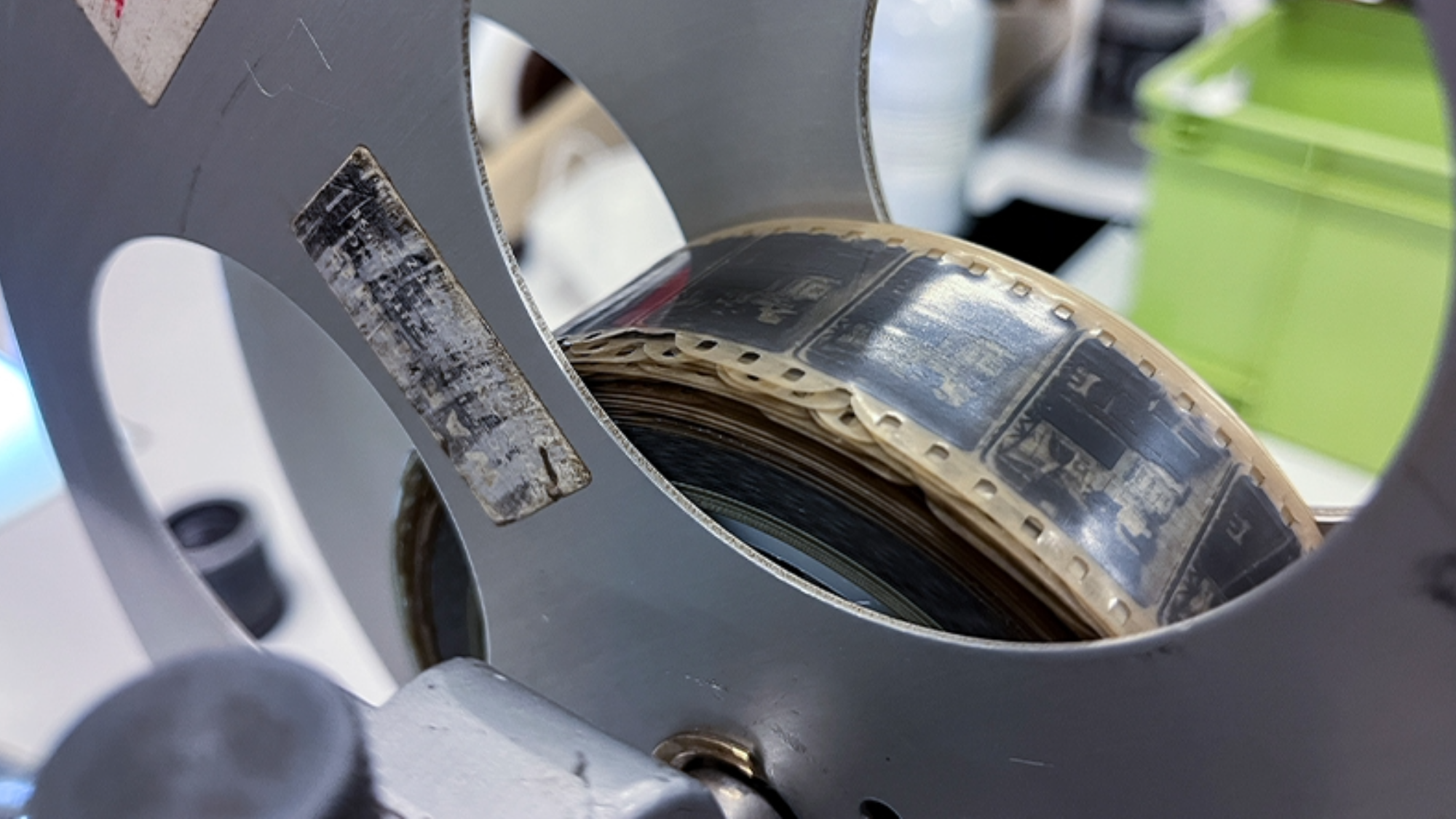
Silent film experts had long known of the short’s existence, but believed it had been lost to time. In all likelihood, Library of Congress technicians note that they were the first to lay eyes on the film in over a century. And this discovery happened largely by chance. The film was part of a larger collection donated by the descendants of William Delisle Frisbee. The late 19th century potato farmer who spent his free time traveling by horse and buggy from town to town, showing films on his projector, which was still rare at the time. Frisbee passed down his film collection to his descendants, who eventually donated them to the Library of Congress.
Technicians at the Library of Congress were examining the film reels when they began to notice telltale signs of Méliès’ work. After consulting a Méliès expert, they received confirmation that they were watching a coveted and long-lost film. They then spent more than a week scanning and stabilizing the images in order to convert them to digital format. It is now available for free in 4K.
“This movie took him from a buggy in rural Pennsylvania to a [Toyota] Michigan Camry in Culpeper [Virginia] in the hands of our technicians at the Library of Congress, and now, because of the work we can do here, we can share it with the world,” Jason Evans Groth, curator of the moving images section at the Library of Congress, said in an Instagram Reel about the findings.
Méliès sparked a long line of evil movie robots
Although he may not be a household name today, Méliès was a heavyweight in the early days of cinema. He began his career as a stage magician before turning to film, which many considered at the time to be a kind of magic in itself. Méliès went on to create around 500 films and pioneered early filmmaking techniques such as double exposure and forced perspective. He would also have had a deep interest in early science fiction writers like HG Wells and Jules Verne, which partly explains his use of the automaton. And although these figures are not strictly robots in the modern sense, real-world wind-up “automata” existed, dating back at least to the early 17th century.
Although it was lost for nearly a century, Méliès’ early science fiction lived on in his mind through a long line of films featuring imposing robots, usually villains. Perhaps the first known example following the Méliès reel is in the 1919 silent film. The mystery of the master, with Harry Houdini. There, an actor dressed in a bombastic robot costume is described as “a mechanical figure with a human brain.” Naturally, the automaton sets off in pursuit of the panicked humans.
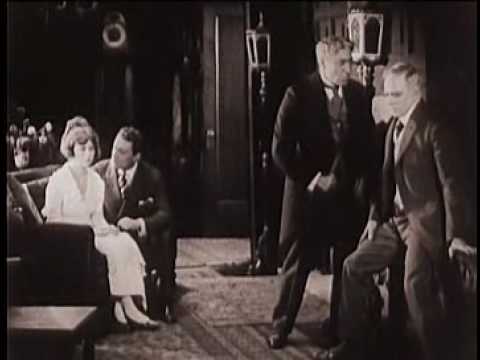
Houdini: The Master Mystery (1920) (Part 2 of 20)
For archivists working at the Library of Congress, the results reveal another oft-overlooked quality of the film. It’s longevity.
“I’ve been working with nitrate for decades now and I’m always amazed at how strong and durable this material can be,” said Nitrate Film Vault manager George Willeman in an Instagram Reel detailing the results. “We have video tapes that are no longer usable and yet here is a nitrate print from 1895 that we were able to identify just by looking at it.”

The best new PopSci 2025 releases