Record haul of rare Yuan Dynasty blue-and-white porcelain discovered at shipwreck off Singapore

In the waters off Singapore, a recently discovered shipwreck with a huge cargo of blue and white porcelain sheds light on legendary Chinese craftsmanship produced during the turbulent era of the Mongol Empire.
The roughly 650-year-old ship, which likely sailed from China to Temasek, a historic settlement on the site of present-day Singapore, contained a record cargo of Yuan dynasty porcelain, according to the newspaper that detailed its discovery.
It took four years for Michael Flecker, the marine archaeologist who led the investigation, and his team to excavate the site of the 14th century wreck and recover the remains of the ship’s cargo.
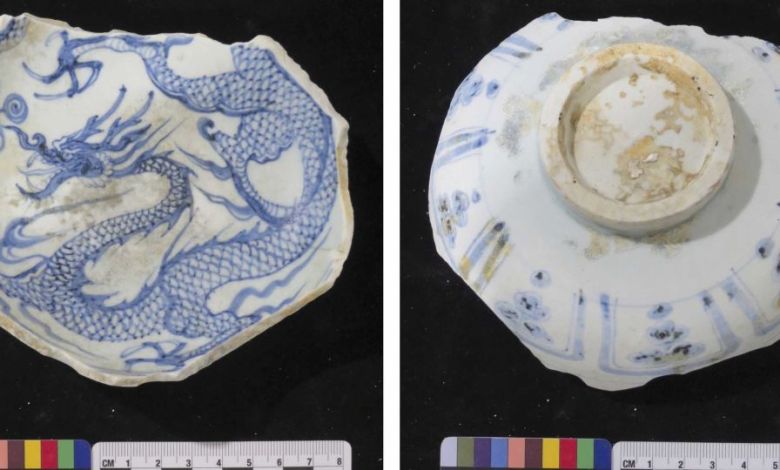
Researchers found about 3.5 tons of ceramic shards, including about 136 kilograms (about 300 pounds) of Yuan porcelain – this distinctive blue and white ceramic with intricate designs, as well as several intact or nearly intact pieces of porcelain.

Archaeologists discovered about 136 kilograms (about 300 pounds) of Yuan Dynasty porcelain shards, as well as several intact or nearly intact pieces of porcelain, on the wreck. -Michael Flecker/Science Direct
Although the wreck site was shallow, researchers battled “strong currents and shocking visibility,” meaning they could only dive about once every four weeks, Flecker told CNN.
“Even then, we were sometimes sent tumbling along the seabed or groping back to the diver in the dark,” added Flecker, a senior archaeologist at Heritage SG, a subsidiary of the National Heritage Council of Singapore.
Under such conditions, the ship itself largely disintegrated, although Flecker suspects it was probably a Chinese junk, a type of sailing ship widely used in the early Middle Ages.
Rare artifacts survived these conditions and almost all the porcelain recovered from the site consisted of shards. Yet enough intact objects have survived to identify the telltale drawings.
One represents a four-clawed dragon; another represents a phoenix surrounded by a band of chrysanthemums.
The recurrence of a particularly popular drawing – mandarin ducks in a lotus pond – even allowed Flecker to date the sinking..
This design was the signature pattern of Emperor Wenzong, who limited it to his personal use during his reign from 1328 to 1332., according to the study. Those restrictions likely ended once he was impeached, meaning commercial kilns produced many more ceramics featuring this pattern, much of which was exported, Flecker said.

The ship itself had largely disintegrated, but researchers recovered the remains of its enormous cargo of ceramics. -Michael Flecker/Science Direct
The Imperial Kilns were probably closed about 20 years later, following the invasion of the Red Turbans, a peasant rebellion movement, thus reducing the window in which this ship could have sunk.
Although some kilns continued to produce ceramics, the Yuan dynasty fell in 1368 and the first Ming emperor banned the trade around 1371, so even the most conservative estimates for dating the sinking still fall between the late 1320s and 1371, the study found.
“Miraculous” material
By the time Yuan porcelain was produced, it had become coveted by elites across Eurasia, said Shane McCausland, a professor of art history at SOAS University of London (formerly the School of Oriental and African Studies), who was not involved in the study.
“It’s tableware, it’s not valued in the same way as gold, painting, calligraphy or greater architecture,” he told CNN. “Yet it has something to do with the translucency, the incredible hardness of it, it’s a kind of somewhat miraculous material.
“It’s even believed to have magical properties that if you put poison in it, it would crack… which partly explains why paranoid leaders would like to have a little blue and white,” he added.
Porcelain also sheds light on the nature of the trade networks that existed at the time: It was made by Chinese artisans, using cobalt native to Persia, now Iran, before being exported along the continental and maritime silk routes, dominated by the Mongols, McCausland said.
For him, Yuan porcelain represented a major cultural and technological advance in Chinese art under Mongol rule, going against long-held orthodox perceptions of the imperial dynasty.
“As soon as the Mongols withdrew from China in 1368, the knowledge that this blue and white was a breakthrough of the Yuan period was lost,” he said.
Until the 1930s, researchers incorrectly identified porcelain as being produced by other dynasties. “In other words, what could the Mongols have had to do with this? They destroyed, they raped, they pillaged,” he said.
This particular cargo likely departed from Quanzhou, a port on China’s east coast close to the creative hubs of Fujian, Zhejiang and Jiangxi provinces, bound for Temasek, according to Flecker.
While historians already knew Temasek was an important duty-free port in the 14th century, this shipwreck “hints at the scale of local consumption” and “demonstrates the wealth” of the colony, Flecker said.
The study was published in June 2025 in the Journal of International Ceramic Studies.
Sign up for CNN’s Wonder Theory science newsletter. Explore the universe with information on fascinating discoveries, scientific advances and much more.
For more CNN news and newsletters, create an account at CNN.com


