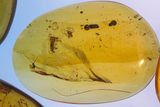
About 99,000 million years ago, some ants were going about their daily business when they were entrapped in an amber prison. Today, researchers are using this relic, and others like it, to learn more about the ecosystems of the past.
Amber fossils like these are biological time capsules that enable scientists to study the behavior of prehistoric insects. They are particularly valuable as insects — unlike mammals, reptiles, and many other animals — rarely leave behind fossils. Those that contain multiple species are especially rare, but they can offer a unique opportunity to explore ancient ecosystems and the interactions that occurred between different organisms.
Indeed, Jose de la Fuente of the Institute for Game and Wildlife Research, Spain, described amber fossils as a “snapshot of life on Earth millions of years ago” in a press release.
However, all this does beg the question: to what extent do these time capsules reveal interactions between different insects, and to what extent are they simply a coincidence? That is what de la Fuente and others attempted to answer in a paper published in Frontiers in Ecology and Evolution.
Fossils from the Past
De la Fuente and his team described six amber fossils dating from the Cretaceous period (circa 99 million years ago) to the Oligocene (34 million to 23 million years ago). Together, these items contained the remains of three ant species, as well as those of various other insects, including mites, wasps, and termites.
To determine the nature of these syninclusions (whereby multiple species are preserved within the same piece of amber), one factor the researchers considered was their proximity to one another. Three out of the six fossils (Case 1, Case 4, and Case 5), for example, contained ants near mites, with Case 4 showing a Stem ant four millimeters away from a mite.
“The closest ant syninclusions are more likely to reflect behavior and interactions between these organisms,” said de la Fuente, who led the research. “The proposed ant-mite interactions in Case 4 may reflect two possible scenarios. First, a commensal specialized temporal relationship where mites attach to ants for free ride dispersal to new habitats. Second, a parasitism when mites feed on the ant host during transport.”
In contrast, Case 6 shows a Stem ant trapped with a spider, a larva or worm-like insect, and what is thought to be a parasitic wasp. The researchers noted the ant displays “possible scavenging, feeding, or foraging activity” and “appears in contact with feeding substrate and worm-like insect.”
However, the researchers explained there is “no evidence of predatory interaction” between the two insects, despite their proximity. In other words, in this instance, their closeness is likely a simple coincidence. The researchers warn that while proximity is more likely to indicate some kind of interaction, that is not necessarily true — it might just be a case of unfortunate timing.
Read More: Mosquitoes May Have Been Feeding on Homo erectus 1.8 Million Years Ago
Unusual Interactions Between Species
Taken as a whole, the study supports previous research that suggests ants may have interacted with several other insects, including mites, spiders, and wasps, according to the researchers.
This includes a more unusual interaction between a Stem ant and an extinct species of spider, displayed in Case 2, which may have mimicked the appearance of an ant as an attempt to deter predators through camouflage, and lingered near real ants in the process.
The team suggests future research will incorporate micro-CT scanning and other advanced imaging techniques. This, they say, could help identify possible attachment structures on the mites that they could use to latch onto ants.
Read More: Fossilized Resin Reveals a Wet Forest Full of Insects and Spiders 112 Million Years Ago
Article Sources
Our writers at Discovermagazine.com use peer-reviewed studies and high-quality sources for our articles, and our editors review for scientific accuracy and editorial standards. Review the sources used below for this article: