Major Changes to NASA’s Artemis III and Artemis IV Missions to the Moon


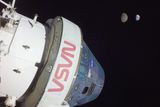
NASA’s Artemis program, which aims to return Americans to the Moon and create an “enduring presence” on its surface, has announced a major update to its schedule.
The previously announced Artemis III mission in 2027 will no longer land astronauts on the Moon; instead, it will conduct tests in low Earth orbit. A recently announced mission, Artemis IV, will reach the Moon in 2028.
In a statement, NASA said testing of Artemis III would include rendezvous and docking exercises with commercial landers produced by SpaceX and Blue Origin. The mission will also consist of testing the survival, propulsion and communication systems of docked vehicles in space. The mission will also test the performance of a new spacesuit, the Axiom Extravehicular Mobility Unit (AxEMU). The AxEMU has not yet been tested in space.
Revision of the Artemis mission program
The announced changes are not the first changes to the Artemis program schedule. Artemis II, the first crewed mission to fly around the Moon since Apollo 17 visited the surface in December 1972, was delayed after a liquid hydrogen leak during a “wet” dress rehearsal in early February 2026 that tested the rocket’s refueling and countdown stages.
A second wet rehearsal, conducted on February 19, 2026, revealed problems with the rocket’s helium flow during the intermediate phase of cryogenic propulsion.
While the revised mission program opted for a more conservative third mission, NASA’s announcement hints at a much more ambitious plan for post-2028. The agency committed to “undertaking at least one surface landing each year thereafter” in its new announcement.
Learn more: Establishing a time zone on the Moon could benefit future missions to Mars
A measured schedule
NASA Administrator Jared Isaacman, a billionaire who became the first private citizen to conduct a spacewalk, said in a statement that changes to the program should remove future obstacles to the agency’s plans.
“NASA must standardize its approach, increase the rate of flight safely, and implement the President’s National Space Policy,” Isaacman said in a statement. “With credible competition from our greatest geopolitical adversary growing by the day, we must move faster, eliminate delays and achieve our goals. Standardizing vehicle configuration, increasing flight cadence and progressing toward goals in a logical, incremental approach is how we achieved the impossible in 1969 and how we will do it again.”
Overall, experts said the agency’s plans represented a more measured timeline that involved a less dramatic jump from lunar orbit to landing.
NASA Associate Administrator Amit Kshatriya acknowledged this in a statement.
“The entire Artemis flight sequence must represent step-by-step capacity building, with each step bringing us closer to our ability to perform the landing missions. Each step must be large enough to progress, but not so large that we take unnecessary risks given previous learnings,” Kshatriya said.
The Lunar Gateway
Experts noted that the agency’s announcement omitted reference to Lunar Gateway, a small space station orbiting the Moon. In the Agency’s initial plans, the Lunar Gateway would have served as a transit station for the second moon landing, but it was not included in the recently announced schedule.
The station will house a $2 billion robotic arm designed by the Canadian space program. This robot, the Canadarm3, uses advanced AI, allowing it to operate relatively independently at a great distance from Earth. This omission comes against a backdrop of tense relations between the United States and Canada.
Learn more: How artificial lunar dust is helping us build the first long-term lunar bases
Article sources
Our Discovermagazine.com editors use peer-reviewed research and high-quality sources for our articles, and our editors review the articles for scientific accuracy and editorial standards. See the sources used below for this article:


