Poll on Iran finds majority opposes U.S. military action : NPR



Plumes of smoke rise from explosions reported Monday in Tehran, after U.S. and Israeli strikes on Iran on Feb. 28 killed Iran’s Supreme Leader Ayatollah Ali Khamenei and other top military officials.
Sohrab/Middle East Images/AFP via Getty Images
hide caption
toggle caption
Sohrab/Middle East Images/AFP via Getty Images
As the war with Iran approaches a second week, most Americans say they oppose military action and disapprove of President Trump’s handling of it, according to the latest NPR/PBS News/Marist poll.
By a margin of 56 to 44 percent, respondents said they were opposed to military action.
Only 36% approve of Trump’s handling of Iran, and a majority (55%) believe Iran poses a minor threat, or no threat, to the United States.

However, 44% view Iran as a major threat, and Republicans continue to strongly support the president’s actions.
The Trump administration has given various justifications for why it attacked Iran alongside Israel on February 28, including arguing that Iran posed an imminent threat.
The survey of 1,591 respondents nationwide took place Monday through Wednesday this week, in the days after the United States and Israel began bombing Iran. The survey has a margin of error of 2.8 percentage points and was conducted in multiple ways: by phone, text and online, as well as in English and Spanish.
Most oppose military action in Iran
Democrats (86%) and independents (61%) are largely aligned with each other in opposing military action.
But 84% of Republicans support it.
There were significant divisions by age, race, and education, in addition to political party.
Younger people (18-29) were the most likely, regardless of age group, to be against the action (64%).
Whites without a college degree were slightly more in favor of the action, by a margin of 53 to 46 percent, while those with a degree were much more likely to be against it: 61 percent opposed it, while only 38 percent were in favor.
Men were also more likely than women to support her. Men were almost split (48% for, 52% against), while women were more strongly against (41% for, 59% against).
Blacks (68%) and Latinos (60%) were more likely than whites (52%) to oppose it.
Support for Trump’s handling of Iran is weak
A majority (54%) disapprove of Trump’s handling of Iran.
This is worse than in the January 2020 Marist poll, after the head of the Iranian Quds Force, Qassem Soleimani, was killed in a drone strike by the Trump administration.
At the time, 42% approved of Trump’s work on Iran, while 49% disapproved.
Again, Democrats (86%) and independents (59%) disapprove, while nearly 8 in 10 Republicans (79%) approve, although that percentage is slightly lower than the percentage of Republicans who specifically approve of military action.

The youngest voters are once again those who least approve of Trump’s handling of Iran: 25% among those aged 18-29, 35% among those aged 30-44 and 41% among those aged 45 and over.
Gen Z is the generation least likely to approve (24%). Millennials made up 36%, Generation X 40% and Baby Boomers 39%.
Here notably, approval among white evangelical Christians is only 68%. On most issues, this group’s support for Trump is generally higher.
There are other divisions along gender, race, and education that stand out.
- Men in small towns/suburbs (42%) are 15 points more likely to approve than women who live in these areas (27%);
- Overall, men are 13 points more likely to approve than women (43% versus 30%);
- By race, black voters are least likely to approve (17%), but Latino approval is also low (32%);
- Whites without a degree are evenly split, while Trump is 21 points underwater with white degree holders – 37% approve and 58% disapprove.
A majority view Iran as a minor threat, if at all.
There were similar divisions on the Iranian threat as on other questions in the survey: 55% view the country as a minor threat (40%) or no threat (15%), while 44% view it as a major threat.
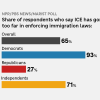
By party, 70% of Republicans say it is a major threat, while three-quarters of Democrats and 6 in 10 independents consider it a minor threat, if at all.
Among those most likely to view Iran as a major threat: white evangelical Christians (63%), white women without a college degree (52%), those living in rural areas (51%), and those aged 45-59 (50%).
Among the least likely: white women with a college degree (34%), those living in the Northeast (39%), white college graduates (39%), Millennials (38%).


