Trump vows to escalate war as divisions in Iran emerge

WASHINGTON- Signs of division emerged within Iran’s leadership on Saturday as U.S. and Israeli strikes continued to hit targets across the country, with Tehran sending mixed signals over whether it would continue attacking Washington’s Arab allies as the war’s second week begins.
Iranian President Masoud Pezeshkian began the day by apologizing “on behalf of Iran to the affected neighboring countries,” promising to put an end to the attacks that have affected almost every country in the Middle East. But the strikes continued within hours, hitting Qatar, Bahrain and the United Arab Emirates, and Pezeshkian quickly issued a statement walking back his comments.
President Trump vowed on social media to “hit Iran really hard” on Saturday, shortly before flying to Dover Air Force Base, Delaware, for the dignified transfer of six service members killed during the war.
Speaking at a summit of Latin American leaders in Miami before his trip to Delaware, the president said fallen service members were heroes “coming home in a different way than they thought they were coming home.” He said it was “a very sad situation” and he pledged to keep American war deaths “to a minimum.”
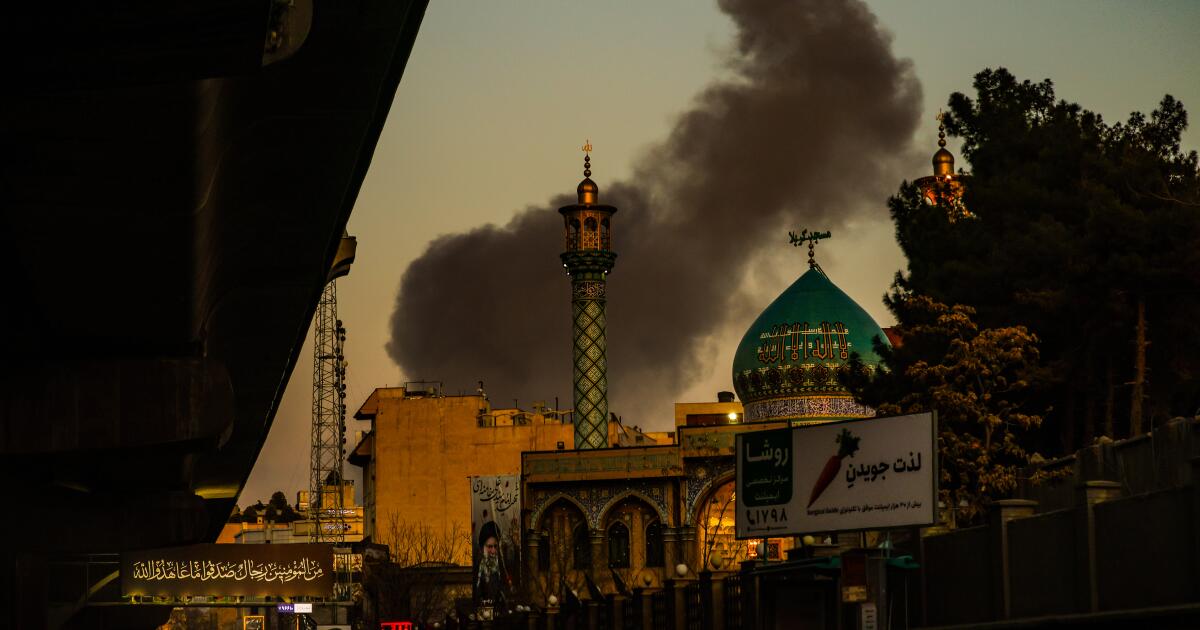
And Israel launched its own wave of attacks against Iran while coming under fire from Hezbollah, Iran’s allied force in Lebanon, which set off sirens in Tel Aviv. Reports of a fire at a major oil refinery outside Tehran have raised fears the conflict will only intensify, marking the first attack on Iran’s energy infrastructure, if confirmed.
The weekend’s burst of activity underscored that Trump’s unexpected war against Iran, launched alongside Israel just a week ago, continues in full force, with no signs of slowing down.
Iran’s missile and drone strikes against Arab countries, targeting U.S. military assets in the region as well as civilian targets including hotels and airports, constitute an attempt by Iran’s Islamic Revolutionary Guard Corps to pressure regional governments to in turn pressure Trump to end the U.S. air campaign. The strikes shook markets around the world and caused the price of oil to skyrocket.

President Trump salutes Saturday as soldiers carry the casket of Sgt. Declan Coady, 20, of West Des Moines, Iowa. Coady and five others were killed in a drone strike in Kuwait.
(Roberto Schmidt/Getty Images)
While attacks have declined significantly over the week, with US Central Command recording a 90% decrease in ballistic missile launches and an 83% drop in drone attacks on Friday, Iranian strikes continue to penetrate regional air defenses. A drone struck the world’s busiest airport in Dubai on Saturday, dashing hopes of a resumption of flights from the regional hub.
Hours after Pezeshkian’s apology, Iran’s Foreign Ministry issued a statement pledging to continue strikes on territories hosting US offensive forces. Iran’s Defense Ministry said its strategic ammunition stockpile was sufficient to support a prolonged campaign. And a Revolutionary Guards spokesperson issued a statement addressing Trump, calling him the “corrupt man of the island,” referring to his former friendship with Jeffrey Epstein, the late sex offender who allegedly trafficked girls to his private island.
“The terrain and the map of war are in our hands,” the Revolutionary Guards official said. “This will continue.”
In his videotaped remarks, Pezeshkian also rejected Trump’s call for an “unconditional surrender” by Tehran. Trump later said he would be satisfied with reaching a point where Iran was no longer able to retaliate.
“The idea of Iran’s unconditional surrender is a dream they will take to their grave,” Pezeshkian said.
A member of the Assembly of Iranian Experts, a council of 88 clerics charged with appointing the country’s supreme leader, was quoted in local state media promising to select a new ayatollah in the coming days, more than a week after U.S. and Israeli forces assassinated Ayatollah Ali Khamenei in the opening salvo of the war.
Trump has said he hopes to have a say in the decision, preemptively rejecting the late supreme leader’s son, Mojtaba Khamenei, who is seen as the most likely successor.
Mojtaba Khamenei is seen as even more ideological than his father, with deep ties to Iran’s security apparatus — and with a potential vendetta against Trump, on the heels of U.S. forces killing much of his family.
Ali Larijani, secretary of Iran’s Supreme National Security Council and a former top adviser to the late Khamenei, said in his first remarks since the ayatollah’s assassination that his assassination was unprecedented. “The price to pay is not small,” Larijani said.
“They shouldn’t think that we’re going to let America quickly sweep this under the rug and say, ‘We hit it, now let’s move on,’” Larijani continued. “Things will only be resolved when they understand that they no longer have the right to violate Iran and when they compensate the Iranian people for their losses. »
More than 1,200 people have been killed in Iran since the start of the war, according to Iranian authorities.
“He killed and martyred our leader,” Larijani added. “We won’t let him go.”


