A supporter poses with a picture of Iran’s new supreme leader, Mojtaba Khamenei, during a rally in central Tehran on Monday.
Atta Kenare/AFP via Getty Images
hide caption
toggle caption
Atta Kenare/AFP via Getty Images
Iran’s killed supreme leader will be replaced by one of his sons, Mojtaba Khamenei, a mid-ranking cleric who has until now wielded his power exclusively behind the scenes.
Iran’s Assembly of Experts — the clerical body tasked with selecting the country’s supreme leader — said on Sunday that a majority of its members voted to appoint Khamenei as the Islamic Republic’s third supreme leader since its founding in 1979.
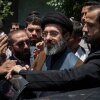
The announcement appeared in state media just over a week after the former supreme leader, Ayatollah Ali Khamenei, was killed in a joint U.S.-Israeli attack. His nearly four-decade rule was marked by staunch opposition to both countries as well as any efforts to reform or modernize Iran. Questions loom about Iran’s future as it responds with continued strikes on Israel and Gulf states.
The younger Khamenei’s appointment answers some of those questions. The 56-year-old has close ties to Iran’s paramilitary Revolutionary Guard Corps (IRGC), signaling a continuation of his father’s hard-line theocratic rule.
“[Of] all the candidates that were put out there, he was the one that was closest to the IRGC. He was also very well-connected in his father’s own office,” Iran specialist Afshon Ostovar told NPR last week, as Khamenei emerged as one of the most likely successors. Ostovar said his selection would mean “the regime wants to preserve as much of the status quo as possible.”

But Khamenei is also a relative mystery. He has never held a formal position in government. And he rarely speaks or appears in public, save for occasional loyalist rallies.
“He’s kind of an unknown quantity,” Ostovar said. “He’s sort of a guy who you see in pictures, in meetings, that sort of thing, kind of in the background.”
But he has long been accused — including by analysts, Iranian dissidents and the U.S. government — of amassing power and pulling strings from within his father’s inner circle. Here’s what to know about Khamenei as he moves into the foreground.

Mojtaba Khamenei pictured in Tehran in December 2016. He is the second son of Iran’s Supreme Leader Ayatollah Ali Khamenei, who was killed in joint U.S.-Israeli airstrikes in late February.
Reza B/Middle East Images/AFP via Getty Images
hide caption
toggle caption
Reza B/Middle East Images/AFP via Getty Images
The second son of the supreme leader
Khamenei is the second of the late leader’s six children. He was born in 1969 and grew up in the holy Shia Muslim city of Mashhad, in northeastern Iran, as his father was emerging as a leading anti-monarchy revolutionary figure.
After the 1979 revolution, the family moved to Tehran, and the elder Khamenei took up key positions in the new government, from deputy defense minister to president and finally to supreme leader in 1989.
Meanwhile, his son graduated from the elite Alavi High School before joining the Revolutionary Guard. The younger Khamenei served in the armed forces during the final years of the Iran-Iraq War (which ended in 1988), forming relationships with future key players in the Iranian security services.
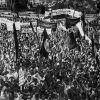
Khamenei went on to pursue theology, a path that led him to the holy city of Qom to study under — and build relationships with — ultra-conservative religious clerics. He holds the clerical rank of “hujjat al-Islam,” which ranks below the senior rank of “ayatollah” (which his own father only attained after being selected as supreme leader).
Khamenei further cemented his political connections with his marriage to Zahra Haddad Adel, the daughter of a prominent hardliner: Gholam-Ali Hadad-Adel, a former parliament speaker who is considered a close member of the late supreme leader’s inner circle. Iranian state media have reported that the younger Khamenei’s wife — as well as his mother, sister and brother-in-law — were killed in the Feb. 28 strike that killed his father.
Alleged behind-the-scenes influence

Mojtaba Khamenei pictured at the annual Quds Day rally in Tehran in May 2019, one of the few times he’s been photographed in public over the years.
Rouzbeh Fouladi/Middle East Images/AFP via Getty Images
hide caption
toggle caption
Rouzbeh Fouladi/Middle East Images/AFP via Getty Images
The U.S. Treasury Department imposed sanctions on Mojtaba Khamenei — and his father-in-law — under the first Trump administration in 2019, for what it said was “representing the Supreme Leader in an official capacity despite never being elected or appointed to a government position aside from work in the office of his father.”
The U.S. said the supreme leader had “delegated a part of his leadership responsibilities to his son.”

Specifically, it said the younger Khamenei worked closely with the commander of the Revolutionary Guard and the Basij Resistance Force (a volunteer paramilitary organization focused on domestic security and suppressing political dissent) “to advance his father’s destabilizing regional ambitions and oppressive domestic objectives.”
That wasn’t the only time Mojtaba Khamenei was accused of quietly influencing Iranian affairs, including multiple presidential elections.
He is believed to be behind the sudden rise of hard-line former President Mahmoud Ahmadinejad in 2005 and his reelection in the disputed election of 2009, which resulted in massive anti-government protests suppressed by security forces, including the Basij. One of the chants of pro-reform protesters was: “Wish you death Mojtaba, so you would never be the next leader!”
Former parliamentary speaker Mehdi Karroubi, who ran in both of those elections, wrote letters to the supreme leader in 2005 and 2009 accusing “the master’s son” of interference. The supreme leader took issue with that characterization, calling Khamenei “a master himself, not a master’s son.” Karroubi was placed under house arrest in 2011 for his role in protests over the election results and held for over 14 years without a trial or charges.
An unsurprising but controversial pick
Khamenei’s selection is already controversial: The Israeli military warned on social media that he was a target before he was even chosen, while President Trump — who wants to be involved in choosing Iran’s new leader — called him “unacceptable.”
“They are wasting their time. Khamenei’s son is a lightweight,” Trump told Axios last week, before a decision was announced.
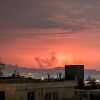
Iran’s defiant choice suggests the road to resolution in this conflict could be long. Crude oil markets reacted accordingly on Sunday, rocketing past $100 for the first time since Russia launched its full-scale invasion of Ukraine in 2022.
Khamenei’s selection could be unpopular at home, given that Iranians had taken to the streets to protest economic conditions and call for regime change — prompting a deadly government crackdown — well before the current outbreak of fighting. It also bears a resemblance to a hereditary monarchy, the very system of government that revolutionaries overthrew in 1979.