Centuries before the Inca, Peru’s wealthy imported parrots from afar


The parrots’ colorful feathers, blue, green and red, were THE status symbol, “essential for communicating status, power, and cosmology,” as Olah and colleagues put it. In the highlands of the Andes, the Wari – and later the Incas – imported millions of brightly feathered rainforest birds over several centuries. On the coasts, the Moche and Nasca cultures did much the same thing.
Parrot feathers feature in headdresses and tunics made from thousands of feathers sewn onto cotton fabric. The birds themselves appear in tombs and temples as mummified offerings, and they have been carved and painted on pottery dating back centuries.
Parrot feathers on a handful of funerary headdresses from one of the only intact, unlooted tombs left at Pachacamac recently indicated that the Ychsma were linked to a trade network that once connected vast swathes of two continents over hundreds of miles.
Based solely on the parrots and their feathers, archaeologists knew there must be connections stretching from the Amazon basin west to the coastal deserts of Chile and Peru and north to Mexico and the southwestern United States. But the details of this trade – including how live parrots eventually crossed one of the world’s most formidable mountain ranges – remained unclear in the centuries before the rise of the Inca Empire and its imperial road networks.
Until recently, archaeologists and historians assumed that the period between the breakup of the Wari Empire and the rise of the Incas was primarily a time when small kingdoms and confederations, like Ychsma and its neighbors, bickered and exercised influence that did not extend much beyond their own region. But based on parrot feathers, these inter-empire Andean cultures actually maintained complex, prosperous, and highly sophisticated trading relationships without the need for a system imposed by a central imperial government.
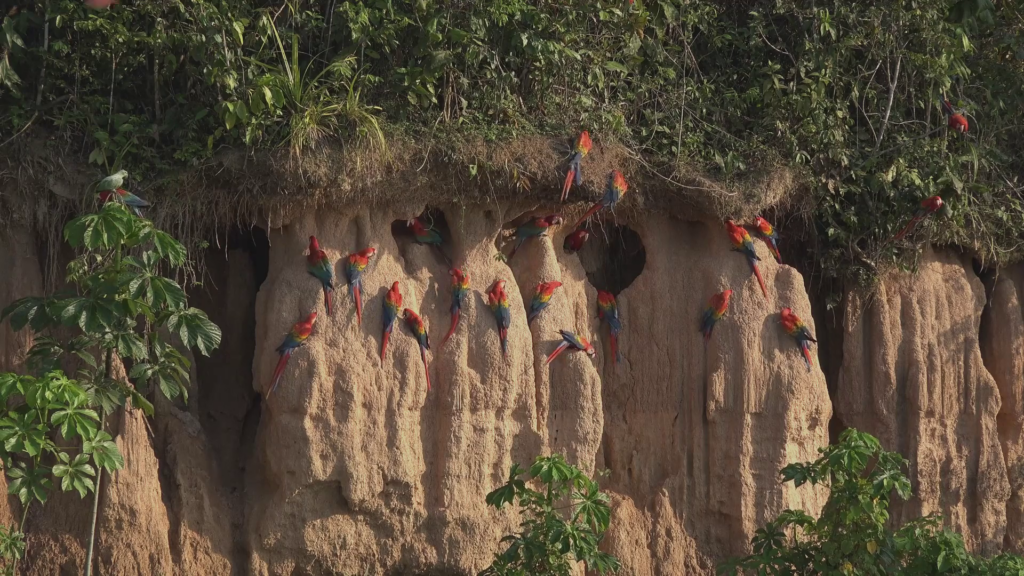
Macaws hang out in the Peruvian Amazon.
Credit: Balazs Tisza
Macaws hang out in the Peruvian Amazon.
Credit: Balazs Tisza
Born in the rainforest, raised in the desert
The headdress’s feathers came from four species of parrots: scarlet macaws, red and green macaws, blue and yellow macaws, and mealy amazons. (The latter are cute little green guys who really deserve a prettier name; “mealy” is apparently a reference to “powdered fluff,” grains of keratin formed by the disintegrated tips of their feathers.) All live in the lowland rainforests and palm swamps of the Amazon basin; Peru’s coastal deserts are virtually the opposite of their usual humid, lush habitat.


