Can courts stop Trump’s mass immigration arrests around L.A.?


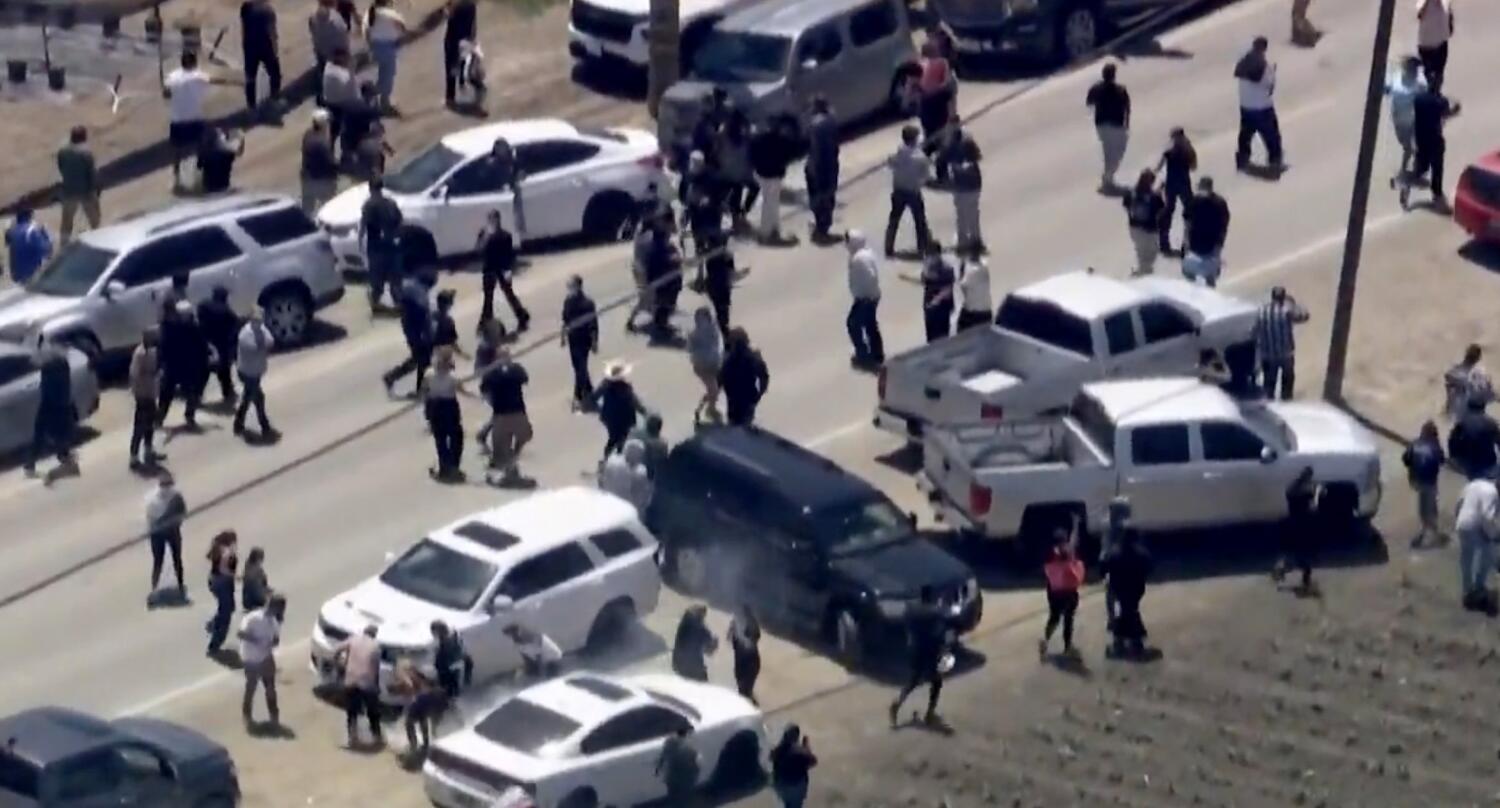
There have been many legal challenges to the immigration of President Trump across California, which led to at least 3,000 arrests.
But a trial has the potential to considerably modify politics.
The decision
A coalition of private rights groups and private lawyers continued the federal government, contesting the cases of three immigrants and two American citizens has been swept away in chaotic arrests that have aroused many demonstrations since early June.
Friday, the American district judge Maame Ewusi -Mensah Frimpong, appointed by President Biden, temporarily blocked federal agents in the Southland to use racial profiling to carry out immigration arrests after finding sufficient evidence that agents used the race, the standard of a person or their location, and their language to form “reasonable suspicions” – legal standard necessary to hold an individual.
Frimpong judged that the use of breed, ethnicity, language, emphasis, location or employment as a pretext for the application of immigration is prohibited by the 4th amendment, which protects against searches and unreasonable seizures by the government.
The order covers the counties of Los Angeles, Riverside, San Bernardino, Orange, Ventura, Santa Barbara and San Luis Obispo.
The judge also ordered that all those who are detained in a downtown detention center known as B-18 are granted at 24 hours to lawyers and a confidential telephone line.
On Monday, the administration asked a federal court of appeal to suspend the ordinance of the judge blocking the traveling patrols, allowing him to take up raids in the seven counties of California.
“It is untenable for a district judge of” restructuring operations “of the application of federal immigration,” said the call. “This judicial control cannot be allowed to stand up.”
What experts say
Legal experts say that it is difficult to say how the federal government will succeed in obtaining a stay on temporary order, given the current political climate.
“This is different from many other types of Trump disputes because the law is so clear in the factual conclusion by the district court,” said Erwin Chemerinsky, Dean of the Berkeley School of Law. “So, if you follow the basic legal principles, this is a very low case for the government on appeal, but it is so difficult to predict what will happen because everything is so ideological.”
In the past, the legal researchers say, it would be extremely rare for a court of appeal to weigh on such an order. But recent events suggest that it is not outside the area of the possibility.
The courts supported Trump’s immigration policies in other cases.
- In June, the United States Supreme Court ruled in favor of authorizing it the federal government to expel criminals sentenced to “third countries” even if they have no prior link with these countries.
- This same month, he also ruled 6 to 3 to limit the ability of federal district judges to issue orders at the national level blocking the policies of the president, which was often a control of executive power.
- In June, the 9th Circuit Court of Appeals decided to leave the troops in Los Angeles in the hands of the Trump administration while the objections of California were disputes before the Federal Court, judging that the president had a broad – but not “invisible” – to deploy the army in American cities. California had continued the deployment.
This is not an easy case for the government, said Ahilan Arulanantham, professor of practice and co -director of the Center for Immigration Law and Policy at the UCLA School of Law.
“I think that a thing that makes this case a little more difficult for the government than some of the other cases of ghost docket is that it really affects citizens importantly,” he said. “Obviously, the immigration agent does not know in advance when he sees someone, whether citizens or not citizens or whether they are legally present or not.”
What is the next step?
The Frimpong decision is now on appeal.
The complainants argued in their complaint that immigration agents have stuck the people with brown skin in the parking lots of Home Depot, in car washes and bus stops across southern California in a show of force without establishing reasonable suspicions that they had violated immigration laws. They allege that the agents have not identified themselves, as required by federal law and carried out illegal arrests without a mandate.
Government lawyers have argued in their request that “ethnicity can be a factor supporting reasonable suspicion in appropriate circumstances – for example, if the agents act on advice that identifies this ethnic – even if it would not be relevant in other circumstances,” said lawyers in their request.
Lawyers have declared in the motion that speaking Spanish, being in a particular place or his job “can contribute to reasonable suspicions in at least certain circumstances.”
Government lawyers said that the FRIMPONG injunction was a first step to place the application of immigration under judicial surveillance and was “indefensible at all levels”. They asked the Superior Court to suspend the order while the appeal was heard.
The government also calls on another injunction imposed by a federal judge in the Oriental District of California after the agents of the border patrol stopped and arrested dozens of agricultural workers and workers – including an American citizen – during a day operation in the central valley in January.
This case is likely to be heard later this year.