
Paleontologists analyzing fossils from Ethiopia have described a previously unknown crocodile species that shared the landscape with a hominid species called Australopithecus afarensis. Named Crocodylus lucivenator, the formidable predator may have stalked Australopithecus afarensis at watering holes in the wetlands and woodlands of the Pliocene.
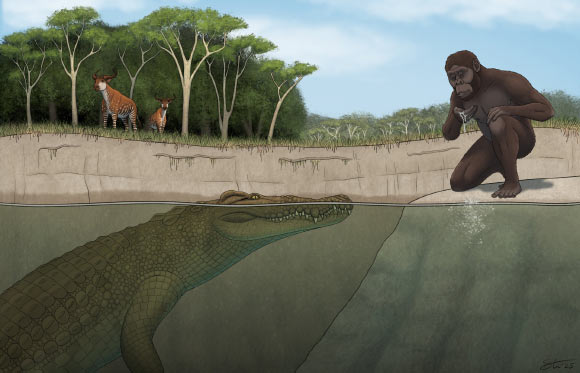
Crocodylus lucivenator overlapped with the famed Lucy and her hominin kin and would have hunted them. Image credit: Tyler Stone, University of Iowa.
Crocodylus lucivenator lived between 3.4 million to 3 million years ago, overlapping the time period and the region in Ethiopia with the famous Lucy and her hominid species, Australopithecus afarensis.
The species ranged from 3.7 to 4.6 m (12-15 feet) in length and weighed between 270 to 590 kg (600-1,300 pounds).
It was an ambush predator, silently submerged in the water, poised to spring on those who came around for a drink.
“It was the largest predator in that ecosystem, more so than lions and hyenas, and the biggest threat to our ancestors who lived there during that time,” said Professor Christopher Brochu, a researcher at the University of Iowa.
“It’s a near certainty this crocodile would have hunted Lucy’s species.”
“I was just blown away because it had this really weird combination of character states.”
Crocodylus lucivenator was identified from 121 specimens — primarily skulls, teeth, and parts of jaws — recovered in the Hadar Formation in the Afar region of Ethiopia.
One fossilized lower jaw bears signs of injury interpreted as pathological changes, possibly the result of combat with another crocodile.
“This specimen had several partially healed injuries on its jaw that suggested it had tussled with one of its peers,” said Dr. Stephanie Drumheller, a paleontologist at the University of Tennessee.
“The fossil record preserves similar injuries in extinct groups as well, so this kind of face-biting behavior can be found throughout the crocodile family tree.”
“We can’t know which combatant came out on top of that fight, but the healing tells us that, winner or loser, this animal survived the encounter.”
Crocodylus lucivenator shows a mix of anatomical features seen in several extinct crocodile species from East Africa.
It shares certain traits with two species known from the Pleistocene, while also retaining more primitive characteristics.
At the same time, the researchers identified a distinctive raised ridge along the top of the snout — a feature similar to those found in modern Neotropical crocodiles and in Late Miocene crocodiles from Libya and Kenya.
Fossils from the Pliocene site of Kanapoi in Kenya, previously assigned to another species, also show a comparable ridge.
The new study indicates that these fossils and Crocodylus lucivenator are closely related to several other extinct crocodiles from East Africa.
A phylogenetic analysis conducted by the scientists supports the idea that this cluster of ancient African crocodiles forms a distinct lineage.
The fossils indicate that Crocodylus lucivenator was the only crocodilian living in the Hadar Formation during the Pliocene.
That contrasts with roughly contemporary deposits in the Turkana Basin, where fossil evidence suggests that as many as four crocodile species lived at the same time. The reason for this difference remains uncertain.
“During the Pliocene, Hadar was composed of a variety of habitats alongside its lake and river systems over space and time, including open and closed woodlands, gallery forests, wet grasslands, and shrublands,” said Dr. Christopher Campisano, a paleontologist at Arizona State University.
“Interestingly, this crocodile was one of only a few species that was able to persist throughout.”
The discovery is reported in a paper in the Journal of Systematic Palaeontology.
_____
Christopher A. Brochu et al. Lucy’s peril: A Pliocene crocodile from the Hadar Formation, north-eastern Ethiopia. Journal of Systematic Palaeontology, published online March 11, 2026; doi: 10.1080/14772019.2026.2614954


