DOJ moves to drop charges against man who burned U.S. flag outside White House


Federal prosecutors in Washington decided Friday to drop charges against a man who was indicted last year after he burned an American flag in front of the White House, after President Trump signed an executive order ordering the DOJ to investigate the flag burning.
Jan Carey was facing two felony counts in federal court in Washington, DC. Neither charge was about burning a flag, specifically: one charge was for starting a fire “not in a designated area and container,” and another was for starting a fire “in a manner that threatened, caused damage, and resulted in the burning of property, real estate, and park resources.”
Both charges carried a fine or prison term of up to six months.
Carey had pleaded not guilty and was contesting his indictment.
The U.S. attorney’s office in Washington did not immediately respond to a request for comment.
“The government’s attempt to criminally punish a protester based on expressive conduct subject to prosecution by executive order poses a serious threat to First Amendment freedoms,” Mara Verheyden-Hilliard, Carey’s attorney, said in a statement provided to CBS News Friday evening. “The Justice Department’s about-face is a crucial vindication of these rights. This case also lays the groundwork for defending those across the country who are the targets of vindictive prosecutions by the Trump administration in an effort to silence and punish viewpoints it does not like. It is a victory for democracy and the First Amendment.”
In video of the flag burning captured by WUSA9, Carey identified himself as a military veteran and said he was protesting the executive order, telling the outlet at the time that he “immediately thought I should go burn a flag in front of the White House and let’s put this to the test.”
Evan Vucci / AP 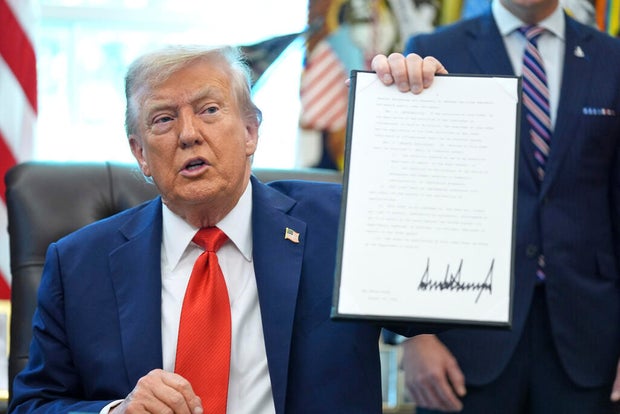
Mr. Trump had signed an executive order directing the DOJ to investigate people who burn the American flag, even though the Supreme Court ruled in 1989 that the First Amendment protects symbolic speech, including flag burning.
The president’s order attempts to circumvent the Supreme Court’s decision. He said federal prosecutors should prioritize prosecuting flag-burning cases that violate other “content-neutral laws,” and said the high court has not excluded charges if burning a flag “is likely to incite imminent unlawful action” or amounts to “fighting words.”
The president has long called for criminal prosecution for burning an American flag, suggesting in 2016 that it should be punished with “loss of citizenship or a year in prison.”


