Pi pops up where you don’t expect it

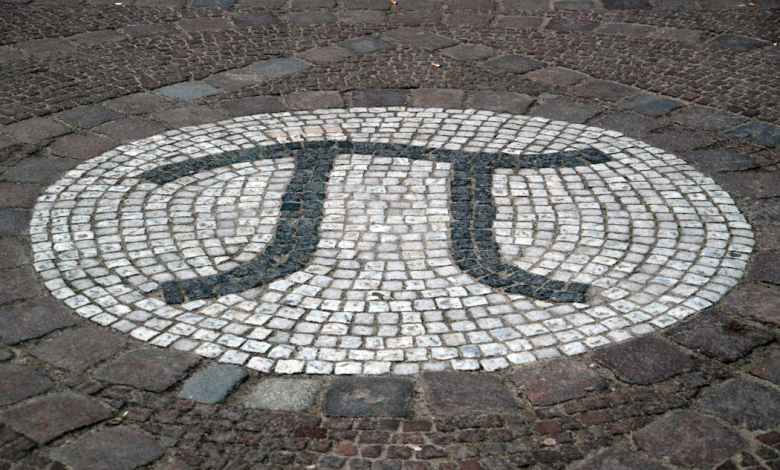
Happy Pi Day, where we celebrate the world’s most famous number. The exact value of π=3.14159… has fascinated people since ancient times, and mathematicians have calculated billions of numbers. But why do we care? Would it really matter if someone got the 11,137,423,895,285th number wrong?
Probably not. The world would continue to rotate (with a circumference of 2πr). What matters about π is not so much the actual value as the ideaand the fact that π seems to appear in many unexpected places.
Let’s start with the expected places. If a circle has radius r, then the circumference is 2πr. So, if a circle has a radius of one foot and you go around the circle in steps of one foot, then you will need 2π = 6.28319…steps to go all the way around. Six steps are not enough and after seven you will be over the hump. And since the value of π is irrational, no multiple of the circumference will be an even number of steps. No matter how many times you take a step of one foot, you will never return exactly to where you started.
From the circumference of a circle we get the area. Cut a pizza into an even number of slices, alternately colored yellow and blue. Arrange all the blue slices facing up and all the yellow slices facing down. Since each color represents half the circumference of the circle, the result is approximately a strip of height r and width πr, or area πr.2. The more slices we have, the better the approximation, so the exact surface must be Exactly πr2.
Pi in other places
You don’t just get π in circular motion. You get π in any oscillation. When a mass swings on a spring or a pendulum swings back and forth, the position behaves like the coordinates of a particle rotating around a circle.
If your maximum displacement is one meter and your maximum speed is one meter/second, it’s like going around a circle of radius one meter at one meter/second, and your period of oscillation will be exactly 2π seconds.
Pi also appears in probability. The function f(x)=e-x²where e=2.71828… is the Euler number, describes the most common probability distribution observed in the real world, governing everything from SAT scores to the locations of darts thrown at a target. The area under this curve is exactly the square root of π.
How did π get in there?! The two-dimensional function f(x)f(y) remains the same if you rotate the coordinate axes. Round objects relate to circles, and circles imply π.
Another place we see π is in the calendar. A normal year of 365 days lasts a little over 10,000,000π seconds. Does this have anything to do with the fact that the Earth revolves around the sun in a nearly circular orbit? Actually, no. It’s just a coincidence, thanks to our arbitrary division of each day into 24 hours, each hour into 60 minutes, and each minute into 60 seconds.
What is this not Coincidence is how day length varies with the seasons. If you plot daylight hours against date, starting from next week’s equinox, you get the same sinusoidal curve that describes the position of a pendulum or a coordinate of circular motion.
Advanced appearances of π
Other examples of π appear in calculus, particularly in infinite series like
1 – (1⁄3) + (1⁄5) – (1⁄7) + (1⁄9) + ⋯ = π/4
And
12 + (1⁄2)2 + (1⁄3)2 + (1⁄4)2 + (1⁄5)2 + ⋯ = π2/6
(The first comes from the Taylor series of the arctangent of 1, and the second from the Fourier series of a sawtooth function.)
From calculus also comes the mysterious Euler equation
eIπ + 1 = 0
connecting the five most important numbers in mathematics: 0, 1, i, π and e, where i is the (imaginary!) square root of -1.
At first glance, this seems absurd. How can you bring a number like e to an imaginary power?! Stay with me. The rate of change of the exponential function f(x)=ex is equal to the value of the function itself. On the left of the figure, where the function is small, it barely changes. On the right, where the function is important, it evolves quickly. Similarly, the rate of change of any function of the form f(x)=eax is proportional to eax.
We can then define f(x)=eix be a complex function whose rate of change is i times the function itself and whose value at 0 is 1. This turns out to be a combination of the trigonometric functions which describe circular motion, namely cos(x) + i sin(x). Since traveling a distance π takes you halfway to the unit circle, cos(π)=-1 and sin(π)=0, so eIπ=-1.
Finally, some prefer to work with τ=2π=6.28… instead of π. Since traveling a distance 2π takes you all the way around the circle, they would write that eIτ = +1. If you find this confusing, take a few months to think about it. Then you can celebrate June 28 by cooking two pies.
This article is republished from The Conversation, an independent, nonprofit news organization that brings you trusted facts and analysis to help you make sense of our complex world. It was written by: Lorenzo Sadun, The University of Texas at Austin
Learn more:
Lorenzo Sadun has received funding from the National Science Foundation.


