3.25-Million-Year-Old Fossil Identified as New Mole Species


Paleontologists have identified a new genre and taupe species (family talpidae) from a partial skeleton discovered on the age of Ninot Camp Pliocene site in Gérona, Spain.
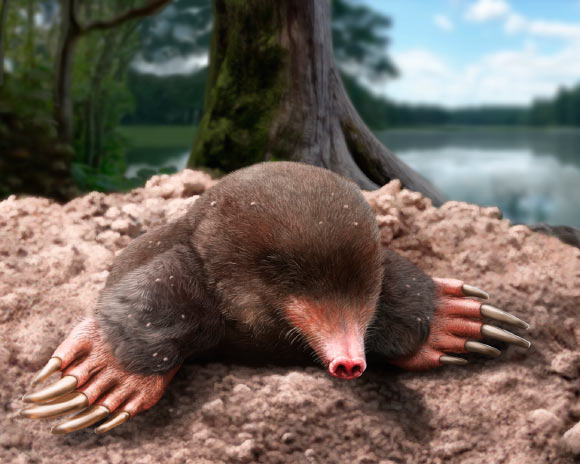
Reconstruction of the life of Vulcanoscaptor Ninoti. Image credit: Jesús Gamarra / Iphus-Carca.
Newly identified species, named Vulcanoscaptor Ninotiis a excavated mole that lived in what is now Spain about 3.25 million years ago.
The animal’s fossilized skeleton was found in 2010 on the Camp Dels Ninots site in Gérona, Spain.
“This specimen preserves the mandible with a complete dentition, part of the torso and several bones of previous members and posterior members, many of them still in anatomical connection,” said Dr. Marc Furió, researcher at the Universitat Autònoma in Barcelona and at the Cataà Institut de Paleontologia Miquel Crusafont (Iphs-Cerca) and his colleagues.
“The exceptional preservation state is extremely rare in small mammals such as moles and makes this specimen one of the oldest and most complete ever found in Europe.”
“The fossil represents the most complete taupe fossil known to date from the Pliocene of Europe and provides valuable information on the evolutionary history of talpids.”
The fossil was partially anchored in a very compact block of sediment and was extracted in its entirety during excavation.
To examine it in detail without damaging it, paleontologists used high-resolution micro-composed tomography (microcht), which allowed a precise three-dimensional reconstruction of the skeleton.
“With the microcht, we were able to analyze extremely small and delicate structures – such as the phalanges and the teeth – which would have been almost impossible to study otherwise,” said Dr. Adriana Linares, researcher at Iphs -Cerca.
“This allowed us to identify unique anatomical characteristics and to integrate them into a robust phylogenetic analysis.”
The structure of Vulcanoscaptor NinotiThe forearm and the front members revealed a high degree of adaptation to an underground lifestyle.
“The humerus is particularly robust, with prominent ridges and areas extended for muscle attachment, while the phalanxes suggest strong excavation capacities,” said Dr. Linares.
“However, the fact that this individual was kept in lake sediments and in the lateral position raises the possibility that he also had aquatic locomotion capacities.”
“We cannot yet confirm this with certainty, but there are modern moles which are powerful diggers and also excellent swimmers.”
According to the team, Vulcanoscaptor Ninoti belonged to the Scalopini, a tribe of moles which are today in North America and in certain parts of Asia.
This discovery of the European Pliocene site suggests a much more complex evolving and paleogeographic scenario than supposed before.
“The description of Vulcanoscaptor Ninoti Confirms that the evolutionary history of the moles was much more dynamic than we thought before, involving any intercontinental dispersions and an underestimated anatomical diversity, “said the authors.
“It also highlights the importance of exceptional fossil sites in the documentation of species rarely preserved in the fossil file, such as small mammals.”
“Despite its clearly fossive morphology, this mole is closely linked to existing North American species from the Genres Scapanus and Scalopus, which indicates a much more complex evolving history for these animals that we had imagined,” added Dr. Furió.
“His presence in Europe suggests passing transcontinental migrations of moles of beauty, which questions the hypothesis that these are mammals with low dispersion capacity.”
The team’s article was published this month in the newspaper Scientific relationships.
_____
A. Linares-Martín and al. 2025. An unexpected scalopini taupe (talpidae, mammal) of the Pliocene d’Europe highlights the phylogeny of talpids. SCI REP 15, 24928; DOI: 10.1038 / S41598-025-10396-1