
Chemical clues preserved in the teeth of straight-tusked elephants (Palaeoloxodon antiquus) from the 125,000-year-old site of Neumark-Nord in Germany suggest these massive animals traveled hundreds of kilometers — and that Neanderthals may have deliberately hunted them at the site.
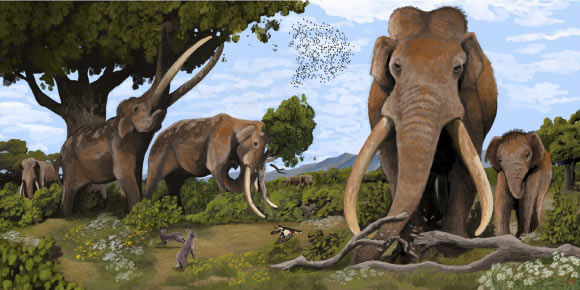
Straight-tusked elephants (Palaeoloxodon antiquus) were the largest land mammals of the European Pleistocene. Image credit: Hodari Nundu, CC-BY-4.0.
“The straight-tusked elephant was an iconic species of the European Pleistocene Interglacial ecosystem, sharing the landscape with Neanderthals during the warmer periods of the Middle and Late Pleistocene,” said Dr. Elena Armaroli, a postdoctoral researcher at the University of Modena and Reggio Emilia, and colleagues.
“Its role as a resource for hominin populations has long been acknowledged, with archaeological findings demonstrating Neanderthal use of elephants as a source of food and their bones for tool making across Europe.”
“Until recently, direct evidence that the straight-tusked elephant was actively hunted, rather than scavenged, remained scarce and debated.”
In the new study, the authors analyzed the molars of four straight-tusked elephants found at the Neumark-Nord site in northeastern Germany.
Strontium isotope analyses along the teeth’s growth axis showed that the animals had spent several years in different regions of Europe.
“Thanks to isotope analyses, we can trace the movements of elephants almost as if we had a travel diary that has been preserved in their teeth for more than one hundred thousand years,” Dr. Armaroli said.
“Some of the elephants we studied were animals that did not stay in just one area,” added Dr. Federico Lugli, also from the University of Modena and Reggio Emilia.
“Their teeth show that they traveled very long distances — up to 300 km — before reaching what is now Neumark-Nord.”
“This allows us to reconstruct their home ranges and understand how these animals used the landscape.”
The researchers also identified the sex of the four elephants: three males and one female.
Two of the males show isotope signatures that differ significantly from those expected for local bed rocks in the area of Neumark-Nord.
This suggests that the males, much like modern elephants, ranged over larger territories than the females.
“The concentration of remains and the isotope profile of the animals suggest that Neanderthals did not kill the elephants merely when a favorable opportunity arose,” Dr. Armaroli said.
“Everything points to organized hunting in which even such enormous prey animals could be deliberately targeted.”
“For this, Neanderthals must have known the landscape well, cooperated, and planned.”
“This study also marks an important methodological advance,” Dr. Lugli said.
“For the first time, paleoproteomics has been applied to European straight-tusked elephants, allowing us to determine the sex of individual animals from proteins preserved in tooth enamel.”
The findings were published March 13 in the journal Science Advances.
_____
Elena Armaroli et al. 2026. Life histories of straight-tusked elephants from the Last Interglacial Neanderthal site of Neumark-Nord (~125 ka). Science Advances 12 (11); doi: 10.1126/sciadv.adz0114


