
Residents across northeastern Ohio received a rude—or at least extremely unexpected—morning wake-up call this morning. According to the National Weather Service (NWS), the loud boom experienced across the region around 9 a.m. EDT on March 17 was most likely the result of a meteor disintegrating as it sped through Earth’s atmosphere.
While multiple videos recorded as far away as Pittsburgh, Pennsylvania, show a bright light streaking across the sky, initial indicators suggested something completely different. Speaking with Cleveland.com, NWS meteorologist Brian Mitchell explained a satellite picture taken by the National Oceanic and Atmospheric Administration’s (NOAA) flagged the visible flash traveling north towards Lake Erie as potential lightning. Given a lack of thunderstorms in the area, a cosmic visitor is more likely the culprit.
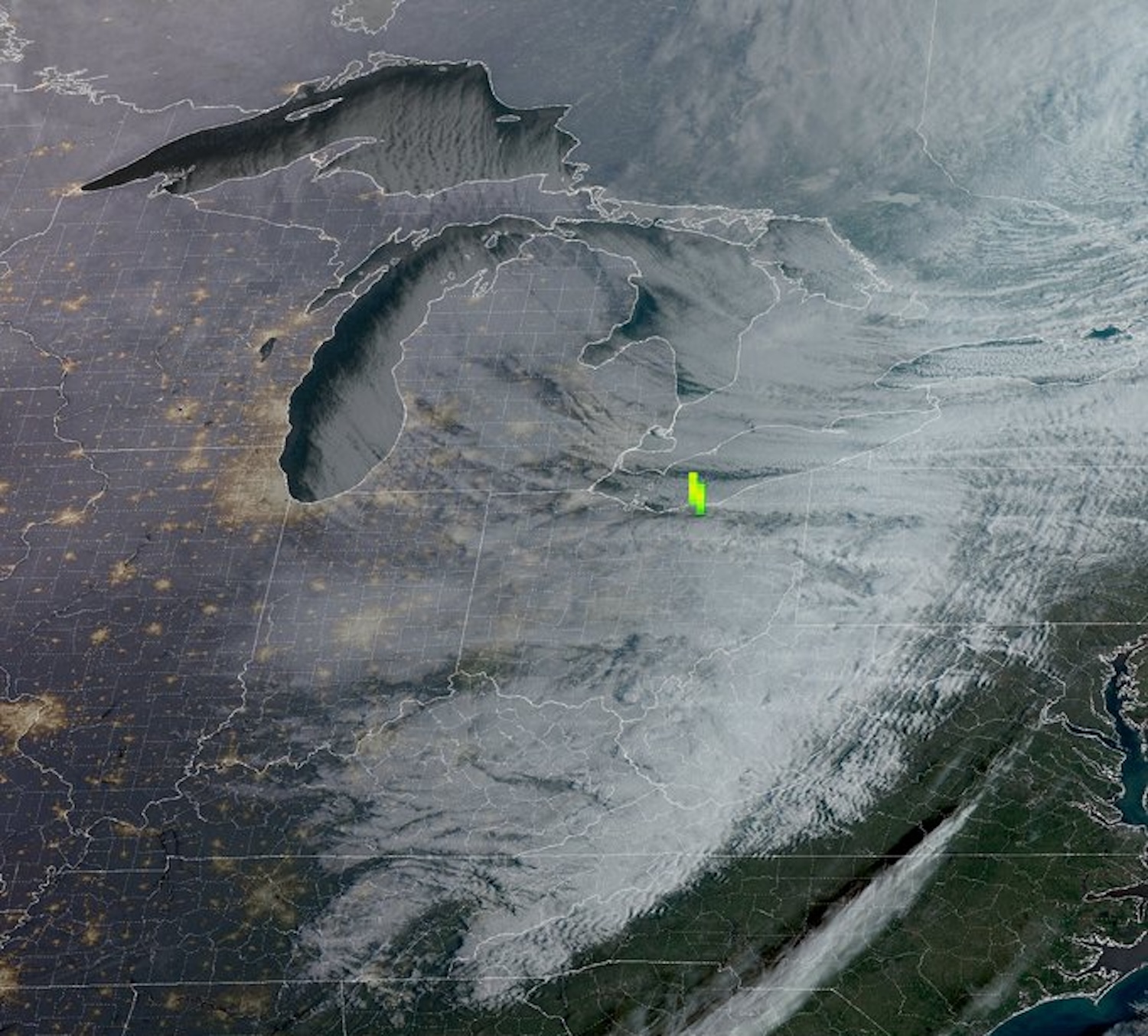
Although known as the Geostationary Lightning Mapper (GLM), NOAA’s satellite isn’t only used to document its namesake weather phenomenon. With the ability to snap 500 images of Earth every second, the GLM is instrumental in helping monitor hurricanes, climate events, wildfires, as well as meteors. This allows meteorologists and emergency responders to track the trajectory, brightness, and speed of incoming space rocks at millisecond precision.
Meteors pass through Earth’s atmosphere every day and almost always burn up before reaching the surface—but this isn’t always the case. Earlier this month, a chunk of meteor likely struck a house in Germany, although no injuries were reported. One of the last major events occurred in 2013, when a roughly six-story-wide meteor exploded approximately 15 miles above Russia. In that case, its resulting sonic boom and shockwave injured an estimated 1,600 people, mostly from issues like shattering windows.
The March 17th meteor, while startling, appears to have been much less severe. The NWS stated it didn’t expect any pieces to survive the final leg of its multimillion-year travel, and any residual pieces almost certainly splashed into Lake Erie.

2025 PopSci Best of What’s New


