FAA tightens helicopter safety rules around major airports : NPR

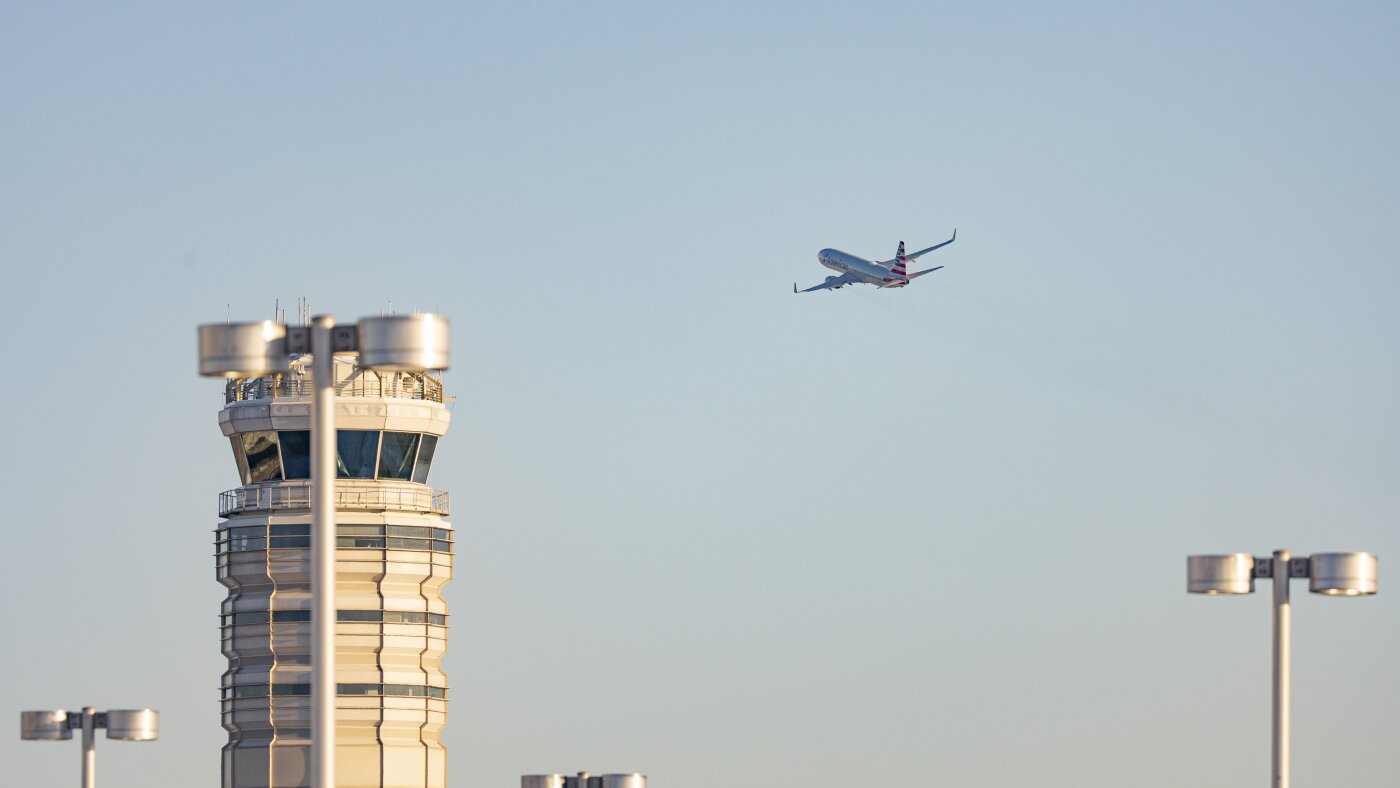

Federal Aviation Administration regulators are tightening safety rules in congested airspace around major airports, suspending the use of visual separation and helicopters. The move comes after an American Airlines plane and a US Army Black Hawk helicopter collided near Washington, DC last year, killing 67 people.
Tom Brenner/Getty Images
hide caption
toggle caption
Tom Brenner/Getty Images
WASHINGTON — Federal Aviation Administration regulators are tightening safety rules in congested airspace around major airports, suspending the use of visual separation between helicopters and planes, the agency announced Wednesday.
The announcement comes more than a year after a U.S. Army Black Hawk helicopter collided with an American Airlines regional jet near Ronald Reagan Washington National Airport, killing 67 people.
The FAA also identified two recent incidents that led to a policy change, including an incident involving a commercial plane and a police helicopter at San Antonio International Airport in February, and a second incident in March involving a Beechcraft 99 and a helicopter at Hollywood Burbank Airport, near Los Angeles.
“We proactively mitigate risks before they impact the traveling public,” FAA Administrator Bryan Bedford said in a statement. “We identified an over-reliance on see-and-avoid operations by pilots who contribute to security events involving helicopters and aircraft.”

Visual separation is a procedure by which air traffic controllers alert pilots of the presence of a nearby aircraft and instruct them to avoid the other craft through visual observation.
The FAA says its data analysis found that visual separation is “not a sufficient safety mitigation tool” in high-traffic areas. In the future, the FAA says air traffic controllers must instead rely on radar to actively manage planes to keep them separated at specific distances.
In its final report on the mid-air collision near Washington, the National Transportation Safety Board blamed the accident in part on the air traffic system’s “overreliance on visual separation” as well as the helicopter crew’s “lack of effective pilot-enforced visual separation.”
Investigators say the helicopter crew likely never saw the plane before the collision, which resulted in the deadliest U.S. air disaster in decades.