
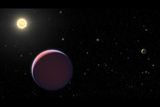
Located roughly 2,500 light-years from Earth, the Kepler-51 star system includes four planets. At least three of these planets are so weird that they defy easy categorization. That’s because while these planets are gas giants the size of Saturn, their mass is far smaller. While Saturn’s mass is equivalent to approximately 95 Earths, the Kepler-51 planets’ mass is roughly the same as our planet.
A new study has delved into the unusual planetary conditions that have created these planets. The paper was published in the Astronomical Journal.
The study focuses on the least dense planet in the Kepler system, Kepler-51d. The work has concluded that the planet is shrouded in a thick haze that obscures its features.
“We think the three inner planets orbiting Kepler-51 have tiny cores and huge atmospheres giving them a density akin to cotton candy,” said Jessica Libby-Roberts, study co-author and astronomer at the University of Tampa, in a statement.
Read More: A Clingy, Cotton Candy Exoplanet Is Causing Its Host Star to Flare Up
The Mysterious Gas Giants
Saturn and Jupiter are the true gas giants in our Solar System (Neptune and Uranus have different elemental constitutions and are classed as ice giants). Gas giants usually form when their dense cores drag in gas.
The gravitational force of the sun would likely yank these gases away from Saturn and Jupiter if they weren’t located so far from the star. But Kepler-51d is really close to its star — around the distance Venus is from the Sun — and has no dense core. To solve the mystery of how the planet formed, the team used NASA’s James Webb Space Telescope (JWST) to study it in greater detail.
Viewing Kepler-51d’s Fingerprints
Kepler-51d is so far away from Earth that the JWST can’t view it directly. But the telescope can study how light from its star is filtered as it passes through the planet’s atmosphere. This can produce a “fingerprint” of the planet’s atmosphere, said Libby-Roberts.
Kepler-51d’s fingerprint, however, was unusually uniform, suggesting that something in the planet’s atmosphere is blocking finer details.
“We think that the planet has such a thick haze layer that is absorbing the wavelengths of light we looked at, so we can’t actually see the features underneath,” said Suvrath Mahadevan, an astronomer at Pennsylvania State University and study co-author, in a statement.
“It seems very similar to the haze we see on Saturn’s largest moon, Titan, which has hydrocarbons like methane, but at a much larger scale. Kepler-51d seems to have a huge amount of haze — almost the radius of Earth — which would be one of the largest we’ve seen on a planet yet,” Mahadevan added.
Much More to Learn About These Oddball Planets
The analysis ruled out some potential alternatives for the planet. If the planet were tilted and had rings, these might artificially inflate the planet’s apparent size from Earth. But the team’s analysis suggested that such rings would have to be short-lived and set at a precise angle to produce the data the JWST recorded. Instead, a thick layer of haze is the most likely explanation.
“If we could observe the planet at even longer wavelengths, such as with JWST’s Mid Infrared Instrument, we might be able to detect the materials that would be in a ring or see the full extent of the haze layer,” said Libby-Roberts.
For now, the team hopes that analysis of the nearby Kepler-51b could answer some of their outstanding questions about these unusual puffy planets.
“We are still left with a ton of questions about how this planet — and the other planets in this system — formed. What is it about this system that created these three really oddball planets, a combination of extremes that we haven’t seen anywhere else?” said Libby Roberts.
Read More: A Cold Earth 146 Lightyears Away Could Be Habitable
Article Sources
Our writers at Discovermagazine.com use peer-reviewed studies and high-quality sources for our articles, and our editors review for scientific accuracy and editorial standards. Review the sources used below for this article:


