Pittsfield Township — Women imprisoned at the state’s only women’s prison, which has been under fire recently for its poor conditions, have asked the governor, legislators and Michigan’s corrections department to consider implementing a plan to eventually release 800 women, or nearly half the prison’s population, over three years.
In an open letter sent earlier this month, inmates of Huron Valley Correctional Facility in Pittsfield Township call on Gov. Gretchen Whitmer to expedite clemency requests from 100 prisoners and legislators to pass a bill that would allow for victims of violent crimes to seek resentencing.
The letter also asks the state to create more programming for women that would allow the prison to address poor conditions and create pathways for “healing and restoration.”
The letter comes just weeks after a state House oversight committee heard testimony last month about Huron Valley’s conditions. Prisoners, advocates and former staff testified in February about poor conditions at the prison, including persistent mold and a lack of medical care. The prison houses about 1,800 women, but has a capacity for 2,000.
One woman incarcerated at Huron Valley has mold growing in her lungs and visibly out of her ears, state Rep. Laurie Pohutsky, D-Livonia, said at the hearing. Another woman died of sepsis after an abscessed tooth became infected and the infection traveled to her heart, said Pohutsky and the woman’s family.
The Michigan Department of Corrections did not respond for comment on the women’s proposal, but said after the February oversight hearing that the department “has established itself as a national leader in evidence-based corrections.”
“Over the last decade, the department has safely reduced the prison population, including the population at Women’s Huron Valley, worked to modernize facilities and operations, increased opportunities that support long-term self-sufficiency and achieved the lowest recidivism rates in our state’s history,” said Jenni Riehle, public information officer for MDOC.
By cutting Huron Valley’s population in half as part of a three-phase plan, the women argue it will reduce strain on the water, electricity, plumbing, sewage and waste systems and allow for remodeling towards a single-cell occupancy facility to begin immediately.
“We know that the implementation of this… initiative is the most viable solution because the areas of concern which need to be addressed to ensure that WHV is habitable and suitable for creating pathways toward wellness, transformation and reunification can and will be corrected once the facility returns to the single cell occupancy that the lay out design was intended for,” the women wrote in their letter.

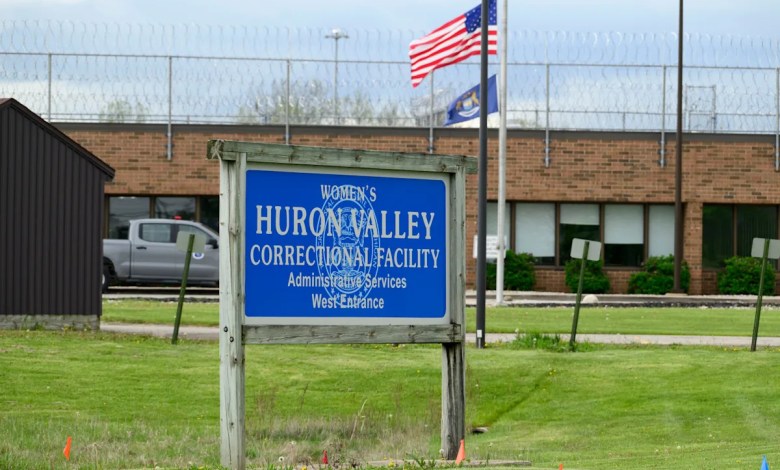
The Women’s Huron Valley Correctional Facility, in Ypsilanti, May 6, 2025.
LaWanda Hollister, who spent 34 years at Women’s Huron Valley and was released in 2020, said she has been through the other changes the state’s corrections department has tried, like moving women to a different prison, and they didn’t work. She said the department has focused too much on punishment and not enough on rehabilitation.
“There are a lot of things that we do today that are caused because of things that happened in our past. This is an opportunity for Michigan to recognize that and show grace and mercy and forgiveness and allow people to move forward,” Hollister said. “This is about moving forward, rehabilitation and some type of empathy. This cannot be about punishment.”
More: Michigan lawmakers hear testimony of mold, mistreatment at prison for women
The first phase of the inmates’ proposal calls on Whitmer to immediately expedite clemency for a list of 100 inmates who have “exhibited phenomenal transformative participation” in completing educational and program opportunities offered within and beyond Huron Valley before the end of her term this year, according to the letter.
Whitmer’s office did not respond for comment about the women’s proposal.
Issuing an executive order and releasing 100 women is something Whitmer could do “very easily,” said Natalie Holbrook-Combs, the program director at the American Friends Service Committee, a nonprofit that aims to work toward systemic change and justice.
“It’s doable, she just has to have the courage to do it,” Holbrook-Combs said. “We are just encouraging them to do more and to be courageous and to use this act of mercy.”
The release of 100 women would allow for the Michigan Department of Corrections to turn corrections officer jobs into community-based jobs that would support women as they return to the community, according to the women.
Phase one would also include the development of more programming, including one that would allow incarcerated moms to stay connected to their children, according to the letter. There is a parenting program already in place at Huron Valley, so less women in the prison would allow for enhanced programs, the women said.
During this period, the legislature should also to pass a Survivor’s Justice Act or something similar, where a woman who experienced harm like domestic violence or sexual abuse could bring their case forward for resentencing with mitigating factors, Holbrook-Combs said.
“Around the country right now, various states are adopting this legislation because they understand women have experienced extreme violence in their histories, more so than men, and need a valve toward release that addresses what landed them there (in prison),” Holbrook-Combs said.
Pohutsky said the act the women are seeking seeks to decrease the number of people who are incarcerated because they were abused and fought back against their abuser, but their actions did not meet the standards for self-defense.
Pohutsky said practically speaking, she is supportive of the proposal — for a Survivor’s Justice Act and for reducing the population of incarcerated people in the state — but she does not think it is politically possible right now.
When Speaker of the House Rep. Matt Hall, R-Richland Township, started his term in January 2025, he wrote on Facebook that he would not “let criminals out of jail early,” noting those policies were “dead on arrival in the state House.”
Pohutsky said Hall is taking a tough-on-crime approach, and nothing has indicated he’s changed his mind on that so far. Hall did not to respond to request for comment.
“I think (a bill like this) is possible from a policy standpoint, but the political pieces at play right now do not make that possible,” Pohutsky said.
Phase two would go into effect in January 2027, as the next governor continues the work started in phase one, the women said.
“By 2027, a presumption of commutation would be in full effect, and the parole board (or a new review board) would have an entire contingent of members dedicated to reviewing women’s cases with a goal towards release,” the women wrote.
The women said their goal in the proposal is for another 350 women to be released by the end of 2027.
The women also would like the state to launch Healing Homes Farm by August of this year, which would provide housing with wraparound services and peer-led programming for women who have been imprisoned for a long time when they return to the community. By the end of 2027, the women proposed the home would have space for 10 to 15 women.
In the third phase, the state would fully revamp how the women’s prison is managed, the women said.
kberg@detroitnews.com
This article originally appeared on The Detroit News: Michigan women’s prison inmates propose release plan