Ancient Roman Machine Gun-Like Weapon May Have Damaged Pompeii’s Walls During Siege


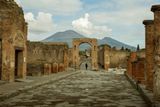
Before Pompeii was engulfed by volcanic ash, its walls could have been struck by an ancient “machine gun” while the city was under siege. With a third of Pompeii still buried under volcanic debris from the eruption of Mount Vesuvius in 79 CE, archaeologists continue to uncover evidence of the city’s turbulent past, including battle damage to its walls.
A study recently published in Heritage offers a compelling hypothesis to explain several peculiar impact marks along the northern portion of Pompeii’s fortified walls: this damage potentially came from a barrage of metal-tipped projectiles launched by a polybolos, a repeating ballista that could have been used to kill Pompeii’s defenders during the siege of the city in 89 BCE.
Learn more: Ancient Romans gave tiny bronze skeletons to party guests as a morbid reminder to live life
Roman siege of Pompeii during the Social War
Most people think of Pompeii as an iconic Roman city, but it wasn’t always inhabited by the Romans. The Roman Republic took control of the city during the Social War of 91–88 BCE, when it fought to subdue its Italian allies (or Company) who wanted either full Roman citizenship or independence, according to EBSCO.
In 89 BCE, an army led by the Roman general and statesman Sulla marched on Pompeii, one of several cities rebelling against Rome. Hoping to cut Pompeii off from resources and force a surrender, Sulla began a siege of Pompeii, according to the Pompeii Archaeological Park.
Ultimately, despite a valiant defense by the inhabitants of Pompeii, Sulla captured the city and added it to the ranks of Rome.
Evidence of a Polybolos
The damage caused to Pompeii by Sulla’s siege is still visible today; the walls surrounding the city are marked with projectile imprints. Some marks are clearly circular and represent projectiles launched by skilled slingers and ballistas (Roman catapults). But other small marks between the gates of Vesuvius and Ercolano have caught the attention of archaeologists: these are four-sided and appear “fan-shaped”.
The researchers behind the new study believe these marks may have come from a polybolos, which fired a rapid succession of twisting-propelled darts.
Digital readings of the walls with the four-sided markings allowed the researchers to create 3D models of the impacts. From these models, they were able to reconstruct what the projectiles might have looked like. The shape of the projectiles, they found, matches what a Roman polybolos would have fired, based on comparisons with pyramid dart heads from museum collections.
Researchers hypothesize that during the siege of Pompeii, polybolos may have been used to strike archers emerging from the bases of the towers or defenders who briefly exposed themselves higher up in the fortification. The ancient weapon was not used to tear down walls; therefore, the marks observed today are simply the result of projectiles missing their Pompeian targets.
Clues from old engineers
The researchers also examined ancient literature, particularly descriptions of polybolos written by the Greek engineer Philo of Byzantium in the 3rd century BCE. Philo described the weapon – which was powered by twisting bundles of natural fibers – as being virtually useless when it came to hitting multiple targets, as its rapid-firing projectiles could not spread well. However, it was extremely effective at hitting a single target multiple times.
The Roman army may have adopted the polybolos from innovations originating on the Greek island of Rhodes, where engineer Dionysius of Alexandria is believed to have invented the weapon several centuries before the siege of Pompeii. Shortly before the siege, Sulla was even governor of the province that included Rhodes, known as a hub of “engineering excellence” in ancient times, according to the study.
“It is therefore plausible that Sulla – a politically astute and technically informed commander – may have acquired or encouraged Rhodian innovations, deploying an improved multi-stroke engine during the siege of Pompeii between summer 89 and winter 88 BC,” the authors conclude.
Learn more: The largest known private baths probably appealed to the guests of ancient Pompeii
Article sources
Our Discovermagazine.com editors use peer-reviewed research and high-quality sources for our articles, and our editors review the articles for scientific accuracy and editorial standards. See the sources used below for this article:


