When health insurance is as expensive as a mortgage payment : NPR

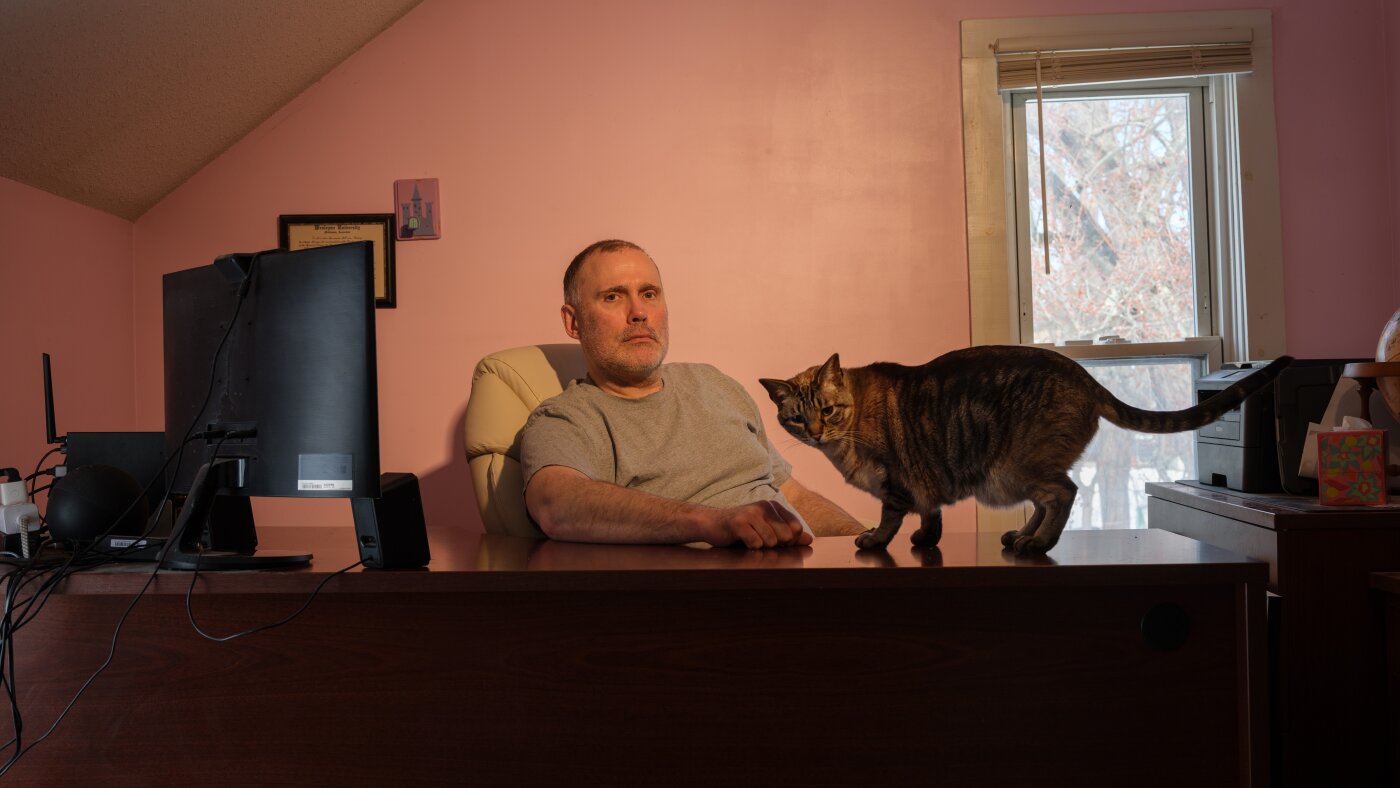

Ken Warner sits with his cat Ostara in his office in Manchester, Connecticut, where he writes science fiction and fantasy novels. Warner and his wife, Parveen Vohra, who is a therapist, buy their insurance on HealthCare.gov.
Jarod Lew for NPR
hide caption
toggle caption
Jarod Lew for NPR
Parveen Vohra and Ken Warner have had an expensive year in 2025. They are in their 50s and live in Manchester, Connecticut, with two dogs and three cats. They are both self-employed, Vohra as a mental health counselor and Warner as a freelance science fiction and fantasy author.
“We needed a new roof and boiler the same year as [two] Surgeries – I had a hip replacement and Parveen had to have eye surgery,” says Warner. The couple gets their health insurance through the Affordable Care Act marketplace. Even with a good plan, they had to pay out of pocket.
To cover these expenses, they wiped out one of two small retirement accounts they had from their previous jobs before becoming self-employed.

This year also promises to be expensive. When enhanced federal subsidies expired for ACA plans, the cost of their premiums skyrocketed.
“By 2025, we were paying a total of $630 a month to cover both medical costs, and that was $100 more for dental care,” Warner says. “Now we’re over $2,500.”
To be precise, $2,531.07 per month. This figure, he says, is insane. This is the average cost of a mortgage payment in the United States. “We can’t afford it – who can afford it?” » asks Warner.
They hoped Congress would reach an agreement to extend the subsidies, and for a few weeks in January it seemed possible. The House passed a bipartisan three-year extension and senators discussed their own deal. But those efforts ultimately failed, and federal lawmakers are no longer actively working toward a solution.

For Warner and Vohra and millions like them, this means these high premiums are a new reality – an additional expense they have been facing for three months, since January 2026.
Reduce shopping
The Affordable Care Act marketplaces had been growing in popularity for several years. Last year, 24 million people were registered.
When the enhanced subsidies expired, premium costs doubled on average, according to KFF, a nonpartisan health policy research and polling organization.
A new KFF survey of ACA plan members reveals that while seven in ten remain loyal to market coverage, a significant number have downgraded their plan or decided to go without health insurance altogether.

“When we ask people why, what we keep hearing is cost,” says Ashley Kirzinger, director of survey methodology at KFF.
To manage these higher costs, enrollees must make difficult choices, she said.
“More than half said they are reducing some household expenses. This includes people cutting back on groceries or finding additional employment or working more hours,” she says. “A significant share report taking out a loan or increasing credit card debt to cover health care costs.”
There are signs that the number of people dropping coverage could increase as the months go by. “Nearly one in five people say they aren’t even sure they can pay their premiums for the entire year – so they are at risk of becoming uninsured,” she says.
Federal data shows that more than 1 million fewer people had signed up for ACA plans for 2026, as of mid-January.
I wonder what will be left to live on
Warner and Vohra met a few months ago to review their monthly budget to find items they could cut. They changed cell phone plans, canceled streaming services and stopped getting help with housework.
“We don’t take vacations, which [are] good mental health practice,” Vohra says. “But to make up for that $2,500 a month…”
“…something has to give,” Warner says.
They’re also trying to increase their income, even though Vohra already works full time at her consulting practice and also takes her 87-year-old mother to doctor’s appointments. Warner is launching crowdfunding for a special edition of one of its epic fantasy books. He has also applied for jobs with health benefits, without success so far.

Ken Warner’s novel, The secret of Gizais the first in a 10-volume series about twins who “are thrust into a war that spans worlds,” according to the book’s description. There is also a letter from Access Health CT on the desk.
Jarod Lew for NPR
hide caption
toggle caption
Jarod Lew for NPR
If Vohra and Warner made less money, they could qualify for subsidies. If they earned more, they might find the unsubsidized premium manageable.
Looming over them is the prospect of additional surgeries – Warner’s other hip and Vohra’s other eye. This leads them to turn to the last remaining retirement account.
“Now we’re wondering, ‘Oh, maybe we need to exploit [that]'” Vohra says. “And this is supposed to be for our 60s, 70s and 80s.”
She says the cost of her mother’s long-term care at a nearby memory center is about $10,000 a month. She wonders how she and Warner will be able to have so much money when they’re older, especially if premiums remain high in the years to come.
“We know that next year there will probably be another 10 to 20 percent increase,” Warner says. “It’s going to get worse – it’s not like it’s a one-off.”
They both say they feel trapped in a broken system. “It’s really been a maddening process to see all of this go backwards,” he adds. “I mean, it seems criminal. It’s like we’re actually being robbed – they’re literally taking money from people like us.”


