NASA Webb, Hubble Share Most Comprehensive View of Saturn to Date


The James Webb Space Telescope and NASA’s Hubble Space Telescope have teamed up to capture new views of Saturn, revealing the planet in surprisingly different ways. Observing in complementary wavelengths of light, the two space observatories offer scientists a richer and more complex understanding of the gas giant’s atmosphere.
Both detect sunlight reflected from Saturn’s banded clouds and mists, but where Hubble reveals subtle color variations across the planet, Webb’s infrared view detects clouds and chemicals at many different depths of the atmosphere, from deep clouds to the thin upper atmosphere.
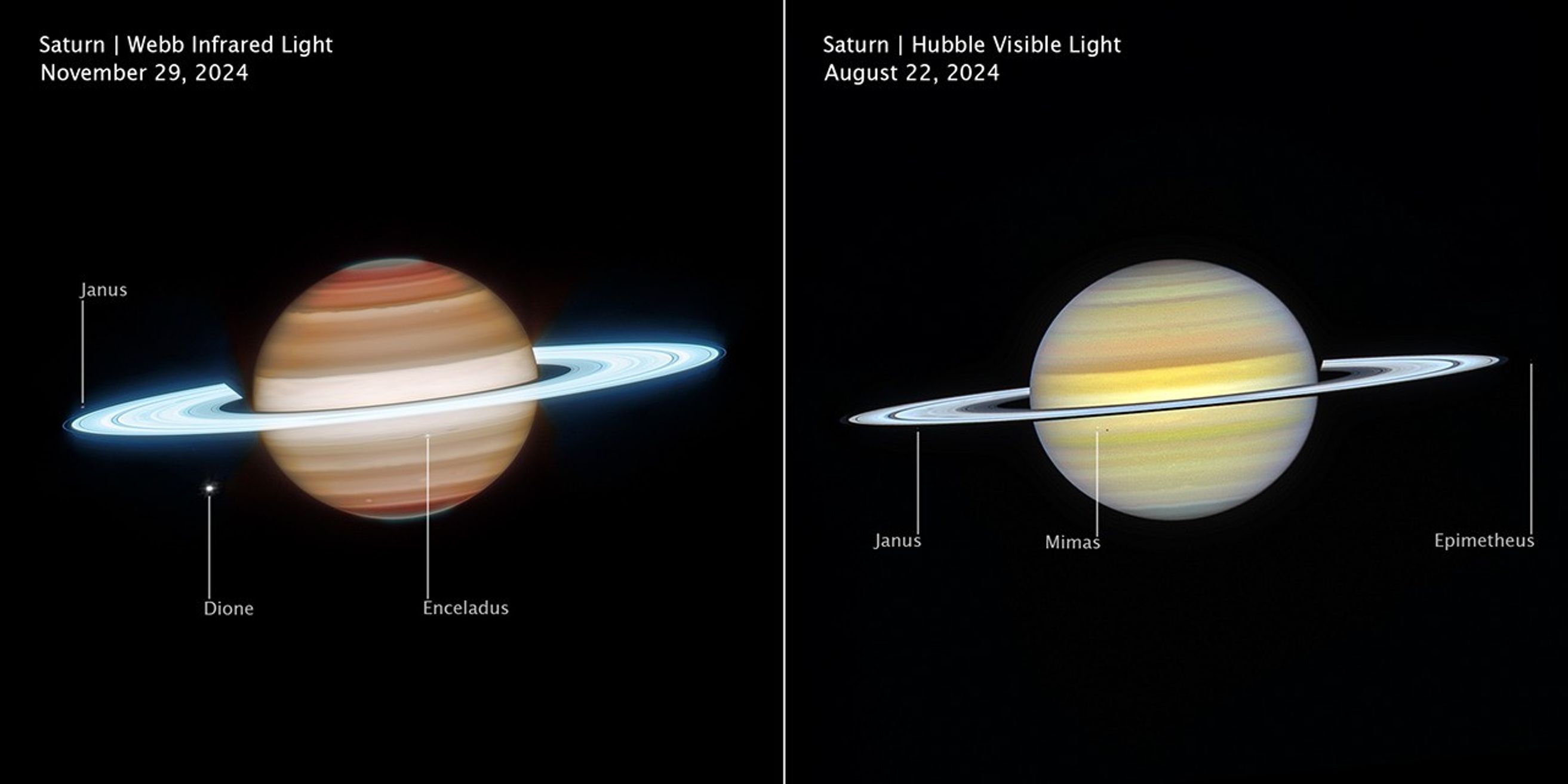
Complementary views of Saturn taken by NASA’s James Webb Space Telescope and Hubble Space Telescope show a dynamic planet with atmospheric features, orbiting moons and bright rings.
Image: NASA, ESA, CSA, STScI, Amy Simon (NASA-GSFC), Michael Wong (UC Berkeley); Image processing: Joseph DePasquale (STScI)
Together, scientists can effectively “slice” Saturn’s atmosphere at multiple altitudes, like peeling the layers of an onion. Each telescope tells a different part of Saturn’s story, and the combined observations help researchers understand how Saturn’s atmosphere works as a connected, three-dimensional system. Both complement previous observations made by NASA’s Cassini orbiter during its study of the Saturnian system from 1997 to 2017.
The Hubble image seen here was captured as part of a more than decade-long monitoring program called OPAL (Outer Planet Atmospheres Legacy) in August 2024, while the Webb image was captured a few months later using the director’s discretionary time.
Newly released images highlight features of Saturn’s charged atmosphere.
In Webb’s image, a long-lived jet stream known as a “ribbon wave” meanders across the northern mid-latitudes, influenced by otherwise undetectable atmospheric waves. Just below, a small spot represents a lingering remnant of the “Great Spring Storm” of 2010 to 2012. Several other storms dotting Saturn’s southern hemisphere are also visible in Webb’s image.
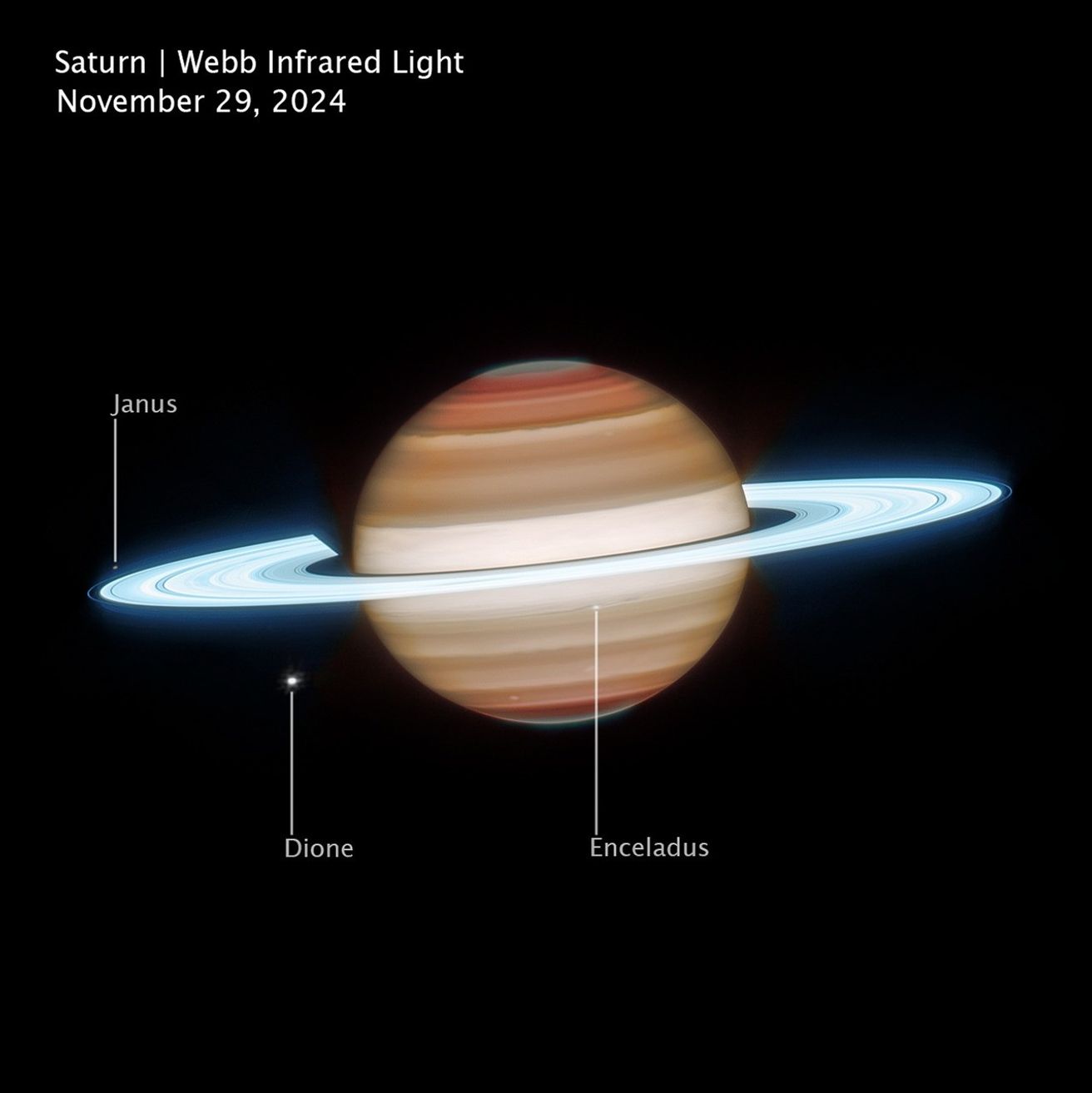
Captured on November 29, 2024, by NASA’s James Webb Space Telescope, this infrared view of Saturn shows its bright ice rings and layered atmosphere. Several moons are visible, including Janus, Dione and Enceladus.
Image: NASA, ESA, ASC, STScI; Image processing: Joseph DePasquale (STScI)

Captured on August 22, 2024, by NASA’s Hubble Space Telescope, this visible-light view of Saturn reveals the planet’s softly banded atmosphere and iconic rings. Several moons are also visible, called Janus, Mimas and Epimetheus.
Image: NASA, ESA, STScI, Amy Simon (NASA-GSFC), Michael Wong (UC Berkeley); Image processing: Joseph DePasquale (STScI)
All of these features are shaped by powerful winds and waves beneath visible cloud cover, making Saturn a natural laboratory for studying fluid dynamics in extreme conditions.
Several of the sharp edges of Saturn’s iconic hexagon-shaped jet stream at its north pole, discovered by NASA’s Voyager space probe in 1981, are also faintly visible in both images. It remains one of the most intriguing weather phenomena in the solar system. Its persistence over decades highlights the stability of certain large-scale atmospheric processes on giant planets. These are likely the last high-resolution images we’ll see of the famous hexagon before the 2040s, as the North Pole enters winter and sinks into darkness for 15 years.
In Webb’s infrared observations, Saturn’s poles appear distinctly gray-green, indicating light emission at wavelengths of about 4.3 microns. This distinct feature could come from a high-altitude aerosol layer in Saturn’s atmosphere that scatters light differently at these latitudes. Another possible explanation is auroral activity, because charged molecules interacting with the planet’s magnetic field can produce light emissions near the poles.
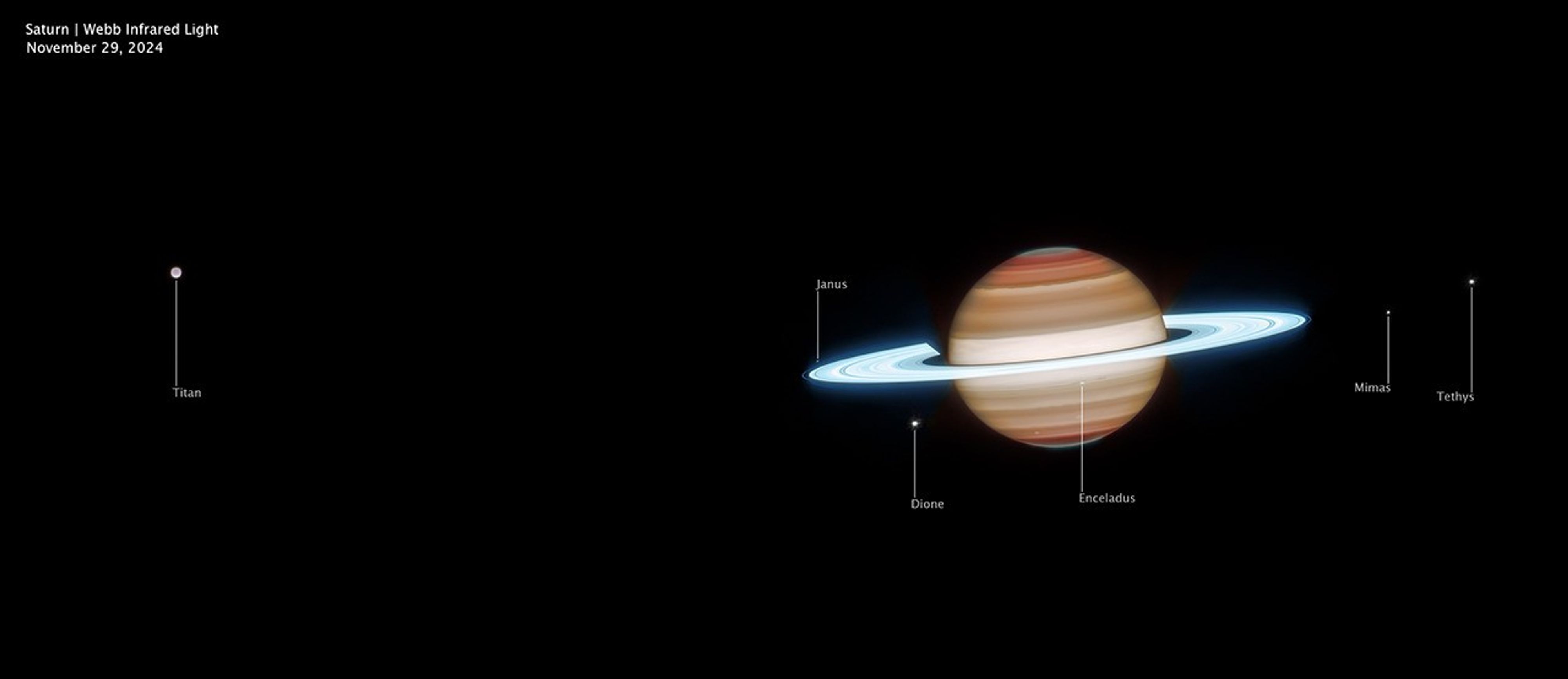
A wider view of Saturn taken by NASA’s James Webb Space Telescope shows six of Saturn’s largest moons, including the largest, Titan, at far left.
Image: NASA, ESA, ASC, STScI; Image processing: Joseph DePasquale (STScI)
NASA’s Hubble and Webb have already explored Saturn’s auroras, provided insight into the spectacular Jupiter auroras also seen with Hubble, confirmed Uranus’ auroras seen in 2011 by Hubble, and detected Neptune’s auroras for the first time with Webb.
In Webb’s infrared image, the rings are extremely bright because they are made of highly reflective water ice. On both images, we see the sunny side of the rings, a little less on the Hubble image, hence the shadows visible below the planet.
There are also subtle features of the rings, such as the radii and structure of the B ring (the thick central region of the rings), which appear differently between the two observatories. The F ring, the outermost ring, appears thin and sharp in the Webb image, while it only glows slightly in the Hubble image.
Saturn’s orbit around the Sun, combined with Earth’s position in its annual orbit, determines the changing viewing angle of Saturn’s face and ring.
These 2024 observations, taken 14 weeks apart, show the planet moving from northern summer toward the equinox of 2025. As Saturn transitions into austral spring and then austral summer in the 2030s, Hubble and Webb will gradually get a better view of this hemisphere.
Hubble’s observations of Saturn over decades have recorded the evolution of its atmosphere. Programs like OPAL, with its annual monitoring, allow scientists to track storms, banding patterns and seasonal changes over time. Webb now adds powerful infrared capabilities to this ongoing recording, expanding what researchers can measure about Saturn’s atmospheric structure and dynamic processes.
The James Webb Space Telescope is the world’s first space science observatory. Webb solves the mysteries of our solar system, looks beyond distant worlds around other stars, and probes the mysterious structures and origins of our universe and our place in it. Webb is an international program led by NASA with its partners, ESA (European Space Agency) and CSA (Canadian Space Agency).
To learn more about Webb, visit:
https://nasa.gov/webb
The Hubble Space Telescope has been operating for more than three decades and continues to make groundbreaking discoveries that shape our fundamental understanding of the universe. Hubble is an international cooperation project between NASA and ESA (European Space Agency). NASA’s Goddard Space Flight Center in Greenbelt, Maryland, manages telescope and mission operations. Lockheed Martin Space, based in Denver, also supports mission operations at Goddard. The Space Telescope Science Institute in Baltimore, operated by the Association of Universities for Astronomical Research, conducts Hubble science operations for NASA.
To learn more about Hubble, visit:
https://nasa.gov/hubble
The following sections contain links to download the images and videos in this article in all available resolutions, followed by related information links, media contacts, and, if available, research materials and Spanish translation links.