‘It’s a workforce issue,’ Nebraska lawmakers say of child care subsidy bill they advanced

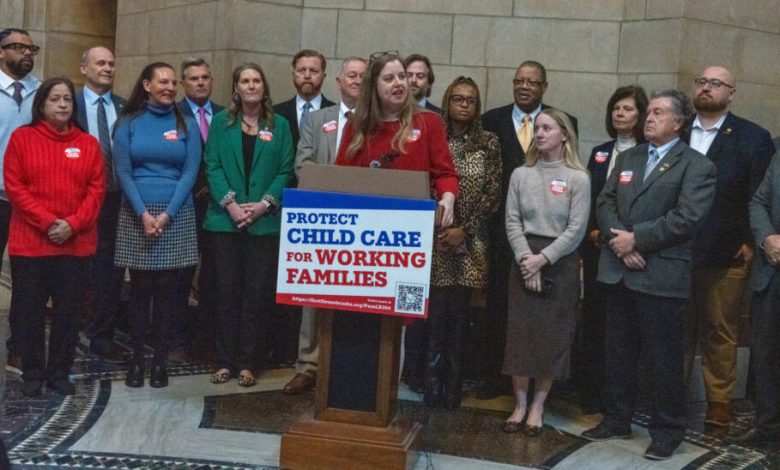
LINCOLN — A proposal that supporters say is key to making Nebraska child care more affordable so more parents can stay in the workforce took a step forward Monday despite objections that businesses, not the government, should bear the brunt of the costs.
Legislative Bill 304 would permanently maintain income eligibility levels for the Nebraska Child Care Subsidy Program at the higher caps set in 2021, during pandemic recovery efforts. On Monday, by a vote of 39-8, the Nebraska Legislature advanced it to the second round of legislative debate.
State Sen. Wendy DeBoer of Omaha, who has made the bill her priority for the session, called the infrastructure grants necessary for the state’s economy and said Nebraska can’t afford to lose more workers. The chambers of commerce considered that 3,000 families are in danger to lose child care assistance if the bill dies.

Child Saving Institute’s child care program in Omaha. (Courtesy of Buffett Early Childhood Institute)
“If we are ever going to be able to attract businesses to come to our state, we need a baseline investment in child care infrastructure,” DeBoer said. “That’s what LB 304 is.”
She and others noted that the average cost of a child in day care is $13,000 a year — more, DeBoer pointed out, than a Nebraska lawmaker makes.
State Sen. Kathleen Kauth, for her part, said COVID-19 is over, as are the expanded eligibility tiers, which are set to expire in October. She was among the lawmakers who thought the caps should go down — if not to where they were in 2021, then at least toward a compromise between the two.
“This money comes from our voters,” Kauth said. “It’s no different than us saying to taxpayers, ‘Hey, look, we want to take money from you, so we can give it to someone else so they can put their kid in day care.'”
House study echoes concerns
As proposed under LB 304, household income eligibility limits would remain permanently at 185% of the federal poverty level rather than dropping back to 130%, as they were before the 2021 law. This means that eligibility for a family of four would be permanently expanded to about $59,000 in annual household income, up from the previous cap of about $42,000.

State Sen. Kathleen Kauth of Omaha. (Zach Wendling/Nebraska Examiner)
An amendment by Kauth to set the proposed cap at 160 percent of the federal poverty level and add a “temporary” provision requiring a legislative reevaluation after three years failed by a vote of 18-24.
DeBoer said COVID wasn’t the only reason she pushed for higher income eligibility levels, saying the pandemic has clarified the importance of child care to the economy, but a combination of factors have sparked interest.
Nebraska’s child care subsidy program is funded by federal and state funds, and child care advocates say the total annual expense is about $110 million. According to a legislative analysis, LB 304 would cost about $3.16 million more next year, an amount that would be taken from the state’s health care cash fund rather than general fund taxes.
Families receiving a subsidy typically still spend 7 percent of their gross income on child care, DeBoer said. Public funds to pay the remainder go directly to the provider.
Monday’s vote came the same day the Greater Omaha Chamber of Commerce released a regional study intended to highlight the importance of access to child care for economic growth. In the chamber’s eight-county coverage area alone, results showed that inadequate child care translates into potentially 3,909 fewer jobs filled.
The study also showed an annual loss of $1.02 billion in business inputs, including direct and multiplier effects, and $919 million in lost labor income.
Hot dogs, macaroni and cheese
During Monday’s debate, some skeptical senators said private companies should take responsibility for their employees’ child care costs, while others talked about the sacrifices parents make to stay home rather than work.

State Sen. Ben Hansen of Blair. (Zach Wendling/Nebraska Examiner)
State Sen. Ben Hansen of Blair said that when he and his wife had a daughter, he worked overtime, lived in a “crutty apartment” and ate hot dogs and macaroni and cheese until he “couldn’t stand it anymore” so his wife could become a stay-at-home mom.
He said businesses, churches and local city and county governments could step in to help, asking, “Where do we draw the line?” »
“The more the government takes care of our children, the less likely parents are to do so,” Hansen said.
State Sen. Mike Moser of Columbus said the proposed bill “messes with the free market.”
State Sen. Merv Riepe of Ralson said that while he worked as a hospital administrator, his employer’s response was to build and operate a 24-hour day care center, which was an “operating cost” and without the use of public funds.
“We need to increase our revenue sources and reduce our allocations,” he said.

State Sen. Tom Brandt of Plymouth. (Courtesy of the Nebraska Legislature)
State Senators Fred Meyer of St. Paul and Tom Brandt of Plymouth were among the rural Republican lawmakers who supported the bill. Meyer said a review of his district showed a higher-than-expected proportion of parents receiving the grant.
Brandt described a small house in her neighborhood that was converted to meet a need for child care. But he said a “crazy” list of codes and security requirements limits the launch of new providers. Others spoke of the high turnover rate of child care staff.
“This bill is helpful,” Brandt said. If not passed, he said, Nebraska would fall to the bottom three states for child care subsidies based on income eligibility. If it becomes law, he said, Nebraska will stand “kind of in the middle of the pack.”
The new dad’s point of view
State Sen. Brad von Gillern, an Omaha lawmaker who chairs the Legislature’s revenue committee, said some might find his support for LB 304 “confusing or surprising” — but he only had to look at his own family to see the value.
Von Gillern said one of her daughters was able to work and enroll her children in daycare. Another girl stays at home because “she can’t afford to go to work.”
“She would really trade dollars if she worked outside the home,” von Gillern said.
Also concerning, he added, is that some families discouraged from working by high child care costs could find themselves more dependent on other forms of government assistance.
“Do we really want to ensure that those who want to work can work? he asked.

State Sen. George Dungan of Lincoln. (Zach Wendling/Nebraska Examiner)
State Sen. George Dungan of Lincoln offered a personal perspective. A brand new father, he and his wife were thrilled to have been accepted by the daycare of their choice — until, he says, they learned of the $1,300-a-month price tag.
The couple have now decided that she will return to work as a mental health professional after her maternity leave, and that he will run his law practice from home, relying on her support system when he has to appear in court.
Dungan said not all families are so lucky.
“It’s not just a want, it’s a need for families across the state,” he said. “If we want to ensure real economic development…and Nebraska is open for business.” »
State Sen. Machaela Cavanaugh of Omaha said she doesn’t dispute that employers should help cover child care costs. But she said employer participation is not the “reality we are in today.”
“We need to do something today to ensure families can put food on the table,” she said. “So parents can show up to work and know their child is taken care of.” »
Monday’s debate follows a failed attempt last week to include the child care subsidy proposal in the state’s main budget. The Appropriations Committee had tried to include it in aand a new voucher provision for private schools in the broader budget package, but both were removed after intense and prolonged debate.
Greater Omaha Chamber Report
The Greater Omaha Chamber’s report, while focusing on Nebraska’s largest metro area, echoes conversations business leaders have had with citizens across the state, said Heath Mello, chamber president and CEO.
First Five Nebraska, a nonpartisan nonprofit that focuses on early childhood care, conducted the survey, basing its economic estimates on self-report surveys of parents regarding their child care concerns.
The study is titled “Working Families, Gig Economy: Examining the Economic Impact, Supply and Demand of the Child Care System in the Greater Omaha Chamber Area.” »
Among other discoveries:
* There is a gap in services for potentially 4,730 children in the chamber’s eight-county coverage area.
* On average, parents with a child in care pay $250 per week, or $13,000 per year.
*Families earning less than $100,000 per year are less likely to use out-of-home child care than families earning more (32% and 68%, respectively) and are more likely to leave or change jobs (29% and 12%, respectively) due to difficulty accessing child care.
*The annual child care staff turnover rate in the Omaha Chamber coverage area is 19%, with approximately 32% of staff working in this career field for at least five years.
Mello, a former Nebraska lawmaker, said the report aims to inform policymakers when they make decisions. Greater Omaha Chamber Child Care Report 2026.
SUPPORT: YOU MAKE OUR WORK POSSIBLE


