Secrets of color vision could hold clues to treating nearsightedness


April 1, 2026
3 min reading
 Add us on GoogleAdd SciAm
A curious secret of color vision revealed by scientists
Knowing how your eye optimizes vision could have big implications on the progression of myopia
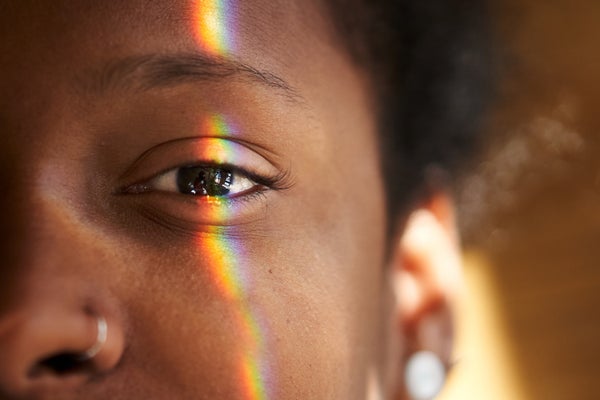
The human eye can see millions of colors but can only focus on one at a time.
Carlos Barquero/Getty Images
The eye is essentially a biological camera. It uses the light around us to create spectacular images that help us navigate the world as visual creatures. Like many modern cameras, the eye focuses automatically. But it can only focus on one thing at a time, specifically one wavelength or color of light.
Scientists have known about this concentration quirk for a long time. But how the eye chooses which color to focus on remains a mystery. A new study, published today in Scientific advances, finally helps to describe this process. Researchers have discovered that our eyes don’t focus only on the wavelength that will produce the brightest image or on colors in the middle of the visual light range. Instead, the color we see best depends on which color is most visible in the environment.
According to the study, this information could also help researchers understand, and perhaps eventually treat, myopia.
On supporting science journalism
If you enjoy this article, please consider supporting our award-winning journalism by subscription. By purchasing a subscription, you are helping to ensure the future of impactful stories about the discoveries and ideas shaping our world today.
“This is a great example of a very automatic aspect of vision,” says Benjamin Chin, lead author of the study and assistant professor of imaging sciences at the Rochester Institute of Technology. “We don’t think about it, but it’s actually very complicated.”
The study authors began investigating how the eyes focus on color because they wanted to reduce nausea during virtual reality experiences. In the natural world, our eyes generally focus in the same direction that they are physically pointed. But virtual reality headsets sometimes decouple this, disrupting people’s sense of position and causing nausea. So, knowing that the eyes choose one wavelength of light to focus on at a time, scientists wondered if they could use color to guide people’s focus in virtual reality. As the project evolved, researchers realized that understanding how eyes choose color to see best could also reveal how focusing physically changes the eye, causing conditions such as myopia.
Historically, vision scientists assumed that the eyes focused on creating the clearest, brightest images possible. This usually means focusing on the color green, which is approximately in the middle of the spectrum of colors we can see and is therefore the one to which our eyes are most sensitive. However, not all stimuli contain green. So to get a better idea of what was going on, the researchers had to peer into the inner workings of the study participants’ eyes.
They created a device presenting a series of images with red, green and blue pixels. As participants viewed the images, a device called a wavefront sensor scanned their eyes to measure how the lenses changed shape to move the focal point. The wavefront sensor used in the study was similar to that used for the focus test performed by ophthalmologists and familiar to eyeglass wearers. But it uses a weak laser that bounces off the retina to get an even more precise measurement.
“The best part of this paper, in my opinion, is the theoretical modeling,” says Shrikant Bharadwaj, a vision researcher at the LV Prasad Eye Institute in India. The models, created using data from study participants, tested how focusing on one color or another could affect visual acuity.
“We found this very systematic relationship,” Chin says. “As would be expected, if the stimulus has a greater ratio of short wavelengths – blue – the emphasis will tend to be more on blue,” and the same goes for other wavelengths.
Myopia, or nearsightedness, occurs when the eyeball extends too long, causing light to focus in front of the retina rather than on it. It typically develops in children and progresses into adulthood, and some research suggests that focusing on close tasks in low light, such as reading or looking at screens, could contribute to it. Yet the signal that causes the eyeballs to elongate and whether looking at certain colors causes enough tension to cause physical changes are not fully understood.
Myopia can have several causes, explains Bharadwaj. The color cues described in the study are just one of many variables that appear to affect eye growth.
However, some laboratories are already experimenting with how exposing or filtering certain colors of light could subtly modify the progression of myopia. Identifying which colors the eye tends to focus on could help direct these efforts so scientists can determine whether color actually plays an important role in disease.
“If you want to understand the long-term changes causing myopia, you also need to understand the short-term changes,” says Chin. “The real-time adjustment of the lens of the eye happens very quickly. We can adapt it in less than a second.”
It’s time to defend science
If you enjoyed this article, I would like to ask for your support. Scientific American has been defending science and industry for 180 years, and we are currently experiencing perhaps the most critical moment in these two centuries of history.
I was a Scientific American subscriber since the age of 12, and it helped shape the way I see the world. SciAm always educates and delights me, and inspires a sense of respect for our vast and magnificent universe. I hope this is the case for you too.
If you subscribe to Scientific Americanyou help ensure our coverage centers on meaningful research and discoveries; that we have the resources to account for decisions that threaten laboratories across the United States; and that we support budding and working scientists at a time when the value of science itself too often goes unrecognized.
In exchange, you receive essential information, captivating podcasts, brilliant infographics, newsletters not to be missed, unmissable videos, stimulating games and the best writings and reports from the scientific world. You can even offer a subscription to someone.
There has never been a more important time for us to stand up and show why science matters. I hope you will support us in this mission.