Tree-Dwelling Tuatara Relative Lived in Solnhofen Archipelago 145 Million Years Ago


The Solnhofen archipelago is a series of islands that existed during the time of late Jurassic in what is now Bavaria, Germany.
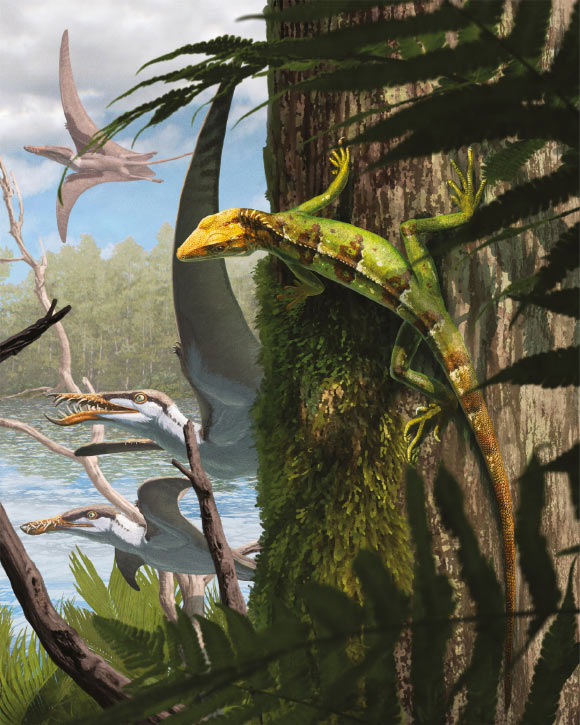
Representation of the life of Sppherto Scandentis in the paleoenvironnement of the Solnhofen archipelago. Image credit: Gabriel Ugueto.
Appointed Sppherto ScandentisThe new species is the oldest known member of the trees of a sister group of Squamates (lizards, snakes and lizards of Ver) called rhynchocephalia.
Currently represented by a single living species, the Tuatara (Sphenodon punctatus), rhynchocephalians were once widespread as lizards today.
The fossilized specimen of Sppherto Scandentis is divided into a main slab, which was mentioned in the literature and previously assigned to Homoeosaurus MaxilianiAnd a counterbasses containing most of its skeletal remains.
The two parties were sold separately almost a century ago at the Museums of Frankfurt and London.
“The breakthrough occurred when I was researching fossil reptiles at the Natural History Museum in London,” said Victor Beccari, a doctorate. Student at the Palaeontological Museum, Munich.
“I noticed a curious similarity between a fossil in the museum collection and the one I studied at the Senckenberg Natural History Museum in Frankfurt.”
“It turned out that they were not similar, they were two halves of the same fossil, most likely divided in two for higher yields when they were sold in the 1930s.”
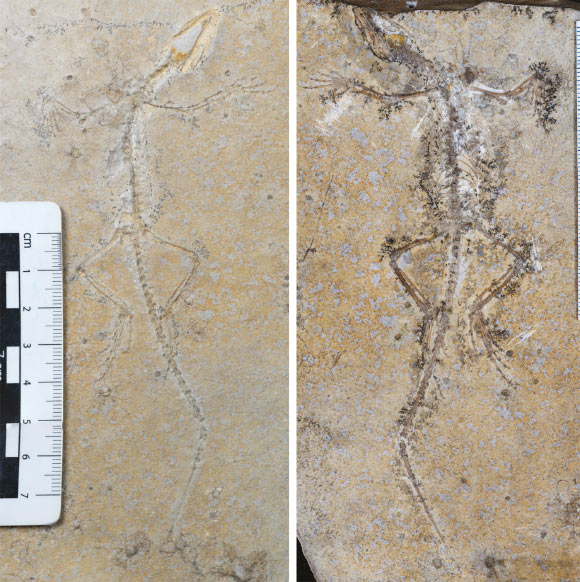
The holotype of Sppherto Scandentis. Left: the main slab, containing bone remains and the skeleton imprint. Right: the counter-2, containing most of the skeletal remains. Image credit: Beccari and al., DOI: 10.1093 / Zoolinnean / Zlaf073.
Thanks to a comparison with the living lizards, including the Tuatara, Beccari and his colleagues have determined that Sppherto Scandentis had the same elongated members and fingers and the shorter body than modern arboreal and slippery lizards leading them to believe that he would have lived among the trees of the island forests of Jurassic.
“The more you look at how these animals have been studied in the past, the more you appreciate that the species is not so well defined,” said Beccari.
“We know that modern islands can have hundreds of reptile species, so there is no reason why the ancient islands would not do so.”
“This study shows how important museum collections are to understand ancient diversity.”
“Even if many of these fossils were discovered almost two centuries ago, there are still a lot to teach us.”
“Although the Solnhofen area has provided many beautiful full rhynchocephalian skeletons, their skulls are sometimes crushed or part of the skeleton is still buried in the rock,” said Dr. Marc Jones, preservative of fossil reptiles and amphibians of the Natural History Museum, London.
“This meant that, until recently, the Solnhofen equipment has not contributed to our understanding as much as it should have.”
“The use of micro X-ray CT and in this case UV imaging has contributed to clarifying anatomical details.”
“This new study also highlights the need to review all the available equipment.”
The study was published on July 2, 2025 in the Linnean Society Zoological Journal.
_____
Victor Beccari and al. 2025. An arboreal rhynchocephalian at the end of the Germany Jurassic, and the importance of the appendicular skeleton for eco -cornphology in the lepidosaurs. Linnean Society Zoological Journal 204 (3): ZLAF073; DOI: 10.1093 / Zoolinnean / Zlaf073


