NASA gears up for Artemis II crew’s return to Earth

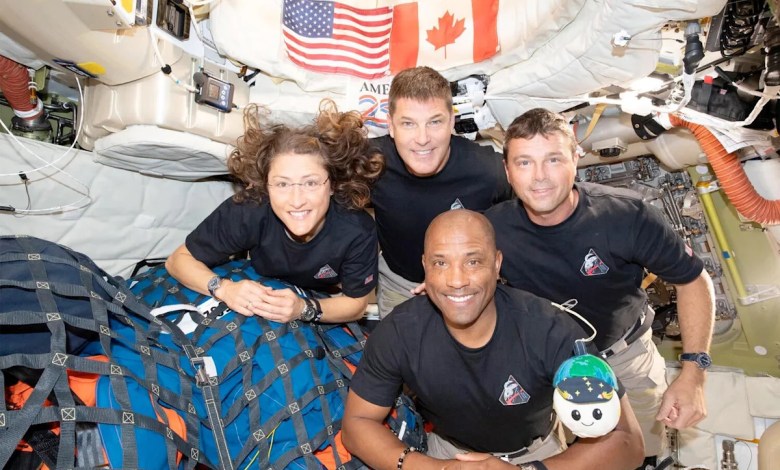
Returning to Earth after a historical loop around the moon, the Astronauts of Artemis II worked a relatively light day in space on Wednesday, finishing some final tests before packing up for re-entry and landing Friday.
Artemis II Commander Reid Wiseman, Victor Glover, Christina Koch and Canadian astronaut Jeremy Hansen planned to hold a news conference Wednesday evening to answer reporters’ questions about the flight, the first piloted trip around the Moon in more than half a century.
The crew had planned to manually pilot their Orion Podtesting their ability, as pilots and non-pilots, to precisely maneuver the spacecraft. NASA plans to open commander and pilot positions to a wider range of astronauts.

The Artemis II astronauts posed for a group photo Tuesday, floating in the cabin of their Orion spacecraft. From left to right: Christina Koch, Canadian astronaut Jeremy Hansen, Victor Glover and Commander Reid Wiseman. / Credit: NASA
But Wednesday’s test, the second to involve all four crew members, was canceled to give flight controllers time to resolve an oxygen pressurization problem in the crewed ship’s service module that occurred shortly after launch.
Otherwise, the ground team reviewed the re-entry schedule and Navy recovery teams headed to the splashdown site off the southern California coast near San Diego, where the Orion capsule is expected to crash at 8:07 p.m. EDT Friday. Favorable weather is expected with light winds and moderate seas.

Artemis II mission specialist Christina Koch (center) and Commander Reid Wiseman (top) are seen through the windows of the Orion spacecraft as they head toward the Moon. This selfie-style photo was taken on April 4, 2026, using a camera placed on the tip of one of Orion’s solar array wings on the fourth day of the roughly 10-day test flight, when Orion was more than halfway to the Moon. / Credit: NASA
Back at the Johnson Space Center in Houston, scientists continued to study thousands of photographs captured by astronauts as they passed over the far side of the Moon on Monday, as well as recorded video and audio descriptions of various high-priority targets.
Nine three men Apollo Crews flew over the far side of the Moon between 1968 and 1972, but these flights were launched when the near side was fully lit and the far side was in shadow.
The Artemis II astronauts were the first humans to see, with their own eyes, large swaths of the dark side in daylight, giving researchers information that could lead to a better understanding of the Moon’s evolution.

A view of the Moon from the Artemis II Orion capsule as it approached for a loop around the Moon’s normally invisible far side Monday evening. / Credit: NASA/edited by CBS News to highlight details
So far, NASA’s first piloted lunar mission since the final Apollo landing in 1972 went like clockwork with only a small number of anomalies. One involved the ship’s toilets, which were having difficulty discharging liquid waste overboard as required.
Although this is sometimes inconvenient for the crew, it is a relatively minor problem given the technical challenges of flying safely to and from the Moon.

A view of the moon’s terminator, the boundary between day and night on the moon, taken from the Orion capsule. As the Artemis II crew flew past the terminator, the astronauts described this boundary between day and night as
A hospital doctor. One year. $71.7 million in Medicare claims.
Search underway for woman after husband says she fell overboard during boat trip in Bahamas
Republican Clay Fuller to replace Marjorie Taylor Greene in the House, CBS News projects


