‘Soft power’ is a buzzword these days. What is it exactly? : NPR

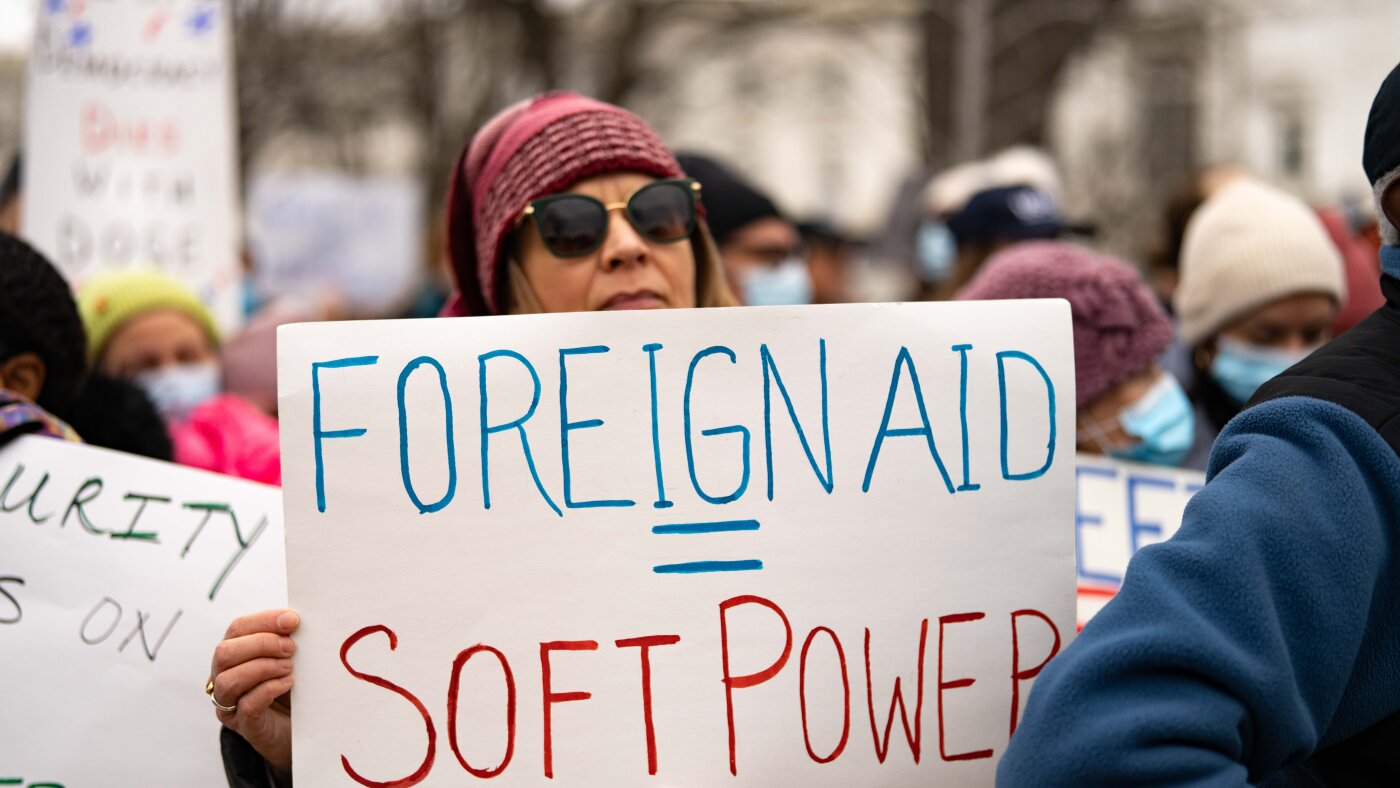

A protester carries a sign equating foreign aid with soft power during a rally near the U.S. Capitol to protest the dismantling of USAID, the international agency responsible for distributing humanitarian aid around the world on behalf of the United States.
Ben de la Cruz/NPR
hide caption
toggle caption
Ben de la Cruz/NPR
Soft power is a hot topic in Washington DC these days.
The question: Has Donald Trump’s removal of foreign aid led to a reduction in soft power?
Sen. Dick Durbin (D-IL) accused the administration of “recklessly gutting American soft power and providing a huge strategic opening to China” in a February 2025 speech. speech on the Senate floor.
That same month, Lindsey Graham (R-SC), a supporter of President Trump’s policies, said he was a “great defender of soft power”.
This raises another question for those unfamiliar with foreign aid terminology: what exactly is soft power?
American political scientist Joseph Nyé is credited with popularizing the term, which he defined as “the ability to obtain preferred results by attraction rather than by coercion or payment.” But it can mean different things depending on whether you exercise soft power or are influenced by it. He introduced it to the public in his 1990 book Related to Leadership: The Changing Nature of American Power.
Since then, the term has become so prevalent in the lexicon that some people attempt to quantify it. Over the past year, American soft power has declined in various measures, from perceived friendliness to the pursuit of common goals, like climate action, according to David HaighCEO of Brandfinance, which produces an annual report soft power index thanks to surveys of 175,000 people around the world.
“This is not surprising because the current administration is rebalancing its foreign policy much more toward hard power and economic power and away from soft power,” Haigh says, referring to aid cuts and the United States’ withdrawal from major international organizations. “I think it’s probably because there’s an impatience to get results. And one of the things with soft power is you can’t be impatient.”
NPR spoke with soft power experts from around the world to understand how soft power can be defined and deployed through foreign aid.
These interviews have been edited for length and clarity.
“Make people like you”
Samuel Brazys studies soft power and international development at University College Dublin
How do you define soft power?
Soft power is about getting others to adopt what you want, to adopt your ideas, to adopt your worldview without force. Basically, making people like you because they like you.
What inspired you to study soft power?
My interest in this issue goes back 10 or 15 years, when China was really beginning to rise on the international stage, to challenge global norms, global ideas, and prey on hearts and minds all over the world.
Can you give an example of a time you saw it play out in real life?
When I lived in Micronesia, the Chinese embassy brought in a troupe of acrobats who performed at the local college. It was this fantastic show. It was the biggest entertainment show anyone had seen there in years. It was 100% soft power at work, and it certainly won the hearts and minds of the audience in the moment. Much of soft power relies on moments that create cultural influence.
In your opinion, where is American soft power today?
My impression is that soft power was the result of people from all over the world wanting to settle in the United States. I think a good indicator that we’ve seen is that people are I’m starting to get more reservations about moving to the United States. It was everyone’s dream. And some people have fewer reservations regarding move to Chinaparticularly from the countries of the South. And I think that’s a really good indicator, because if I’m willing to do whatever it takes to leave my home and my family to start a new life, I must really like something about what’s happening in this system, right? So the intensity of your desire to do so may well reflect the extent of soft power exercised by this country.
“MTV was considered the best form of entertainment”
Salvador Santino Regilme, studies American soft power at Leiden University in the Netherlands and is the author of Aid Imperium: United States Foreign Policy and Human Rights in Post-Cold War Southeast Asia
What inspired you to study soft power?
I am originally from the Philippines. Despite all kinds of abuse that the American government did it before the Second World War, during the American occupation, the The Philippines has one of the highest rates positive public perceptions of American power in world politics. I think it’s fascinating.
How do you define soft power?
For me, the soft power of a particular country refers to the instruments that a state can use to shape a positive perception of that country, such as the number of vaccines distributed, but also idealistic elements, for example the number of students of the latest generations sent on scholarships to the United States.
An example of a moment you saw it play out in real life?
When I was young, in the 1990s, American music played on MTV was considered the best form of entertainment, rather than Filipino music. And in terms of education, most people of my generation and my brightest classmates chose to go to the United States for their higher education.
I think the most concrete program would be the Fulbright program [the one for international students that sends them to the U.S.]. Many of our professionals and top leaders in the country studied in the United States and are now in politics, elected officials holding powerful, even military, positions. One of the presidents of the Philippines in the 1990s was Fidel Ramos and he graduated from West Point.
“No matter how powerful a state is, it cannot fully rely on its hard power”
Oluwaseon Tella is responsible for the future of diplomacy at University of Johannesburg
What inspired you to study soft power?
I realized that no matter how powerful a state is, it cannot rely entirely on hard power, and that some actions require soft power. For example, if you promote democracy, you need soft power. If you want to fight terrorism, you need strong power. But there are situations that require both. It’s one thing to kill terrorists, it’s another to be able to deter potential terrorists from joining terrorist groups.
How do you define soft power?
Because I am an African academic, my definition of soft power reflects African reality. It is the ability of an actor to influence the behavior of other actors through its philosophy, political values, foreign policy and cultural exports.
An example of a moment you saw it play out in real life?
After September 11 and the Iraq War, the image of the United States deteriorated around the world. But in the African context, the United States’ image was stable. This is because George Bush implemented various American policies after 9/11 to try to counter the influence of terrorists. This is why the United States has spent a lot of money in Africa through USAID and via PEPFAR –- the HIV/AIDS program. This was highly appreciated and was an important source of American soft power until the administration of Donald Trump.
In your opinion, where is American soft power today?
I think it’s definitely been impacted by the foreign aid cuts imposed by the Trump administration. But also, among the major players in Africa, American soft power seems to be the most sophisticated and robust. So while a particular aspect of American soft power may be declining, you may not feel the impact as much.
“They arrived on time for appointments because Americans arrive on time”
Jon Alterman is president of global security and geostrategy at Center for Strategic and International Studies in Washington, D.C.
Can you share a time when you saw soft power manifest in real life?
I was in Egypt in the 1990s doing research and people were telling me stories about Americans they had met 40 years before who left them lessons that they treated like it was yesterday. They showed up on time for appointments because Americans showed up on time for appointments. I met a guy who told me he had an American instructor and every time he asked him a question, the American said: why not? It was the only English he remembered and it shaped the next 40 years of his life. This type of connection creates soft power, creates people who want to behave the way you want them to, not because you force them.
In your opinion, what has been the United States’ most effective soft power tool?
People yearn for American education and medical care. People still view American medical care as the best in the world, as do scientific advances. And the United States has provided all kinds of humanitarian aid.
But governments sometimes want to hide the fact that they accept U.S. aid.
When I was researching in Egypt, I learned that the United States gave trains to the Egyptians in the 1950s and that the Egyptians removed the symbols of American aid from the trains and painted them over. American officials were dismayed, and there was an exchange about how the United States could weld labels onto the trains so the Egyptians couldn’t remove them.
What is the current effect of the war in Iran on US soft power?
I think the argument I’ve heard from people in the Middle East is that they see the true face of the United States, which is looking out for its own interests, and that’s not new. It’s just that the United States is no longer trying to hide it. There is certainly today, in the midst of the war in Iran, a feeling that citizens and governments are paying the price for American decisions. This is also happening in Asia and around the world, where people are facing higher prices, shortages of certain types of products, and interrupted shipments. They say we didn’t ask for this. No one told us about it and we pay the price every day.
But ultimately, I think the legacy and the impact on America’s soft power and reputation will not be judged in April 2026. They will be judged in April 2027 or 2028, when people see what they do. [the war] what he did in the months and years to come.


:max_bytes(150000):strip_icc()/CopyofStockPhotoRedBadge1-2cf45a30b5834fa592715da77a3ec0dd.png?w=390&resize=390,220&ssl=1 "FDA Announces Nationwide Recall of Cholesterol Medication—More Than 140,000 Bottles Affected")
