NASA’s Artemis II moon mission is on track for Friday splashdown


April 9, 2026
2 min reading
 Add us on GoogleAdd SciAm
from NASA Artemis II lunar mission faces final hurdle: getting home
After eight intense days in space, the Artemis II the crew – and the many NASA personnel supporting their journey – are ready for the final leg of the mission
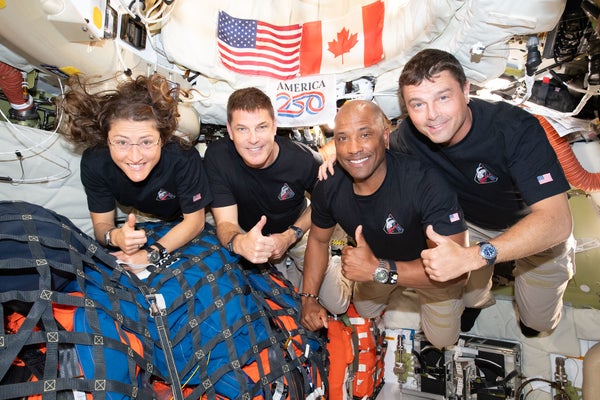
THE Artemis II crew on April 7.
NASA launched four astronauts on a pioneering journey around the Moon: the Artemis II assignment. Follow our coverage here.
THE Artemis II The crew is in for a wild adventure Friday, when their Orion capsule takes them home through Earth’s atmosphere.
In less than an hour, the capsule will shed its bulky service module and plunge toward Earth at 24,000 miles per hour. If all goes according to plan, its protective heat shield and a sequence of massive parachutes will ensure that the capsule – and the four astronauts inside – land with a gentle splash in the Pacific Ocean at a leisurely speed of 17 miles per hour.
“They’re going to feel and hear when all the different parachutes deploy and when the front bay cover comes off – all pyrotechnic events that are part of a nominal entry, descent and landing sequence,” said Artemis II’Flight Director Jeff Radigan during a news conference Thursday. “I actually think it’s going to be a fun ride for them.”
On supporting science journalism
If you enjoy this article, please consider supporting our award-winning journalism by subscription. By purchasing a subscription, you are helping to ensure the future of impactful stories about the discoveries and ideas shaping our world today.
As soon as Orion crashes, the crew will be busy stopping the spacecraft, determining where it is, and opening the hatch. During this time, but only after any threat of debris from re-entry has disappeared, NASA’s recovery team will meet the astronauts and fish them out of the capsule. Less than an hour after landing, they should be safely installed aboard the USS John P. Murtha and I went home.
This assumes everything goes as planned – and there are no guarantees on that. “You have to make things go well for 13 minutes,” Radigan said. If Orion collided with Earth’s atmosphere at even a single degree of the expected angle, re-entry could devastate its heat shield — a potential NASA learned from the uncrewed Artemis I mission, which revealed the shield was not as strong as expected.
THE Artemis II The crew still has a full day in space ahead of them, most of which will be spent preparing for re-entry. This work includes putting away everything they used during the flight, arranging the cabin, and collecting data on an unexpected situation that arose with the service module’s propulsion system. The module has guided the astronauts’ journey so far, but it will be jettisoned and largely burn up in the atmosphere as part of the re-entry procedure, Radigan said. The spacecraft will also perform up to two other maneuvers to ensure it will be at the right angle and on track for its descent to the Pacific Ocean.
Although only the four astronauts – Reid Wiseman, Victor Glover, Christina Koch and Jeremy Hansen – will personally experience the drama of re-entry, Friday evening will be a moment of truth for the entire Artemis program and NASA.
“Every system we’ve demonstrated over the last nine days – life support, navigation, propulsion, communications – it all depends on the last minutes of flight,” NASA Associate Administrator Amit Kshatriya said during the same Thursday briefing. “To every engineer, to every technician who has touched this machine, tomorrow belongs to you. The team did its part. Now we must do ours.”
It’s time to defend science
If you enjoyed this article, I would like to ask for your support. Scientific American has been defending science and industry for 180 years, and we are currently experiencing perhaps the most critical moment in these two centuries of history.
I was a Scientific American subscriber since the age of 12, and it helped shape the way I see the world. SciAm always educates and delights me, and inspires a sense of respect for our vast and beautiful universe. I hope this is the case for you too.
If you subscribe to Scientific Americanyou help ensure our coverage centers on meaningful research and discoveries; that we have the resources to account for decisions that threaten laboratories across the United States; and that we support budding and working scientists at a time when the value of science itself too often goes unrecognized.
In exchange, you receive essential information, captivating podcasts, brilliant infographics, newsletters not to be missed, unmissable videos, stimulating games and the best writings and reports from the scientific world. You can even offer a subscription to someone.
There has never been a more important time for us to stand up and show why science matters. I hope you will support us in this mission.


