Cuban President Miguel Díaz-Canel tells NBC News that he will not step down : NPR

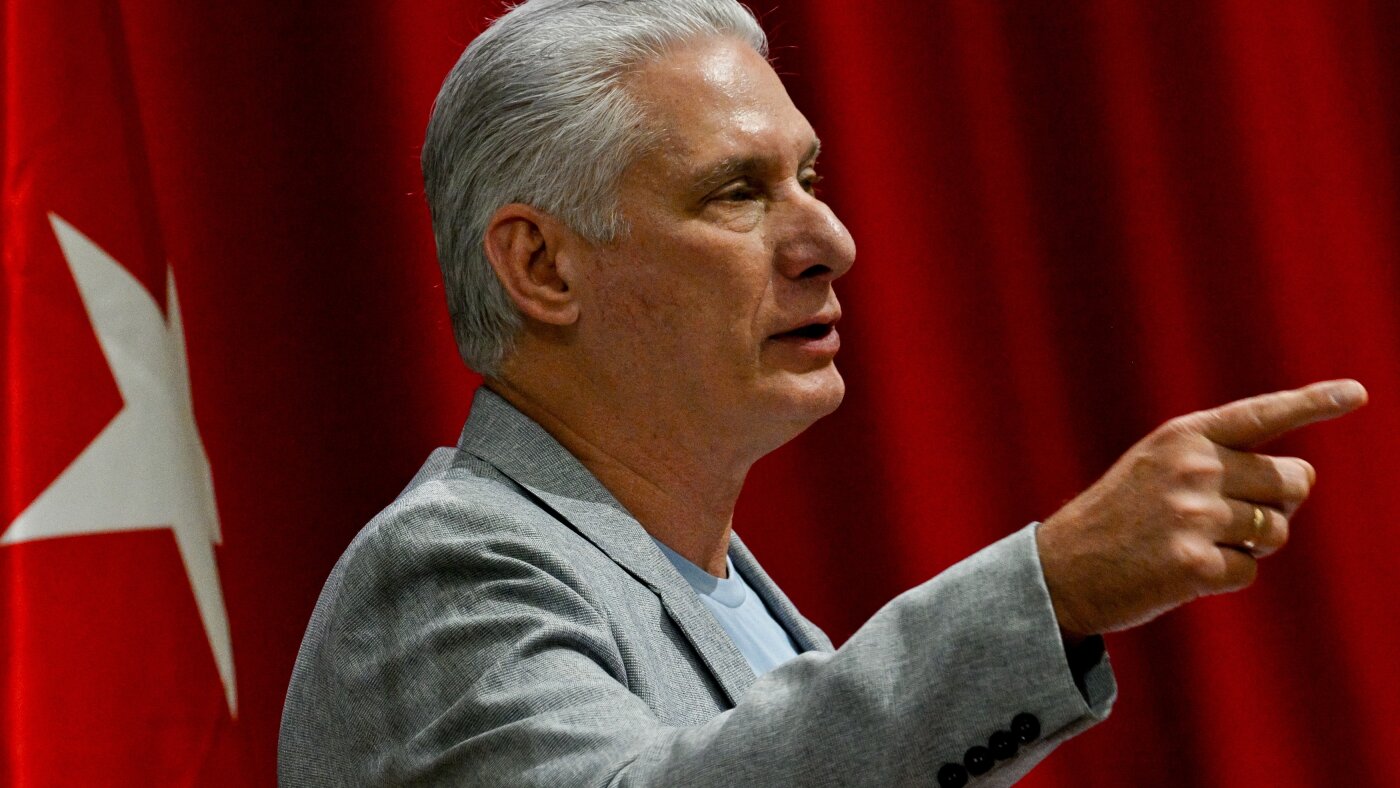

Cuban President Miguel Diaz-Canel delivers a welcoming speech to participants of the “Nuestra America,” or Our America convoy, at the Convention Center in Havana, Cuba, Friday, March 20, 2026.
Adalberto Roque/Pool photo via AP
hide caption
toggle caption
Adalberto Roque/Pool photo via AP
SAN JUAN, Puerto Rico — Cuban President Miguel Díaz-Canel told NBC News’ Meet the Press that he would not step down during his first interview with a U.S. network, part of which aired Thursday.
In a nearly five-minute clip that is part of a longer interview scheduled to air Sunday, journalist Kristen Welker asked Díaz-Canel if he would be “willing to step down if it meant saving Cuba.”
Before answering, Díaz-Canel asked if she had ever asked this question of any other president in the world: “Is this a question from you, or is this coming from the State Department of the United States government?”
Díaz-Canel added: “In Cuba, people in leadership positions are not elected by the U.S. government and do not have a mandate from the U.S. government. We have a sovereign and free state. »
He said he became president not because of “personal ambition, corporate ambition or even party ambition,” but because of a mandate from the people.
“If the Cuban people understand that I am not fit to hold this position, that I have no reason to be here, then I should not hold this position of president, I will respond to them,” he said.
The interview comes as tensions between Cuba and the United States remain high, even as both sides acknowledge the talks, although no details have been shared.
Díaz-Canel accused the U.S. government of implementing a “hostile policy” against Cuba and said it had “no morals to demand anything from Cuba.”
He said the United States should recognize how much these policies have cost the Cuban people “and how much they have deprived the American people of a normal relationship with the Cuban people.”
Díaz-Canel stressed that Cuba wants to engage in dialogue and discuss any subject without conditions, “without demanding changes to our political system, as we do not demand changes to the American system, about which we have a certain number of doubts.”
Cuba blames its growing problems on the U.S. energy blockade, with a lack of oil affecting the island’s health system, public transportation and production of goods and services.
In late March, a Russian tanker carrying 730,000 barrels of crude oil arrived in Cuba, marking the first oil shipment to the island in three months. Russia has promised to send a second tanker.
Despite threats of customs duties imposed in early January on countries that sell or supply oil to Cuba, the administration of US President Donald Trump authorized the transport of the tanker.
“Cuba is finished,” Trump said at the time. “They have a bad regime. They have very bad and corrupt leaders and whether they get a ship of oil or not, it won’t matter.”
Cuba produces only 40% of the fuel it consumes and stopped receiving essential oil shipments from Venezuela after the United States attacked the South American country in early January and arrested its then-leader.