Worsening ocean heat waves are ‘supercharging’ hurricane damage, study finds

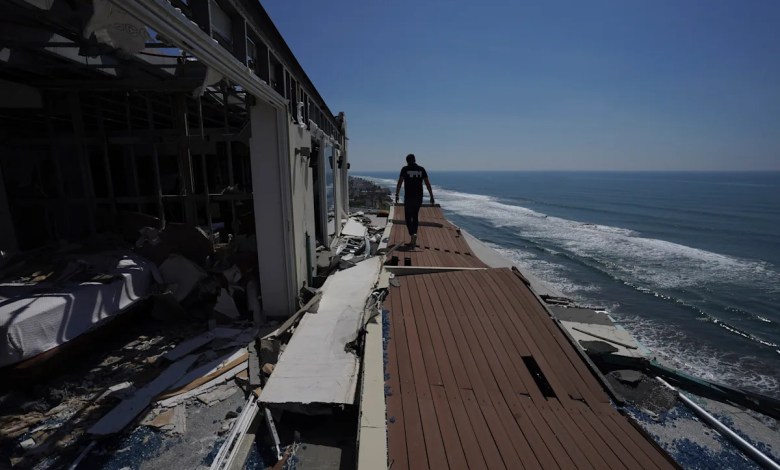
WASHINGTON — Marine heat waves are worsening the damage caused by hurricanes and tropical cyclones around the world, a new study shows.
Researchers looked at 1,600 tropical cyclones — the broader category of storms that includes hurricanes — that made landfall since 1981 and found that those that passed through very warm water were more likely to intensify quickly, an increasingly common problem. That led to 60 percent more disasters that caused at least $1 billion in damage — adjusted for inflation — when they made landfall, according to a study published Friday in the journal Science Advances.
A better understanding of how marine heatwaves amplify hurricanes could help forecasters, emergency managers and long-range planners prepare for future storms.
The study defined marine heatwaves as large, long-lived areas of water falling within the top 10% of historical heat. They are becoming increasingly dangerous with climate change and ever-warmer oceans, according to the study authors. Hot water is hurricane fuel.
“These marine heatwaves affect more than half of tropical cyclones that make landfall,” said study co-author Gregory Foltz, an oceanographer at the National Oceanic and Atmospheric Administration. “They occur closer to land and more frequently, so I think people need to pay attention to them and know that they are more likely to cause extreme damage when they make landfall.”
It’s important for meteorologists forecasting storm tracks to see if these hurricanes ride out a marine heatwave because it’s more likely it will intensify quickly, which “can potentially have a greater impact on landfall,” Foltz said.
Just look at the devastating hurricanes that hit the United States in 2023, said study co-author Hamed Moftakhari, a coastal engineering professor who studies compound hazards at the University of Alabama.
“The story of Helen and Milton is that if you have a warmer ocean, you have the fuel to supercharge even cascading tropical cyclones. So in a matter of weeks you could have two rapidly intensifying hurricanes making landfall on the west coast of Florida,” Moftakhari said. “It’s shocking, but it should also alarm people.”
The study also highlights October 2023’s Hurricane Otis, which rapidly intensified in a single day from a tropical storm to a high-level Category 5 hurricane, then caused an estimated $16 billion in damage and 52 deaths when it made landfall near Acapulco, Mexico, with winds of 165 mph.
The researchers said the greater damage, compared to storms that did not pass through marine heatwaves, was not due to increased coastal development. The storms that passed through warm waters and struck developed coastlines contrasted with other storms that struck urbanized areas in a similar manner but without passing through warm water, said the study’s lead author, Soheil Radfar, a scientist who models hurricane risks at Princeton University.
Science has long known that warm water often fuels and strengthens tropical cyclones, providing a causal link.
That means the future looks more dangerous, Radfar said.
“All of these pieces of the puzzle are going to pose a real challenge to the coastal environment over the next four decades, with faster intensification and more marine heatwaves,” Radfar said. This “is going to be very costly and frightening for the coastal environment, and it is going to cause other disasters worth billions of dollars in the future.”
Moftakhari said that “from a coastal engineering and risk management perspective, this has important implications for how governments plan, design and respond to these risks.”
Evacuation planning should take into account that storms passing through ocean hotspots are more likely to intensify quickly and pose greater threats, according to Moftakhari. Earlier warnings and triggers when people leave may be needed during marine heatwaves. Designs for flood protection, drainage systems and levees all need to be updated for the new reality of worsening storms, he said.
Outside scientists said the study matched the known physics of hurricanes and climate change, while giving a more precise number on the likelihood of mega-damage from marine heatwaves.
“Climate change is causing stronger and longer marine heat waves. Tropical cyclones draw their energy and produce heavy rain via the evaporation of warm ocean waters,” said Brian Tang, a professor of atmospheric sciences at the University at Albany, who was not involved in the study. “It is reasonable for marine heat waves to fuel hurricanes, provided that other environmental conditions are favorable for hurricane intensification. In fact, the dice are loaded.”
___
Associated Press climate and environmental coverage receives financial support from several private foundations. AP is solely responsible for all content. Find AP’s standards for working with philanthropic organizations, a list of supporters, and funded coverage areas at AP.org.