Mexico’s new top diplomat: A gay millennial and expert on U.S.

MEXICO CITY — The young Mexican diplomat, who was part of an official delegation to Washington, was caught in an undiplomatic moment: munching peanuts piled on a napkin while sitting with political heavyweights, including Mexican Cabinet secretaries and then-Speaker of the House of Representatives Nancy Pelosi.
The 2019 image of the envoy eating peanuts quickly went viral, spawning a biting social media hashtag: #LordCacahuates (Lord Peanuts).
It was the kind of unprotocol moment that could derail a career. A joker wrote on X that the young diplomat had “behaved like a drunk in a bar under the stunned gaze of Nancy Pelosi”.
But Roberto Velasco Álvarez survived Peanutgate – with flying colors.
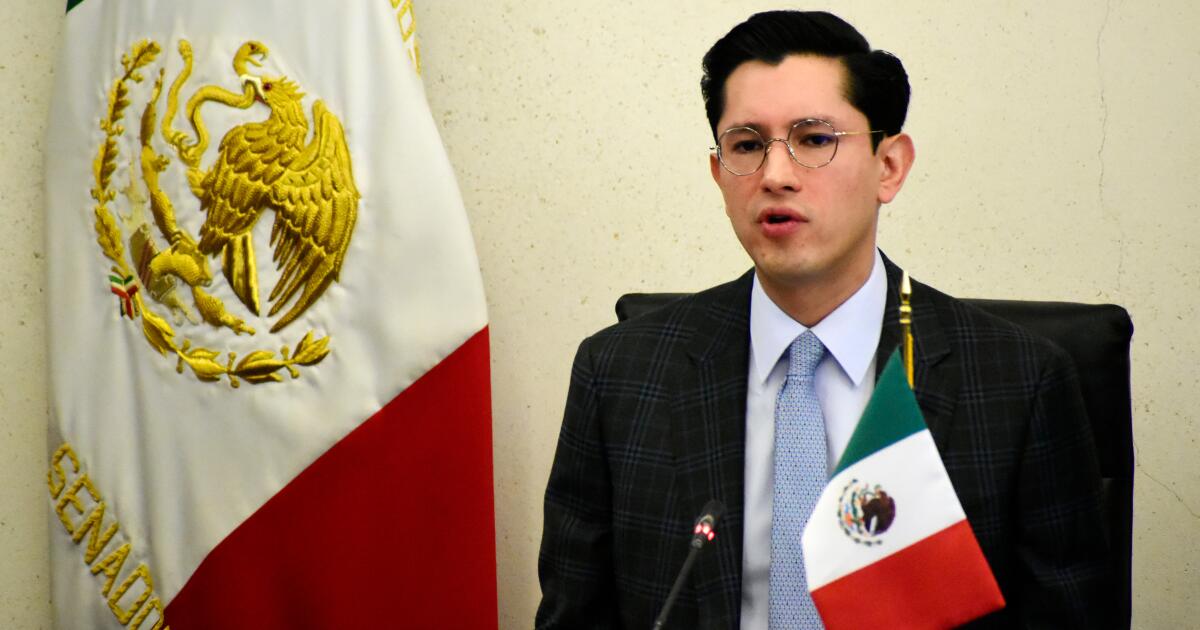
Last week, the Mexican Senate confirmed President Claudia Sheinbaum’s nomination of Velasco as the new secretary of Foreign Relations, the Mexican equivalent of secretary of state.
Velasco, who is 38 but looks even younger, replaced Juan Ramón de la Fuente, 74, a veteran diplomat and academic who resigned, he said, for health reasons.
It was a changing of the cultural and generational guard. Velasco, a millennial coming of age in the digital age, is one of the youngest officials to head the secretariat. He is also the country’s first openly gay senior diplomat.
Velasco is a bespectacled political enthusiast known for his discipline, discretion and pragmatic bent, as well as his unquestioned loyalty to the ruling left-wing Morena political bloc, according to reports in Mexico. These characteristics, along with his status as a protégé of Marcelo Ebrard – Mexico’s economic secretary, who previously served as foreign minister – contributed to the meteoric rise of Velasco’s career.
But observers say Velasco managed to make the leap into a traditional diplomatic career thanks in large part to something else: his deep knowledge of Mexico’s most crucial foreign policy issue: the United States. Nowadays, it is an essential specialty for a Mexican diplomat.
Under Sheinbaum, writes columnist León Krauze in the newspaper El Universal, the Mexican Ministry of Foreign Affairs “had one overriding objective: to appease Donald Trump.”

U.S. Secretary of State Marco Rubio, left, and Juan Ramón de la Fuente, then Mexico’s foreign minister, meet at a news conference in Mexico City in 2025.
(Hector Vivas/Getty Images)
In addition to a law degree from the Iberoamerican University of Mexico, Velasco holds a master’s degree in public policy from the University of Chicago. According to his official bio, he even interned in the Chicago mayor’s office, which is certainly a deep dive into a singular iteration of American politics.
Prior to his promotion, Velasco oversaw relations with the United States and Canada as the department’s head for North America. He has participated in countless bilateral forums, working groups and discussions on immigration, drug trafficking, cross-border trade and other concerns, and generally received high marks from U.S. officials.
On Thursday, Velasco received a congratulatory call from Secretary of State Marco Rubio.
Rubio, according to the State Department, “addressed efforts to deter mass illegal immigration, secure our borders, and promote regional stability.”
Upon Velasco’s nomination, U.S. Ambassador Ronald Johnson wrote of X that he wished him “much success” as the U.S. and Mexican governments work to “advance the historic cooperation led by” Presidents Trump and Sheinbaum.
It’s a generous reading of the bilateral zeitgeist at a tumultuous moment.
Velasco has no shortage of challenges. Mexico has struggled to keep pace with Trump’s shifting and often inflammatory demands on security, trade and immigration, among other issues. Global tariff threats from the White House have hit Mexico, which relies on trade to the north, particularly hard.
The new secretary takes office at a time when traditional diplomacy often takes a back seat to Trump’s off-the-cuff comments and social media outbursts.
In a speech to fellow Mexican diplomats, the new foreign minister alluded to the atmosphere of global tumult, without naming those responsible.
“I assume this responsibility at a time when the international order, supported by clear and reasonable rules and principles accepted by all, is undergoing a very profound reconfiguration,” Velasco said.
He will be among the negotiators leading the high-stakes negotiations already underway to renew the North American Free Trade Agreement, a pillar of Mexico’s export-dominated economy. Trump has already considered abandoning the deal he signed into law during his first term.
Velasco reportedly regularly participates in frequent Sheinbaum-Trump conference calls — conversations that have emerged as key indicators of how things are going between the neighboring countries. During morning press briefings, reporters quiz Sheinbaum about the finer details of his latest discussions with Trump.
The American president, she often points out, has his “own way” of communicating. His motto is to keep a “cool head” in the midst of the maelstrom.
Trump has repeatedly charged that Mexico is “run by” the cartels — a claim disputed by Sheinbaum, who spent much of the last year trying to prevent unilateral U.S. strikes against drug trafficking targets in Mexico. She also strongly resisted Trump’s tariff threats.
Likewise, Velasco vowed that Mexico would never give up its “sovereignty,” assuring his fellow diplomats that the country would “maintain security cooperation…without subordination.”
Without doubting his abilities and dedication, some have questioned Velasco’s relative lack of experience in a prestigious position traditionally held by party notables with decades of public service.
And he takes control of a ministry that, in many ways, is deeply troubled.
Various diplomats have complained bitterly that budget deficits have hit hard — particularly when it comes to what many see as the department’s central responsibility: helping millions of Mexican citizens in the United States, many of whom are now directly in the crosshairs of Trump’s mass deportations.
“Roberto Velasco seems like an intelligent, well-educated person,” said a senior Mexican diplomat stationed in the United States, who asked not to be named because the person was not authorized to speak. “But the problems within the ministry go far beyond the appointment of a new foreign minister. »
Velasco, in an interview last week with Mexican radio station Radio Formula, pledged to seek “more resources” for Mexican consulates.
Consulates are overwhelmed, some diplomats say, with large numbers of Mexican nationals facing deportation — or worse. Under the Trump administration, the Mexican government said last month that at least 14 Mexican citizens had died while in U.S. immigration custody or during immigration enforcement operations.
“It is shameful that in many cases we are leaving people to fend for themselves during the worst migration crisis we have ever faced,” the veteran diplomat said. “The official narrative is that our country’s foreign policy priority is to defend our compatriots in the United States. But it’s hard to believe that without leadership, without aid, without resources.”
On Monday, U.S. authorities confirmed that another Mexican citizen had died while in Immigration and Customs Enforcement custody. Alejandro Cabrera Clemente, 49, “was found unresponsive” Saturday at Winn Correctional Center in Louisiana, ICE said in a statement.
The immigration raids and deaths of Mexican migrants have sparked condemnation, protests and calls for an investigation by the Sheinbaum administration. But these actions seem more symbolic than substantial.
The White House has denied any wrongdoing and signaled no intention of changing its aggressive approach to immigration — a deep source of frustration for Sheinbaum and his new top diplomat.
At a press conference in March, just days before being named foreign minister, Velasco condemned the deaths of Mexican citizens in U.S. custody as “painful, heartbreaking and absolutely unacceptable to the Mexican government.”
Sánchez Vidal is special correspondent.