The Lyrid meteor shower is visible now and peaking soon. Here’s how to spot it

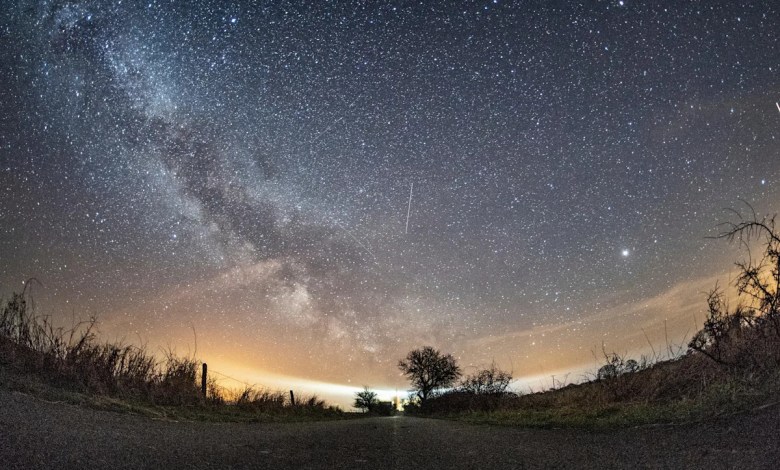
NEW YORK (AP) — This year’s Lyrid meteor shower is getting a boost from a faint crescent moon. Skywatchers could see 10 to 20 shooting stars per hour soaring across the spring sky, according to NASA, when the fiery display peaks Tuesday night into Wednesday morning.
The show will be visible all over the world, but views will be best in the Northern Hemisphere. And there’s no risk of the crescent moon photobombing the Lyrid shower. This will be sorted out before the fun begins.
Meteor showers occur when Earth passes through debris trails left by space rocks. These stray bits become hot as they enter the atmosphere, producing fiery trails also known as shooting stars.
Contrary to their name, most meteor showers are actually comet debris. The Lyrids are the remains of an icy ball called Comet Thatcher.
“We only see the actual comet once every 415 years. But we pass through the grains that were left in its wake every year around the same time,” said Maria Valdes, who studies meteorites and works at the School of the Art Institute of Chicago.
A handful of random meteors are visible each night. At predictable times of the year, enough can be seen at once to create an even more exciting spectacle. The Lyrids are one of the oldest meteor showers on record, with reported sightings dating back over 2,500 years.
To see the Lyrids, go out after midnight and stay away from tall buildings and city lights. It will take at least 15-30 minutes for your eyes to adjust to the night sky and remember to resist looking at your phone.
Bring lawn chairs or a sleeping bag and be patient until the meteors reveal themselves. They will appear to come from the Lyra constellation in the northeastern sky.
“A meteor looks like a streak of light in the sky. What you tend to detect is the movement in the background,” said astronomer Lisa Will of San Diego City College.
The next major downpour is approaching at the beginning of May: the Eta Aquarids, debris from Halley’s Comet.
___
The Associated Press Health and Science Department receives support from the Howard Hughes Medical Institute’s Department of Science Education and the Robert Wood Johnson Foundation. The AP is solely responsible for all content.


